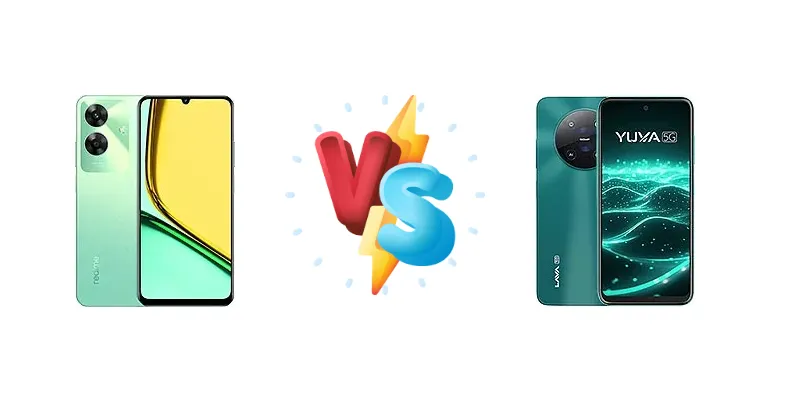
The sub-₹10,000 5G smartphone segment is fiercely competitive. Both the Realme C61 (India) and Lava Yuva 5G aim to deliver 5G connectivity at an accessible price point, but they take different approaches to achieving this. This comparison dissects their core components – chipsets, charging, and overall performance – to determine which device offers the best value for budget-conscious consumers.
🏆 Quick Verdict
For most users, the Lava Yuva 5G emerges as the stronger contender. Its Unisoc T750, fabricated on a more efficient 6nm process, provides a noticeable performance advantage over the Realme C61’s T612. The faster 18W charging also significantly improves the user experience, making it a more practical daily driver.
| Network |
|---|
| 2G bands | GSM 850 / 900 / 1800 / 1900 | GSM 900 / 1800 |
| 3G bands | HSDPA 850 / 900 / 2100 | HSDPA 900 / 2100 |
| 4G bands | 1, 3, 5, 7, 8, 20, 28, 38, 40, 41 | 1, 3, 5, 8, 28, 40, 41 |
| 5G bands | - | 1, 3, 5, 8, 28, 40, 77, 78 SA/NSA |
| Speed | HSPA, LTE | HSPA, LTE, 5G |
| Technology | GSM / HSPA / LTE | GSM / HSPA / LTE / 5G |
| Launch |
|---|
| Announced | 2024, June 28 | 2024, March 30 |
| Status | Available. Released 2024, July 02 | Available. Released 2024, June 06 |
| Body |
|---|
| Dimensions | 167.3 x 76.7 x 7.8 mm (6.59 x 3.02 x 0.31 in) | 163.4 x 76.2 x 9.1 mm (6.43 x 3.00 x 0.36 in) |
| SIM | Nano-SIM + Nano-SIM | Nano-SIM + Nano-SIM |
| Weight | 187 g (6.60 oz) | 208 g (7.34 oz) |
| Display |
|---|
| Resolution | 720 x 1600 pixels, 20:9 ratio (~270 ppi density) | 720 x 1600 pixels, 20:9 ratio (~269 ppi density) |
| Size | 6.78 inches, 102.1 cm2 (~79.6% screen-to-body ratio) | 6.53 inches, 102.9 cm2 (~82.7% screen-to-body ratio) |
| Type | IPS LCD, 90Hz, 450 nits (typ), 560 nits (HBM) | IPS LCD, 90Hz |
| Platform |
|---|
| CPU | Octa-core (2x1.8 GHz Cortex-A75 & 6x1.8 GHz Cortex-A55) | Octa-core (2x2.0 GHz Cortex-A76 & 6x1.8 GHz Cortex-A55) |
| Chipset | Unisoc Tiger T612 (12 nm) | Unisoc T750 (6 nm) |
| GPU | Mali-G57 | Mali-G57 MC2 |
| OS | Android 14, Realme UI 5.0 | Android 13 |
| Memory |
|---|
| Card slot | microSDXC (dedicated slot) | microSDXC |
| Internal | 64GB 4GB RAM, 128GB 4GB RAM, 128GB 6GB RAM | 64GB 4GB RAM, 128GB 4GB RAM |
| Main Camera |
|---|
| Dual | - | 50 MP, (wide), AF
2 MP (macro) |
| Features | LED flash, panorama | LED flash, HDR, panorama |
| Single | 32 MP, f/1.8, (wide), PDAF
Auxiliary lens | - |
| Video | 1080p@30fps | 1080p@30fps |
| Selfie camera |
|---|
| Single | 5 MP, (wide) | 8 MP |
| Video | Yes | 1080p@30fps |
| Sound |
|---|
| 35mm jack | Yes | Yes |
| Loudspeaker | Yes | Yes |
| Comms |
|---|
| Bluetooth | 5.0, A2DP, LE | 5.0, A2DP, LE |
| NFC | No | No |
| Positioning | GPS, GALILEO, GLONASS, BDS | GPS |
| Radio | Unspecified | FM radio |
| USB | USB Type-C 2.0 | USB Type-C 2.0, OTG |
| WLAN | Wi-Fi 802.11 a/b/g/n/ac, dual-band | Wi-Fi 802.11 b/g/n/ac |
| Features |
|---|
| Sensors | Fingerprint (side-mounted), accelerometer, proximity, compass | Fingerprint (side-mounted), accelerometer, proximity, compass |
| Battery |
|---|
| Charging | 10W wired | 18W wired |
| Type | 5000 mAh | Li-Po 5000 mAh |
| Misc |
|---|
| Colors | Safari Green, Marble Black | Green, Blue |
| Models | RMX3939, RMX3933 | - |
| Price | About 90 EUR | About 110 EUR |
Realme C61 (India)
- Familiar Realme UI
- Established brand reputation
- Potentially wider service network
- Less efficient Unisoc T612 chipset
- Slower 10W charging
- Likely lower sustained performance
Lava Yuva 5G
- More efficient Unisoc T750 chipset (6nm)
- Faster 18W charging
- Supports an Indian brand
- Potentially better thermal management
- Less established brand recognition
- Software experience may be less refined
Display Comparison
Neither Realme nor Lava provide display specifications beyond resolution. However, given the price bracket, both likely utilize LCD panels. The key difference lies in the underlying performance. Without knowing panel quality, it's difficult to assess color accuracy or brightness. The focus here is on the chipset's ability to drive the display smoothly, which we'll cover in the performance section.
Camera Comparison
Both phones likely feature similar camera setups focused on affordability. Without detailed sensor information, it’s difficult to make a definitive judgment. However, the image signal processor (ISP) within the Unisoc T750 may offer slightly better image processing capabilities due to its newer architecture. Users shouldn't expect flagship-level camera performance from either device; the cameras are primarily suited for casual snapshots in good lighting conditions. The inclusion of 2MP macro lenses on both phones is largely a marketing tactic, offering minimal practical benefit.
Performance
The core differentiator between these two phones is their chipsets. The Lava Yuva 5G’s Unisoc T750, built on a 6nm process, represents a significant leap in efficiency compared to the Realme C61’s Unisoc T612 (12nm). This smaller process node translates to lower power consumption and reduced heat generation, allowing the T750 to sustain higher clock speeds for longer periods. While both CPUs feature a similar core configuration (2x Cortex-A76/A75 and 6x Cortex-A55), the T750’s higher 2.0 GHz clock speed on the performance cores, versus the C61’s 1.8 GHz, provides a tangible performance boost in demanding applications. This benefits users who engage in multitasking or light gaming.
Battery Life
While battery capacity isn't specified, the Lava Yuva 5G’s 18W wired charging is a clear advantage over the Realme C61’s 10W charging. This faster charging speed significantly reduces the time required to replenish the battery, making the Yuva 5G more convenient for users who are frequently on the go. The 6nm process of the T750 also contributes to better power efficiency, potentially offsetting any difference in battery capacity.
Buying Guide
Buy the Realme C61 (India) if your primary need is a basic smartphone for essential tasks like calls, messaging, and light social media use, and you prioritize a familiar brand. Buy the Lava Yuva 5G if you prioritize smoother multitasking, slightly better gaming performance, and faster charging speeds, and are open to supporting an Indian brand focused on local manufacturing.
Frequently Asked Questions
❓ Will the Lava Yuva 5G’s Unisoc T750 handle demanding games like PUBG Mobile?
While the Unisoc T750 isn't a gaming powerhouse, it's capable of running PUBG Mobile at medium settings with reasonable frame rates. The 6nm process helps mitigate thermal throttling, allowing for more sustained performance compared to the Realme C61’s T612. However, don't expect a consistently smooth experience at the highest settings.
❓ Is the 10W charging on the Realme C61 a significant drawback?
Yes, the 10W charging is a notable disadvantage. It will take considerably longer to fully charge the device compared to the Lava Yuva 5G’s 18W charging. This can be frustrating for users who need a quick power boost throughout the day.
❓ Does the Lava Yuva 5G support VoWiFi (Wi-Fi Calling)?
Support for VoWiFi varies by carrier and software updates. While the Unisoc T750 is capable of supporting VoWiFi, it's crucial to check with your mobile carrier to confirm compatibility with the Lava Yuva 5G.
❓ How does the software experience differ between Realme UI and Lava's software?
Realme UI is a more mature and feature-rich software experience, offering a wider range of customization options and pre-installed apps. Lava’s software is likely to be closer to stock Android with fewer bloatware applications, potentially offering a cleaner and faster experience, but may lack some of the advanced features found in Realme UI.