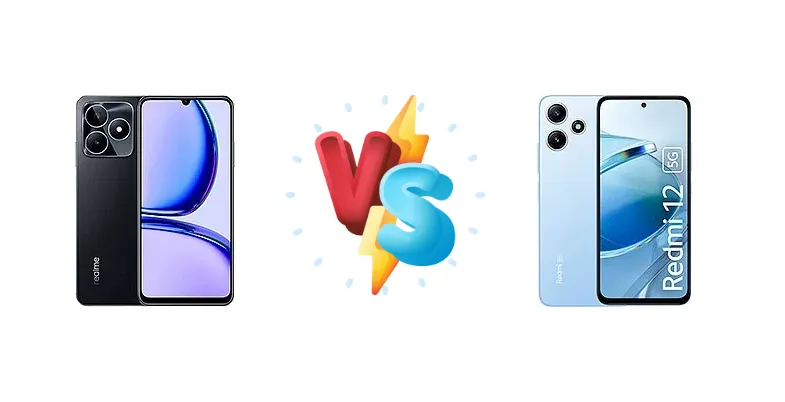
The sub-$200 5G smartphone market is heating up, with the Realme C53 and Xiaomi Redmi 12 5G vying for dominance. While both aim to deliver 5G connectivity at an accessible price, they take drastically different approaches to achieving this, particularly in their core processing power and charging capabilities. This comparison will dissect these differences to determine which phone offers the best overall experience.
🏆 Quick Verdict
For the average user prioritizing consistent performance and future-proofing, the Xiaomi Redmi 12 5G emerges as the stronger contender. Its Snapdragon 4 Gen 2, built on a more efficient 4nm process, provides a noticeable performance advantage over the Realme C53’s Unisoc Tiger T612, despite the Realme’s faster charging.
| Network |
|---|
| 2G bands | GSM 850 / 900 / 1800 / 1900 | GSM 850 / 900 / 1800 / 1900 |
| 3G bands | HSDPA 850 / 900 / 2100 | HSDPA 850 / 900 / 2100 |
| 4G bands | 1, 3, 5, 8, 38, 40, 41 | 1, 3, 5, 8, 40, 41 |
| 5G bands | - | 1, 3, 5, 8, 28, 40, 78 SA/NSA |
| Speed | HSPA, LTE | HSPA, LTE, 5G |
| Technology | GSM / HSPA / LTE | GSM / HSPA / LTE / 5G |
| Launch |
|---|
| Announced | 2023, May 31 | 2023, August 01 |
| Status | Available. Released 2023, May 31 | Available. Released 2023, August 04 |
| Body |
|---|
| Build | Glass front, plastic frame, plastic back | Glass front (Gorilla Glass), plastic frame, glass back (Gorilla Glass) |
| Dimensions | 167.3 x 76.7 x 7.5 mm (6.59 x 3.02 x 0.30 in) | 168.6 x 76.3 x 8.2 mm (6.64 x 3.00 x 0.32 in) |
| SIM | Nano-SIM + Nano-SIM | Nano-SIM + Nano-SIM |
| Weight | 182 g (6.42 oz) | 199 g (7.02 oz) |
| Display |
|---|
| Protection | - | Corning Gorilla Glass |
| Resolution | 1080 x 2400 pixels, 20:9 ratio (~390 ppi density) | 1080 x 2460 pixels (~396 ppi density) |
| Size | 6.74 inches, 109.7 cm2 (~85.5% screen-to-body ratio) | 6.79 inches, 109.5 cm2 (~85.1% screen-to-body ratio) |
| Type | IPS LCD, 90Hz, 560 nits (peak) | IPS LCD, 90Hz, 550 nits |
| Platform |
|---|
| CPU | Octa-core (2x1.8 GHz Cortex-A75 & 6x1.8 GHz Cortex-A55) | Octa-core (2x2.2 GHz Cortex-A78 & 6x1.95 GHz Cortex-A55) |
| Chipset | Unisoc Tiger T612 (12 nm) | Qualcomm SM4450 Snapdragon 4 Gen 2 (4 nm) |
| GPU | Mali-G57 | Adreno 613 |
| OS | Android 13, Realme UI T | Android 13, upgradable to Android 15, HyperOS 2 |
| Memory |
|---|
| Card slot | microSDXC (dedicated slot) | microSDXC (uses shared SIM slot) |
| Internal | 128GB 6GB RAM, 256GB 8GB RAM | 128GB 4GB RAM, 128GB 6GB RAM, 128GB 8GB RAM, 256GB 8GB RAM |
| Main Camera |
|---|
| Dual | 50 MP, f/1.8, (wide), PDAF
Auxiliary lens | 50 MP, f/1.8, (wide), PDAF
Auxiliary lens |
| Features | LED flash, HDR, panorama | LED flash, HDR |
| Video | 1080p@30fps | 1080p@30fps |
| Selfie camera |
|---|
| Features | HDR | HDR |
| Single | 8 MP, f/2.0, (wide) | 8 MP, f/2.0, (wide), 1.12µm |
| Video | 720p@30fps | 1080p@30fps |
| Sound |
|---|
| 35mm jack | Yes | Yes |
| Loudspeaker | Yes | Yes |
| Comms |
|---|
| Bluetooth | 5.0, A2DP, LE | 5.3, A2DP, LE |
| Infrared port | - | Yes |
| NFC | No | Unspecified |
| Positioning | GPS, GLONASS, GALILEO | GPS, GLONASS, GALILEO, BDS |
| Radio | Unspecified | No |
| USB | USB Type-C 2.0 | USB Type-C |
| WLAN | Wi-Fi 802.11 a/b/g/n/ac, dual-band | Wi-Fi 802.11 a/b/g/n/ac, dual-band |
| Features |
|---|
| Sensors | Fingerprint (side-mounted), accelerometer, gyro, proximity, compass | Fingerprint (side-mounted), accelerometer, compass |
| Battery |
|---|
| Charging | 33W wired, 50% in 31 min | 18W wired, PD |
| Type | 5000 mAh | Li-Po 5000 mAh |
| Misc |
|---|
| Colors | Champion Gold, Mighty Black | Jade Black, Pastel Blue, Moonstone Silver |
| Models | RMX3760 | 23076RN4BI, 23076RN8DY, 2AFZZRN8DY |
| Price | € 134.99 / $ 99.15 / £ 126.54 | € 104.09 / ₹ 15,999 |
| SAR | - | 1.09 W/kg (head) 0.88 W/kg (body) |
| SAR EU | - | 0.98 W/kg (head) 1.00 W/kg (body) |
Realme C53
- Significantly faster 33W charging
- Potentially lower price point
- Unisoc chipset offers decent performance for basic tasks
- Less powerful Unisoc Tiger T612 chipset
- 12nm process node leads to lower efficiency and potential throttling
- Likely inferior image processing capabilities
Xiaomi Redmi 12 5G
- More powerful and efficient Snapdragon 4 Gen 2 chipset
- 4nm process node for better thermal management and battery life
- Superior image processing capabilities
- Slower 18W charging
- Potentially slightly higher price
- May not offer the absolute fastest charging speeds
Display Comparison
Neither device boasts a standout display. Both likely utilize LCD panels, common in this price segment. However, detailed specs are missing. The focus here is on the internals. We can assume similar resolutions (likely 1080p+) and refresh rates (60Hz or 90Hz). The real difference will be in color accuracy and peak brightness, which are currently unknown, but the Redmi 12 5G's more advanced chipset *could* translate to better image processing for display output.
Camera Comparison
Without detailed camera specs, a direct comparison is difficult. However, the chipset plays a role. The Redmi 12 5G’s Snapdragon 4 Gen 2 includes a more capable ISP (Image Signal Processor) than the Unisoc T612, resulting in better image processing, noise reduction, and dynamic range. While both phones likely feature a primary camera and multiple secondary sensors (often including a 2MP macro), the Redmi 12 5G is expected to deliver superior image quality, particularly in challenging lighting conditions. The Realme C53's camera will likely be adequate for casual snapshots, but the Redmi 12 5G will offer a more refined photographic experience.
Performance
The core battleground is the chipset. The Xiaomi Redmi 12 5G’s Qualcomm Snapdragon 4 Gen 2 (4nm) is a clear upgrade over the Realme C53’s Unisoc Tiger T612 (12nm). The 4nm process node is significantly more power-efficient, leading to better thermal management and sustained performance. While both are octa-core CPUs, the Redmi 12 5G utilizes 2x Cortex-A78 cores clocked at 2.2 GHz, offering a substantial performance boost over the C53’s 2x Cortex-A75 cores at 1.8 GHz. This translates to faster app loading times, smoother multitasking, and a more responsive overall experience. The Redmi 12 5G will handle graphically intensive tasks and gaming with greater ease.
Battery Life
The Realme C53’s 33W wired charging is a significant advantage, capable of reaching 50% charge in just 31 minutes. The Redmi 12 5G’s 18W charging with PD (Power Delivery) is slower. However, the Snapdragon 4 Gen 2’s superior power efficiency means the Redmi 12 5G will likely offer comparable, if not better, real-world battery life despite potentially having a similar or slightly smaller battery capacity. The faster charging of the C53 is beneficial for quick top-ups, but the Redmi 12 5G’s efficiency mitigates the charging speed difference.
Buying Guide
Buy the Realme C53 if you prioritize extremely fast charging and are primarily focused on basic smartphone tasks like calling, texting, and light social media use. The 33W charging is a significant advantage in this price bracket. Buy the Xiaomi Redmi 12 5G if you value smoother multitasking, a more responsive user experience, and better long-term performance thanks to the more modern and efficient Snapdragon 4 Gen 2 chipset. This is the better choice for mobile gaming and demanding applications.
Frequently Asked Questions
❓ Will the Unisoc Tiger T612 in the Realme C53 struggle with demanding games like PUBG Mobile?
Yes, the Unisoc Tiger T612 is likely to struggle with PUBG Mobile at higher settings. While playable at low settings, you may experience frame drops and stuttering, especially during intense firefights. The Redmi 12 5G’s Snapdragon 4 Gen 2 will provide a significantly smoother gaming experience.
❓ Does the Redmi 12 5G support carrier aggregation for faster 5G speeds?
While not explicitly stated, Qualcomm Snapdragon chipsets generally support carrier aggregation. This means the Redmi 12 5G is more likely to achieve faster 5G speeds in areas with carrier aggregation enabled, providing a more consistent and reliable 5G experience compared to the Realme C53.
❓ Is the 18W charging on the Redmi 12 5G really that much slower in real-world use?
While 33W is faster on paper, the Redmi 12 5G’s Snapdragon 4 Gen 2 is significantly more power-efficient. This means the phone consumes less power during charging, reducing the overall time to full charge. The difference in real-world charging times may be less dramatic than the wattage suggests.