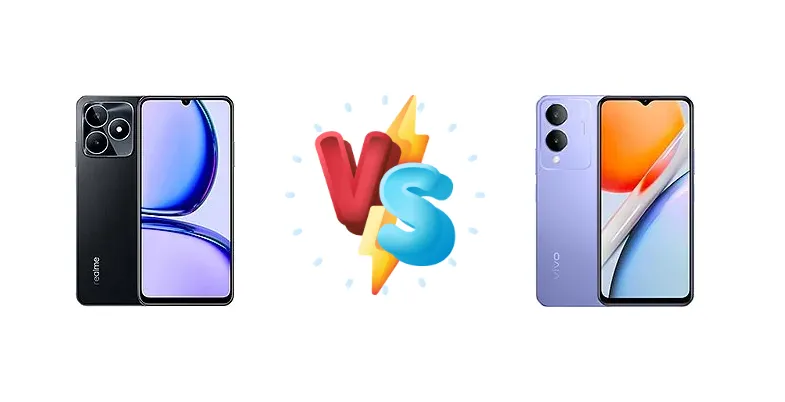
The sub-$200 smartphone market is fiercely competitive. The Realme C53 and vivo Y36i represent two compelling options, but cater to slightly different priorities. The C53 emphasizes rapid charging, while the Y36i leans on a more modern chipset. This comparison will dissect their strengths and weaknesses to determine which device offers the best overall value.
🏆 Quick Verdict
For most users, the vivo Y36i emerges as the stronger choice. Its Mediatek Dimensity 6020, fabricated on a 7nm process, provides a noticeable performance advantage over the Realme C53’s Unisoc Tiger T612. While the C53 boasts faster 33W charging, the Y36i’s superior processing power makes it the better all-rounder.
| Network |
|---|
| 2G bands | GSM 850 / 900 / 1800 / 1900 | GSM 850 / 900 / 1800 / 1900 |
| 3G bands | HSDPA 850 / 900 / 2100 | HSDPA 850 / 900 / 2100 |
| 4G bands | 1, 3, 5, 8, 38, 40, 41 | 1, 3, 5, 8, 28, 34, 38, 39, 40, 41 |
| 5G bands | - | 1, 5, 8, 28, 41, 77, 78 SA/NSA |
| Speed | HSPA, LTE | HSPA, LTE, 5G |
| Technology | GSM / HSPA / LTE | GSM / HSPA / LTE / 5G |
| Launch |
|---|
| Announced | 2023, May 31 | 2023, December 09 |
| Status | Available. Released 2023, May 31 | Available. Released 2024, January |
| Body |
|---|
| Build | Glass front, plastic frame, plastic back | Glass front, plastic frame, plastic back |
| Dimensions | 167.3 x 76.7 x 7.5 mm (6.59 x 3.02 x 0.30 in) | 163.7 x 75.4 x 8.1 mm (6.44 x 2.97 x 0.32 in) |
| SIM | Nano-SIM + Nano-SIM | Nano-SIM + Nano-SIM |
| Weight | 182 g (6.42 oz) | 186 g (6.56 oz) |
| Display |
|---|
| Resolution | 1080 x 2400 pixels, 20:9 ratio (~390 ppi density) | 720 x 1612 pixels, 20:9 ratio (~269 ppi density) |
| Size | 6.74 inches, 109.7 cm2 (~85.5% screen-to-body ratio) | 6.56 inches, 103.4 cm2 (~83.8% screen-to-body ratio) |
| Type | IPS LCD, 90Hz, 560 nits (peak) | IPS LCD, 90Hz, 840 nits (HBM) |
| Platform |
|---|
| CPU | Octa-core (2x1.8 GHz Cortex-A75 & 6x1.8 GHz Cortex-A55) | Octa-core (2x2.2 GHz Cortex-A76 & 6x2.0 GHz Cortex-A55) |
| Chipset | Unisoc Tiger T612 (12 nm) | Mediatek Dimensity 6020 (7 nm) |
| GPU | Mali-G57 | Mali-G57 MC2 |
| OS | Android 13, Realme UI T | Android 13, OriginOS 3 |
| Memory |
|---|
| Card slot | microSDXC (dedicated slot) | microSDXC |
| Internal | 128GB 6GB RAM, 256GB 8GB RAM | 128GB 4GB RAM |
| Main Camera |
|---|
| Dual | 50 MP, f/1.8, (wide), PDAF
Auxiliary lens | - |
| Features | LED flash, HDR, panorama | LED flash, panorama |
| Single | - | 13 MP, f/2.2, (wide), PDAF
Anti-stroboscopic sensor |
| Video | 1080p@30fps | 1080p@30fps |
| Selfie camera |
|---|
| Features | HDR | - |
| Single | 8 MP, f/2.0, (wide) | 5 MP, f/1.8, (wide) |
| Video | 720p@30fps | Yes |
| Sound |
|---|
| 35mm jack | Yes | Yes |
| Loudspeaker | Yes | Yes |
| Comms |
|---|
| Bluetooth | 5.0, A2DP, LE | 5.1, A2DP, LE, aptX HD |
| NFC | No | No |
| Positioning | GPS, GLONASS, GALILEO | GPS, GLONASS, BDS |
| Radio | Unspecified | FM radio |
| USB | USB Type-C 2.0 | USB Type-C 2.0, OTG |
| WLAN | Wi-Fi 802.11 a/b/g/n/ac, dual-band | Wi-Fi 802.11 a/b/g/n/ac, dual-band |
| Features |
|---|
| Sensors | Fingerprint (side-mounted), accelerometer, gyro, proximity, compass | Fingerprint (side-mounted), accelerometer, proximity, compass |
| Battery |
|---|
| Charging | 33W wired, 50% in 31 min | 15W wired
Reverse wired |
| Type | 5000 mAh | 5000 mAh |
| Misc |
|---|
| Colors | Champion Gold, Mighty Black | Purple, Gold, Black |
| Models | RMX3760 | V2318A |
| Price | € 134.99 / $ 99.15 / £ 126.54 | About 160 EUR |
Realme C53
- Significantly faster 33W charging
- Potentially lower price point
- Reverse charging not available
- Less powerful Unisoc Tiger T612 chipset
- Less efficient 12nm process
- Likely lower sustained performance
vivo Y36i
- More powerful and efficient Mediatek Dimensity 6020
- 7nm process for better thermal management
- Reverse wired charging capability
- Slower 15W charging
- Potentially higher price
- May not be ideal for users prioritizing ultra-fast charging
Display Comparison
Neither device boasts a standout display. Both likely utilize LCD panels, common in this price bracket. The absence of specified refresh rates suggests both are limited to 60Hz. The real difference lies under the hood; the chipset will impact UI smoothness more than display specs. We anticipate similar color accuracy and viewing angles given the market segment.
Camera Comparison
Without detailed camera specs beyond the main sensor, a direct comparison is difficult. However, the image signal processor (ISP) within the Dimensity 6020 likely offers more sophisticated image processing capabilities than the ISP paired with the Unisoc Tiger T612. This could result in better dynamic range and noise reduction in photos. The absence of OIS on either device suggests reliance on software stabilization. The 2MP macro cameras on both are likely present for marketing purposes and offer limited real-world utility.
Performance
The Mediatek Dimensity 6020 in the vivo Y36i is the clear winner here. Built on a 7nm process, it offers superior power efficiency and processing capabilities compared to the Realme C53’s 12nm Unisoc Tiger T612. The Dimensity 6020’s Cortex-A76 cores (2x2.2 GHz) are architecturally more advanced than the C53’s Cortex-A75 cores (2x1.8 GHz), resulting in faster single-core performance. This translates to snappier app launches and smoother multitasking. While both have octa-core CPUs, the Dimensity 6020’s architecture provides a tangible advantage for demanding tasks.
Battery Life
The Realme C53’s 33W charging is a significant advantage, allowing a 50% charge in just 31 minutes. The vivo Y36i’s 15W charging is considerably slower. However, the Dimensity 6020’s superior power efficiency may offset the difference in charging speed. The Y36i will likely exhibit better battery life during typical usage due to its more efficient chipset, even if it takes longer to fully recharge. The Y36i also offers reverse wired charging, a feature absent on the C53, adding to its versatility.
Buying Guide
Buy the Realme C53 if you prioritize extremely fast charging and frequently find yourself needing to top up your battery quickly. It’s ideal for users who are always on the go and can’t afford downtime. Buy the vivo Y36i if you value smoother performance for everyday tasks, social media, and light gaming. Its more efficient chipset translates to a more responsive user experience and better long-term usability.
Frequently Asked Questions
❓ Will the Dimensity 6020 in the vivo Y36i struggle with demanding games like PUBG Mobile?
While not a flagship chipset, the Dimensity 6020 is capable of running PUBG Mobile at medium settings with reasonable frame rates. Expect some frame drops during intense firefights, but it’s a playable experience. The Unisoc Tiger T612 in the Realme C53 will likely require lower settings and may exhibit more noticeable lag.
❓ How much of a difference will the 7nm process of the Dimensity 6020 make in real-world usage?
The 7nm process translates to significantly improved power efficiency compared to the 12nm process of the Unisoc Tiger T612. This means the vivo Y36i will consume less power for the same tasks, resulting in longer battery life and less heat generation. Less heat also means sustained performance will be higher, preventing throttling during extended use.
❓ Is the reverse wired charging on the vivo Y36i useful for accessories like earbuds?
Yes, the reverse wired charging feature allows you to use the vivo Y36i as a power bank for other devices, such as wireless earbuds or a smartwatch. While the charging speed is limited to 15W, it’s a convenient feature for topping up smaller accessories on the go.