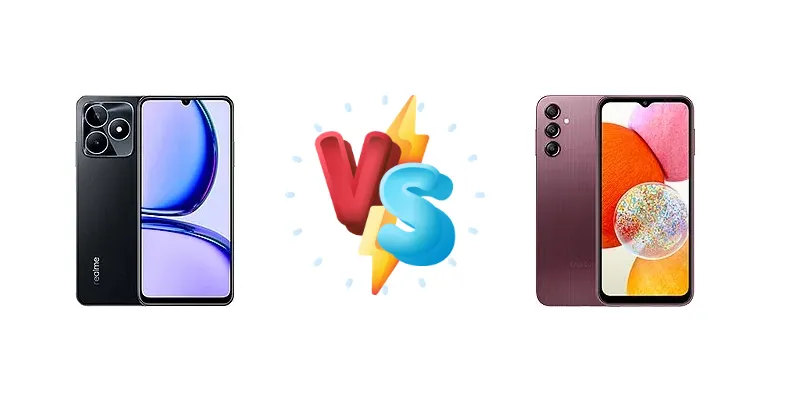
The sub-$200 smartphone market is fiercely competitive, and the Realme C53 and Samsung Galaxy A14 are two strong contenders. The C53 prioritizes fast charging and a modern design, while the A14 offers a choice of chipsets and Samsung’s established software ecosystem. This comparison dives deep into the specs to determine which phone offers the best overall experience.
🏆 Quick Verdict
For most users, the Realme C53 emerges as the better value. Its significantly faster 33W charging and comparable performance from the Unisoc Tiger T612 chipset outweigh the Samsung Galaxy A14’s software advantages, especially considering the A14’s slower 15W charging.
| Network |
|---|
| 2G bands | GSM 850 / 900 / 1800 / 1900 | GSM 850 / 900 / 1800 / 1900 |
| 3G bands | HSDPA 850 / 900 / 2100 | HSDPA 850 / 900 / 2100 |
| 4G bands | 1, 3, 5, 8, 38, 40, 41 | 1, 3, 5, 7, 8, 20, 28, 38, 40, 41 |
| Speed | HSPA, LTE | HSPA, LTE |
| Technology | GSM / HSPA / LTE | GSM / HSPA / LTE |
| Launch |
|---|
| Announced | 2023, May 31 | 2023, February 28 |
| Status | Available. Released 2023, May 31 | Available. Released 2023, March 27 |
| Body |
|---|
| Build | Glass front, plastic frame, plastic back | Glass front, plastic back, plastic frame |
| Dimensions | 167.3 x 76.7 x 7.5 mm (6.59 x 3.02 x 0.30 in) | 167.7 x 78 x 9.1 mm (6.60 x 3.07 x 0.36 in) |
| SIM | Nano-SIM + Nano-SIM | · Nano-SIM· Nano-SIM + Nano-SIM |
| Weight | 182 g (6.42 oz) | 201 g (7.09 oz) |
| Display |
|---|
| Resolution | 1080 x 2400 pixels, 20:9 ratio (~390 ppi density) | 1080 x 2408 pixels, 20:9 ratio (~400 ppi density) |
| Size | 6.74 inches, 109.7 cm2 (~85.5% screen-to-body ratio) | 6.6 inches, 104.9 cm2 (~80.2% screen-to-body ratio) |
| Type | IPS LCD, 90Hz, 560 nits (peak) | PLS LCD |
| Platform |
|---|
| CPU | Octa-core (2x1.8 GHz Cortex-A75 & 6x1.8 GHz Cortex-A55) | Octa-core (2x2.0 GHz Cortex-A75 & 6x1.8 GHz Cortex-A55) - Version AOcta-core (4x2.0 GHz Cortex-A55 & 4x2.0 GHz Cortex-A55) - Version B |
| Chipset | Unisoc Tiger T612 (12 nm) | Mediatek MT6769 Helio G80 (12 nm) - Version AExynos 850 (8 nm) - Version B |
| GPU | Mali-G57 | Mali-G52 MC2 |
| OS | Android 13, Realme UI T | Android 13, upgradable to Android 15, One UI 7 |
| Memory |
|---|
| Card slot | microSDXC (dedicated slot) | microSDXC (dedicated slot) |
| Internal | 128GB 6GB RAM, 256GB 8GB RAM | 64GB 4GB RAM, 128GB 4GB RAM, 128GB 6GB RAM |
| Main Camera |
|---|
| Dual | 50 MP, f/1.8, (wide), PDAF
Auxiliary lens | - |
| Features | LED flash, HDR, panorama | LED flash, panorama, HDR |
| Single | - | 13 MP, f/2.0, (wide) |
| Triple | - | 50 MP, f/1.8, 26mm (wide), 1/2.75", 0.64µm, PDAF
5 MP, f/2.2, 17mm (ultrawide), 1/5.0", 1.12µm
2 MP (macro) |
| Video | 1080p@30fps | 1080p@30fps |
| Selfie camera |
|---|
| Features | HDR | - |
| Single | 8 MP, f/2.0, (wide) | 13 MP, f/2.0, 26mm (wide), 1/3.1", 1.12µm |
| Video | 720p@30fps | 1080p@30fps |
| Sound |
|---|
| 3.5mm jack | - | Yes |
| 35mm jack | Yes | Yes |
| Loudspeaker | Yes | Yes |
| Comms |
|---|
| Bluetooth | 5.0, A2DP, LE | 5.1 or 5.3, A2DP, LE |
| NFC | No | Yes (market/region dependent) |
| Positioning | GPS, GLONASS, GALILEO | GPS, GALILEO, GLONASS, BDS, QZSS |
| Radio | Unspecified | Unspecified |
| USB | USB Type-C 2.0 | USB Type-C 2.0 |
| WLAN | Wi-Fi 802.11 a/b/g/n/ac, dual-band | Wi-Fi 802.11 a/b/g/n/ac, dual-band, Wi-Fi Direct |
| Features |
|---|
| Sensors | Fingerprint (side-mounted), accelerometer, gyro, proximity, compass | Fingerprint (side-mounted), accelerometer, proximity, compass |
| Battery |
|---|
| Charging | 33W wired, 50% in 31 min | 15W wired |
| Type | 5000 mAh | Li-Po 5000 mAh |
| Misc |
|---|
| Colors | Champion Gold, Mighty Black | Black, Dark Red, Silver, Green |
| Models | RMX3760 | SM-A145F, SM-A145F/DSN, SM-A145M, SM-A145M/DS, SM-A145P, SM-A145R |
| Price | € 134.99 / $ 99.15 / £ 126.54 | € 85.76 / $ 147.60 / £ 79.95 |
| SAR EU | - | 0.46 W/kg (head) 1.37 W/kg (body) |
Realme C53
- Significantly faster 33W charging
- Comparable performance to Helio G80
- Potentially more affordable price point
- Less established brand reputation
- Software updates may be less frequent
Samsung Galaxy A14
- Samsung’s One UI software experience
- Exynos 850 version (B) offers potentially better efficiency
- Wider carrier compatibility in some regions
- Slow 15W charging
- Helio G80 version (A) offers less efficiency than Exynos 850
- Potentially higher price
Display Comparison
Neither device boasts a standout display. Both are likely utilizing LCD panels, common in this price segment. While specific nit brightness isn't provided, the focus here isn't on color accuracy or high refresh rates. The Realme C53’s display size is not specified, but the A14 features a 6.6-inch display. The A14’s larger screen may be preferable for media consumption, but the C53’s potentially smaller form factor could appeal to users seeking a more pocketable device.
Camera Comparison
Camera performance is likely similar, relying heavily on software processing. Neither phone is expected to excel in low-light conditions. The A14’s camera specs aren’t detailed enough to provide a meaningful comparison beyond the presence of a main sensor. The C53’s camera details are also missing. The inclusion of a 2MP macro camera on the A14 is largely a marketing gimmick and won’t significantly impact image quality. Focus should be on the main sensor’s capabilities, which are currently unknown for both devices.
Performance
The performance gap is nuanced. The Realme C53’s Unisoc Tiger T612, built on a 12nm process, features a dual-core Cortex-A75 setup paired with six Cortex-A55 cores. The Samsung Galaxy A14 presents a split: Version A uses the Mediatek Helio G80 (12nm) with a similar core configuration (dual A75, hexa A55), while Version B utilizes the Exynos 850 (8nm) with a quad-core A55 setup. The Exynos 850’s 8nm process *should* offer better power efficiency, potentially leading to longer sustained performance and less thermal throttling, but its core configuration is less geared towards peak performance than the Helio G80 or Tiger T612. For everyday tasks, the difference will be minimal, but the Unisoc and Helio chips will likely show an edge in graphically intensive tasks.
Battery Life
Battery life is a key differentiator. While the mAh capacity isn’t specified for either device, the charging speeds are drastically different. The Realme C53’s 33W charging can deliver a 50% charge in just 31 minutes, a significant advantage over the Samsung Galaxy A14’s sluggish 15W charging. This means less downtime and quicker top-ups, making the C53 more convenient for users on the go. A larger battery capacity on the A14 would need to be substantial to offset this charging speed disparity.
Buying Guide
Buy the Realme C53 if you prioritize quick top-ups and don't mind a less established brand. Its 33W charging is a game-changer in this price bracket. Buy the Samsung Galaxy A14 if you value Samsung’s One UI software experience, prefer a potentially more efficient Exynos 850 variant (Version B), and aren’t as concerned about charging speed. The A14 also offers a slightly broader carrier compatibility in some regions.
Frequently Asked Questions
❓ Does the Unisoc Tiger T612 chipset in the Realme C53 struggle with demanding games like PUBG?
The Unisoc Tiger T612 is capable of running PUBG Mobile, but you’ll likely need to lower the graphics settings to achieve a smooth frame rate. It’s not a gaming powerhouse, but it’s sufficient for casual gaming and everyday tasks. The Helio G80 in the A14 offers similar performance, while the Exynos 850 version (B) may provide slightly better sustained performance due to its more efficient 8nm process.
❓ Is the 15W charging on the Samsung Galaxy A14 a significant drawback in 2024?
Yes, 15W charging is noticeably slow compared to the 33W charging on the Realme C53. Expect a much longer charging time to reach 100%, potentially taking over 2 hours. This is a significant inconvenience for users who frequently need to top up their battery quickly.
❓ Which phone will receive more software updates and security patches?
Samsung generally provides more consistent and longer-term software support than Realme. However, Realme has been improving its update cadence. Expect the Galaxy A14 to receive updates for a longer period, but the C53 will still receive essential security patches.
❓ What are the real-world benefits of the Exynos 850 version (B) of the Samsung Galaxy A14?
The Exynos 850, built on an 8nm process, offers improved power efficiency compared to the Helio G80. This translates to potentially longer battery life and less thermal throttling during prolonged use, such as extended gaming sessions or video recording. However, the performance difference isn't massive.