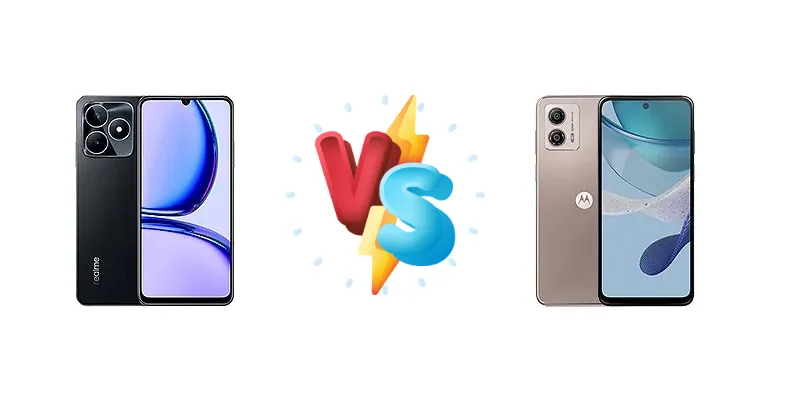
The sub-$200 smartphone market is fiercely competitive, and the Realme C53 and Motorola Moto G53 are two contenders vying for your attention. Both offer 5G connectivity at an accessible price point, but they take different approaches to achieving this. The Realme prioritizes fast charging and a newer design, while the Motorola focuses on established Qualcomm silicon and a potentially longer-lasting battery. This comparison will dissect their key differences to determine which phone delivers the best value.
🏆 Quick Verdict
For the average user prioritizing consistent performance and a potentially longer lifespan, the Motorola Moto G53 emerges as the better choice. Its Snapdragon 480+ chipset, built on an 8nm process, offers a more efficient and capable platform than the Realme C53’s Unisoc Tiger T612. While the Realme boasts faster charging, the Moto G53’s endurance rating and Qualcomm’s track record provide greater peace of mind.
| Network |
|---|
| 2G bands | GSM 850 / 900 / 1800 / 1900 | GSM 850 / 900 / 1800 / 1900 |
| 3G bands | HSDPA 850 / 900 / 2100 | HSDPA 850 / 900 / 1900 / 2100 - EMEA & AP, China |
| 4G bands | 1, 3, 5, 8, 38, 40, 41 | 1, 2, 3, 5, 7, 8, 18, 19, 20, 26, 28, 32, 38, 40, 41, 42 - EMEA & AP |
| 5G bands | - | 1, 3, 5, 7, 8, 20, 28, 38, 40, 41, 77, 78 SA/NSA - EMEA & AP |
| Speed | HSPA, LTE | HSPA, LTE, 5G |
| Technology | GSM / HSPA / LTE | GSM / CDMA / HSPA / LTE / 5G |
| | - | 1, 5, 8, 28, 41, 78 SA/NSA - China |
| Launch |
|---|
| Announced | 2023, May 31 | 2022, December 15 |
| Status | Available. Released 2023, May 31 | Available. Released 2022, December 15 |
| Body |
|---|
| Build | Glass front, plastic frame, plastic back | Glass front, plastic back, plastic frame |
| Dimensions | 167.3 x 76.7 x 7.5 mm (6.59 x 3.02 x 0.30 in) | 162.7 x 74.7 x 8.2 mm (6.41 x 2.94 x 0.32 in) |
| SIM | Nano-SIM + Nano-SIM | · Nano-SIM + eSIM· Nano-SIM + Nano-SIM |
| Weight | 182 g (6.42 oz) | 183 g (6.46 oz) |
| | - | Water-resistant design |
| Display |
|---|
| Resolution | 1080 x 2400 pixels, 20:9 ratio (~390 ppi density) | 720 x 1600 pixels, 20:9 ratio (~270 ppi density) |
| Size | 6.74 inches, 109.7 cm2 (~85.5% screen-to-body ratio) | 6.5 inches, 102.0 cm2 (~83.9% screen-to-body ratio) |
| Type | IPS LCD, 90Hz, 560 nits (peak) | IPS LCD, 120Hz |
| Platform |
|---|
| CPU | Octa-core (2x1.8 GHz Cortex-A75 & 6x1.8 GHz Cortex-A55) | Octa-core (2x2.2 GHz Kryo 460 & 6x1.8 GHz Kryo 460) |
| Chipset | Unisoc Tiger T612 (12 nm) | Qualcomm SM4350-AC Snapdragon 480+ 5G (8 nm) |
| GPU | Mali-G57 | Adreno 619 |
| OS | Android 13, Realme UI T | Android 13, planned upgrade to Android 14 |
| Memory |
|---|
| Card slot | microSDXC (dedicated slot) | microSDXC (uses shared SIM slot) |
| Internal | 128GB 6GB RAM, 256GB 8GB RAM | 64GB 4GB RAM, 128GB 4GB RAM, 128GB 6GB RAM, 128GB 8GB RAM |
| Main Camera |
|---|
| Dual | 50 MP, f/1.8, (wide), PDAF
Auxiliary lens | 50 MP, f/1.8 (wide), 1/2.76", 0.64µm, PDAF
2 MP (macro) |
| Features | LED flash, HDR, panorama | LED flash, HDR, panorama |
| Video | 1080p@30fps | 1080p@30fps |
| Selfie camera |
|---|
| Features | HDR | - |
| Single | 8 MP, f/2.0, (wide) | 8 MP, f/2.0, (wide), 1/4.0", 1.12µm
or
16 MP, f/2.2, (wide), 1.0µm |
| Video | 720p@30fps | 1080p@30fps |
| Sound |
|---|
| 3.5mm jack | - | Yes |
| 35mm jack | Yes | Yes |
| Loudspeaker | Yes | Yes, with stereo speakers |
| Comms |
|---|
| Bluetooth | 5.0, A2DP, LE | 5.1, A2DP, LE |
| NFC | No | Yes (market/region dependent) |
| Positioning | GPS, GLONASS, GALILEO | GPS, GLONASS, GALILEO, BDS |
| Radio | Unspecified | FM radio (market/region dependent) |
| USB | USB Type-C 2.0 | USB Type-C 2.0, OTG |
| WLAN | Wi-Fi 802.11 a/b/g/n/ac, dual-band | Wi-Fi 802.11 a/b/g/n/ac, dual-band |
| Features |
|---|
| Sensors | Fingerprint (side-mounted), accelerometer, gyro, proximity, compass | Fingerprint (side-mounted), accelerometer, gyro, proximity, compass |
| Battery |
|---|
| Charging | 33W wired, 50% in 31 min | 18W wired (China, LATAM)
10W wired (International)
Reverse wired |
| Type | 5000 mAh | Li-Po 5000 mAh |
| Misc |
|---|
| Colors | Champion Gold, Mighty Black | Ink Blue, Arctic Silver, Pale Pink |
| Models | RMX3760 | XT2335-2 |
| Price | € 134.99 / $ 99.15 / £ 126.54 | $ 295.00 / £ 143.15 |
| Tests |
|---|
| Battery life | - |
Endurance rating 123h
|
| Camera | - |
Photo / Video |
| Display | - |
Contrast ratio: 1746:1 (nominal) |
| Loudspeaker | - |
-26.0 LUFS (Very good)
|
| Performance | - |
AnTuTu: 314195 (v9)
GeekBench: 1594 (v5.1), 1797 (v6.0)
GFXBench: 29fps (ES 3.1 onscreen) |
Realme C53
- Significantly faster 33W charging
- Potentially more modern design aesthetic
- Competitive price point
- Less efficient Unisoc Tiger T612 chipset
- Likely lower performance in demanding tasks
- Unknown battery capacity
Motorola Moto G53
- More efficient Qualcomm Snapdragon 480+ 5G
- Stronger endurance rating (123h)
- Brighter display (599 nits)
- Slower charging speeds (10W/18W)
- Potentially less eye-catching design
- Software update support may be limited
Display Comparison
Both the Realme C53 and Motorola Moto G53 feature displays with a 1746:1 contrast ratio, suggesting similar visual pop. However, the Moto G53’s measured peak brightness of 599 nits provides a noticeably brighter viewing experience, especially outdoors. While both lack high refresh rates, the G53’s superior brightness makes it more usable in direct sunlight. Details regarding panel technology (IPS vs. VA) are missing, but the contrast ratio suggests IPS panels are likely used in both.
Camera Comparison
Both phones list 'Photo / Video' capabilities, but lack specific details. Without sensor size or aperture information, a direct comparison is difficult. However, given the price point, it’s safe to assume both rely on budget sensors. The inclusion of a 2MP macro camera on either device is largely a marketing tactic, offering limited practical benefit. Image processing will likely be the differentiating factor, and Motorola’s software generally prioritizes natural-looking images, while Realme tends towards more saturated colors.
Performance
The core difference lies in the chipsets. The Motorola Moto G53 utilizes the Qualcomm Snapdragon 480+ 5G (8nm), featuring a 2x2.2 GHz Kryo 460 core configuration alongside six 1.8 GHz Kryo 460 cores. This 8nm process offers better power efficiency compared to the Realme C53’s Unisoc Tiger T612 (12nm). The T612’s 2x1.8 GHz Cortex-A75 and 6x1.8 GHz Cortex-A55 configuration, while octa-core, is less efficient and generally delivers lower performance. This translates to smoother multitasking and gaming on the Moto G53, particularly in graphically intensive titles. The Snapdragon’s Adreno GPU also provides a significant advantage.
Battery Life
The Motorola Moto G53 boasts an endurance rating of 123 hours, indicating strong battery life. While the Realme C53’s battery capacity is unknown, its 33W charging significantly outpaces the Moto G53’s 18W (China/LATAM) or 10W (International) charging. The Realme can reach 50% charge in just 31 minutes, a substantial advantage for users who frequently need a quick top-up. However, the Moto G53’s higher endurance rating suggests it may last a full day on a single charge even with moderate to heavy use, mitigating the slower charging speed.
Buying Guide
Buy the Realme C53 if you absolutely need the fastest possible charging speeds in this price bracket and prioritize a modern aesthetic. Its 33W charging is a significant advantage. Buy the Motorola Moto G53 if you value a more established chipset with proven performance, potentially better long-term software support, and a battery that’s rated for all-day use. The Snapdragon 480+ offers a smoother experience for demanding apps and games.
Frequently Asked Questions
❓ Does the Unisoc Tiger T612 in the Realme C53 struggle with demanding games like PUBG or Call of Duty?
Yes, the Unisoc Tiger T612 is a budget chipset and will likely struggle to deliver a smooth experience in graphically intensive games like PUBG or Call of Duty, even at lower settings. Expect noticeable frame drops and potential stuttering. The Motorola Moto G53’s Snapdragon 480+ is significantly better equipped for gaming.
❓ The Moto G53 has different charging speeds depending on the region. What does this mean for me?
If you purchase the Moto G53 in China or Latin America, you’ll benefit from 18W fast charging. However, in most international markets, the charging speed is limited to 10W. This slower charging speed will significantly increase the time it takes to fully charge the device. Check the specifications for your region before purchasing.
❓ Is the difference between 8nm and 12nm chipsets really that noticeable in everyday use?
Yes, the difference in manufacturing process (8nm vs 12nm) directly impacts power efficiency. The 8nm Snapdragon 480+ in the Moto G53 consumes less power for the same level of performance, resulting in better battery life and less heat generation. This translates to a smoother, more consistent user experience, especially during prolonged use.