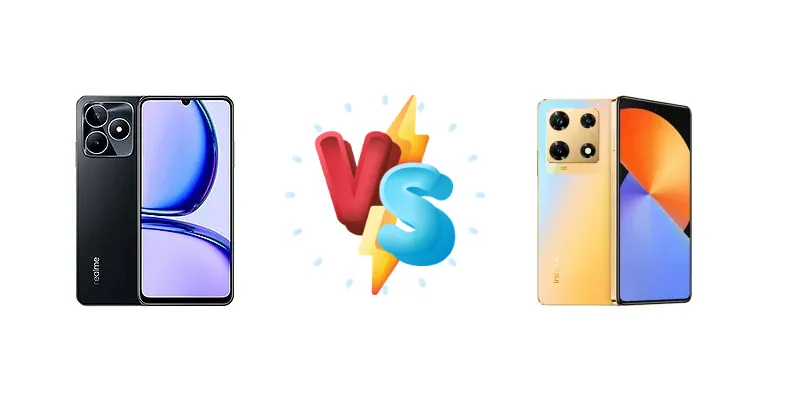
The sub-$200 smartphone market is fiercely competitive. The Realme C53 and Infinix Note 30 Pro both aim to deliver a compelling experience without breaking the bank, but they take different approaches. The C53 focuses on affordability, while the Note 30 Pro prioritizes fast charging and a more powerful chipset. This comparison dives deep into the specifics to determine which device best suits your needs.
🏆 Quick Verdict
For most users, the Infinix Note 30 Pro is the superior choice. Its Mediatek Helio G99 chipset offers a noticeable performance boost over the Realme C53’s Unisoc Tiger T612, and the significantly faster 68W charging (with wireless charging as a bonus) dramatically improves usability. While the C53 is cheaper, the Note 30 Pro’s advantages justify the price difference.
| Network |
|---|
| 2G bands | GSM 850 / 900 / 1800 / 1900 | GSM 850 / 900 / 1800 / 1900 |
| 3G bands | HSDPA 850 / 900 / 2100 | HSDPA 850 / 900 / 1700(AWS) / 1900 / 2100 |
| 4G bands | 1, 3, 5, 8, 38, 40, 41 | 1, 2, 3, 4, 5, 7, 8, 12, 17, 20, 28, 38, 40, 41, 66 |
| Speed | HSPA, LTE | HSPA, LTE |
| Technology | GSM / HSPA / LTE | GSM / HSPA / LTE |
| Launch |
|---|
| Announced | 2023, May 31 | 2023, May 22 |
| Status | Available. Released 2023, May 31 | Available. Released 2023, May 22 |
| Body |
|---|
| Build | Glass front, plastic frame, plastic back | Glass front, plastic frame, glass back |
| Dimensions | 167.3 x 76.7 x 7.5 mm (6.59 x 3.02 x 0.30 in) | 162.7 x 76 x 8.2 mm (6.41 x 2.99 x 0.32 in) |
| SIM | Nano-SIM + Nano-SIM | Nano-SIM + Nano-SIM |
| Weight | 182 g (6.42 oz) | 203 g (7.16 oz) |
| | - | IP53 |
| Display |
|---|
| Resolution | 1080 x 2400 pixels, 20:9 ratio (~390 ppi density) | 1080 x 2400 pixels, 20:9 ratio (~395 ppi density) |
| Size | 6.74 inches, 109.7 cm2 (~85.5% screen-to-body ratio) | 6.67 inches, 107.4 cm2 (~86.9% screen-to-body ratio) |
| Type | IPS LCD, 90Hz, 560 nits (peak) | AMOLED, 1B colors, 120Hz, 900 nits (peak) |
| | - | * the display diagonal size and resolution is unconfirmed |
| Platform |
|---|
| CPU | Octa-core (2x1.8 GHz Cortex-A75 & 6x1.8 GHz Cortex-A55) | Octa-core (2x2.2 GHz Cortex-A76 & 6x2.0 GHz Cortex-A55) |
| Chipset | Unisoc Tiger T612 (12 nm) | Mediatek Helio G99 (6 nm) |
| GPU | Mali-G57 | Mali-G57 MC2 |
| OS | Android 13, Realme UI T | Android 13, XOS 13 |
| Memory |
|---|
| Card slot | microSDXC (dedicated slot) | microSDXC (dedicated slot) |
| Internal | 128GB 6GB RAM, 256GB 8GB RAM | 256GB 8GB RAM |
| Main Camera |
|---|
| Dual | 50 MP, f/1.8, (wide), PDAF
Auxiliary lens | - |
| Features | LED flash, HDR, panorama | Quad-LED flash, HDR, panorama |
| Triple | - | 108 MP, (wide), 1/1.67", PDAF
2 MP (macro)
Auxiliary lens |
| Video | 1080p@30fps | 1440p@30fps, 1080p@30fps |
| Selfie camera |
|---|
| Features | HDR | LED flash, HDR |
| Single | 8 MP, f/2.0, (wide) | 32 MP, f/2.0, (wide), 1/2.8" |
| Video | 720p@30fps | 1080p@30fps |
| Sound |
|---|
| 3.5mm jack | - | Yes |
| 35mm jack | Yes | Yes |
| Loudspeaker | Yes | Yes, with dual speakers |
| | - | Sound by JBL
24-bit/192kHz audio |
| Comms |
|---|
| Bluetooth | 5.0, A2DP, LE | Yes |
| NFC | No | Yes (market/region dependent) |
| Positioning | GPS, GLONASS, GALILEO | GPS |
| Radio | Unspecified | FM radio |
| USB | USB Type-C 2.0 | USB Type-C 2.0, OTG |
| WLAN | Wi-Fi 802.11 a/b/g/n/ac, dual-band | Wi-Fi 802.11 a/b/g/n/ac, dual-band, Wi-Fi Direct |
| Features |
|---|
| Sensors | Fingerprint (side-mounted), accelerometer, gyro, proximity, compass | Fingerprint (side-mounted), accelerometer, gyro, proximity, compass |
| Battery |
|---|
| Charging | 33W wired, 50% in 31 min | 68W wired, PD3.0, 80% in 30 min
15W wireless
Reverse wireless |
| Type | 5000 mAh | 5000 mAh |
| Misc |
|---|
| Colors | Champion Gold, Mighty Black | Magic Black, Variable Gold |
| Models | RMX3760 | X678B |
| Price | € 134.99 / $ 99.15 / £ 126.54 | - |
Realme C53
- Lower price point makes it accessible.
- Functional for basic smartphone tasks.
- Decent battery life for light usage.
- Unisoc Tiger T612 chipset is underpowered.
- Slow 33W charging.
- Likely limited camera performance.
Infinix Note 30 Pro
- Mediatek Helio G99 offers significantly better performance.
- Ultra-fast 68W wired and 15W wireless charging.
- More efficient chipset for longer battery life.
- Slightly higher price than the Realme C53.
- May still lack advanced camera features like OIS.
- Build quality may be similar to the C53 (plastic).
Display Comparison
Neither device boasts a standout display. Both likely utilize LCD panels, a common cost-saving measure in this segment. However, the focus here is on the underlying performance. Display specs are not provided, so we can only infer. The Realme C53’s Unisoc chipset will likely struggle to drive a high-refresh-rate panel smoothly, while the Infinix Note 30 Pro’s Helio G99 has more headroom. The absence of details like peak brightness or color gamut makes a direct comparison difficult, but the G99’s superior processing power suggests a potentially more responsive and visually capable display experience.
Camera Comparison
Without detailed camera specifications, a precise comparison is challenging. However, it’s safe to assume both phones feature budget-oriented camera systems. The focus should be on the main sensor. The Infinix Note 30 Pro, given its overall positioning, likely has a higher-resolution or larger sensor than the Realme C53. Larger sensors capture more light, resulting in better low-light performance. Image processing capabilities, tied to the chipset, will also be superior on the Infinix. Expect the Note 30 Pro to deliver more detailed and vibrant photos, particularly in challenging conditions. The presence of features like Optical Image Stabilization (OIS) is unlikely on either device, but the G99’s ISP (Image Signal Processor) will offer more sophisticated noise reduction and dynamic range optimization.
Performance
The core difference lies in the chipsets. The Infinix Note 30 Pro’s Mediatek Helio G99, built on a 6nm process, is a clear upgrade over the Realme C53’s Unisoc Tiger T612 (12nm). The 6nm node translates to improved power efficiency and reduced heat generation, allowing the G99 to sustain higher clock speeds for longer. The CPU configuration – 2x2.2 GHz Cortex-A76 vs 2x1.8 GHz Cortex-A75 – further favors the Infinix. This means faster app launches, smoother multitasking, and a more enjoyable gaming experience. While both are octa-core CPUs, the architectural improvements in the G99 are significant. The Realme C53 will likely exhibit noticeable lag with demanding applications.
Battery Life
The Infinix Note 30 Pro’s 68W wired charging is a game-changer. Achieving 80% charge in 30 minutes is significantly faster than the Realme C53’s 33W charging, which takes 31 minutes for 50%. The Note 30 Pro also adds 15W wireless charging and reverse wireless charging, offering unparalleled convenience. While battery capacity isn’t specified, the faster charging speed mitigates the impact of a potentially smaller battery. The G99’s 6nm efficiency also contributes to better battery life. The Realme C53 will require more frequent charging, making the Note 30 Pro a better choice for heavy users.
Buying Guide
Buy the Realme C53 if you need a basic, functional smartphone for essential tasks like calls, messaging, and light social media use, and your budget is extremely limited. You’ll be making compromises on performance and charging speed. Buy the Infinix Note 30 Pro if you prioritize a smoother user experience, faster app loading times, and the convenience of rapid charging – especially if you frequently find yourself needing to top up your battery throughout the day. It’s the better option for anyone who values time and convenience.
Frequently Asked Questions
❓ Will the Helio G99 in the Infinix Note 30 Pro overheat during prolonged gaming sessions?
The Helio G99’s 6nm process is designed for improved thermal efficiency compared to the Realme C53’s 12nm Unisoc T612. While some heat generation is inevitable during gaming, the G99 is less prone to throttling and should maintain stable performance for longer periods. However, sustained peak performance will still generate heat, and the phone’s cooling solution (likely passive) will play a role.
❓ Is the 15W wireless charging on the Infinix Note 30 Pro actually useful, or is it too slow?
While 15W wireless charging isn’t the fastest available, it’s a valuable convenience feature. It’s significantly slower than the 68W wired charging, but it allows for overnight or desk-based charging without the hassle of cables. It’s ideal for topping up the battery gradually and maintaining a comfortable charge level throughout the day.
❓ How does the Unisoc Tiger T612 handle multitasking compared to the Helio G99?
The Unisoc Tiger T612 will struggle with heavy multitasking. The Helio G99, with its more powerful CPU and improved architecture, handles multiple apps simultaneously with significantly less lag and stutter. Expect noticeable slowdowns on the Realme C53 when switching between demanding applications.