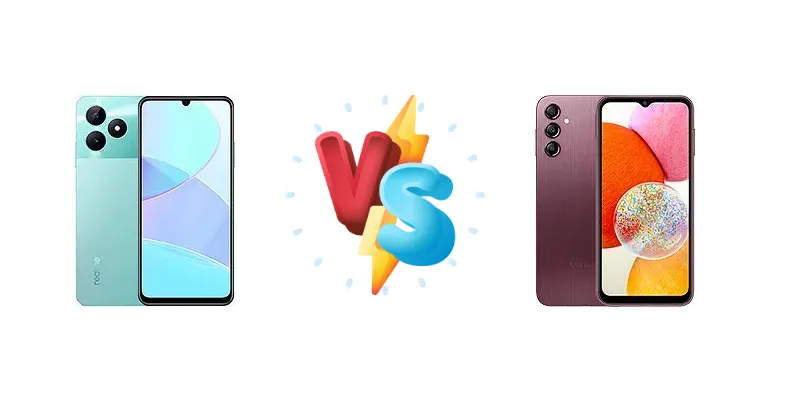
The sub-$200 smartphone market is fiercely competitive. The Realme C51 and Samsung Galaxy A14 both aim to deliver essential features at an accessible price point, but they take different approaches. The C51 prioritizes fast charging and a streamlined experience, while the A14 offers a choice of chipsets and Samsung’s established software ecosystem. This comparison dissects their key differences to help you choose the right device.
🏆 Quick Verdict
For most users, the Realme C51 offers a more compelling package. Its 33W charging significantly outperforms the Galaxy A14’s 15W, and the Unisoc Tiger T612 provides adequate performance for everyday tasks. While the A14 offers an Exynos variant, the base Helio G80 model doesn't justify the price difference for typical users.
| Network |
|---|
| 2G bands | GSM 850 / 900 / 1800 / 1900 | GSM 850 / 900 / 1800 / 1900 |
| 3G bands | HSDPA 850 / 900 / 2100 | HSDPA 850 / 900 / 2100 |
| 4G bands | 1, 3, 5, 8, 38, 40, 41 - Africa, India | 1, 3, 5, 7, 8, 20, 28, 38, 40, 41 |
| Speed | HSPA, LTE | HSPA, LTE |
| Technology | GSM / HSPA / LTE | GSM / HSPA / LTE |
| Launch |
|---|
| Announced | 2023, July 24 | 2023, February 28 |
| Status | Available. Released 2023, August | Available. Released 2023, March 27 |
| Body |
|---|
| Build | Glass front, plastic frame, plastic back | Glass front, plastic back, plastic frame |
| Dimensions | 167.2 x 76.7 x 8 mm (6.58 x 3.02 x 0.31 in) | 167.7 x 78 x 9.1 mm (6.60 x 3.07 x 0.36 in) |
| SIM | Nano-SIM + Nano-SIM | · Nano-SIM· Nano-SIM + Nano-SIM |
| Weight | 186 g (6.56 oz) | 201 g (7.09 oz) |
| Display |
|---|
| Resolution | 720 x 1600 pixels, 20:9 ratio (~260 ppi density) | 1080 x 2408 pixels, 20:9 ratio (~400 ppi density) |
| Size | 6.74 inches, 109.7 cm2 (~85.5% screen-to-body ratio) | 6.6 inches, 104.9 cm2 (~80.2% screen-to-body ratio) |
| Type | IPS LCD, 90Hz, 560 nits (peak) | PLS LCD |
| Platform |
|---|
| CPU | Octa-core (2x1.8 GHz Cortex-A75 & 6x1.8 GHz Cortex-A55) | Octa-core (2x2.0 GHz Cortex-A75 & 6x1.8 GHz Cortex-A55) - Version AOcta-core (4x2.0 GHz Cortex-A55 & 4x2.0 GHz Cortex-A55) - Version B |
| Chipset | Unisoc Tiger T612 (12 nm) | Mediatek MT6769 Helio G80 (12 nm) - Version AExynos 850 (8 nm) - Version B |
| GPU | Mali-G57 | Mali-G52 MC2 |
| OS | Android 13, Realme UI T | Android 13, upgradable to Android 15, One UI 7 |
| Memory |
|---|
| Card slot | microSDXC (dedicated slot) | microSDXC (dedicated slot) |
| Internal | 64GB 3GB RAM, 64GB 4GB RAM, 128GB 4GB RAM, 256GB 6GB RAM | 64GB 4GB RAM, 128GB 4GB RAM, 128GB 6GB RAM |
| Main Camera |
|---|
| Features | LED flash, HDR, panorama | LED flash, panorama, HDR |
| Single | 50 MP, f/1.8, 27mm (wide), 1/2.76", 0.64µm, PDAF
Auxiliary lens | 13 MP, f/2.0, (wide) |
| Triple | - | 50 MP, f/1.8, 26mm (wide), 1/2.75", 0.64µm, PDAF
5 MP, f/2.2, 17mm (ultrawide), 1/5.0", 1.12µm
2 MP (macro) |
| Video | 1080p@30fps | 1080p@30fps |
| Selfie camera |
|---|
| Features | HDR | - |
| Single | 5 MP, f/2.2, 28mm (wide), 1/5.0", 1.12µm | 13 MP, f/2.0, 26mm (wide), 1/3.1", 1.12µm |
| Video | 720p@30fps | 1080p@30fps |
| Sound |
|---|
| 3.5mm jack | - | Yes |
| 35mm jack | Yes | Yes |
| Loudspeaker | Yes | Yes |
| Comms |
|---|
| Bluetooth | 5.0, A2DP, LE | 5.1 or 5.3, A2DP, LE |
| NFC | Yes, 360˚ (market/region dependent) | Yes (market/region dependent) |
| Positioning | GPS, GLONASS, GALILEO | GPS, GALILEO, GLONASS, BDS, QZSS |
| Radio | Unspecified | Unspecified |
| USB | USB Type-C 2.0, OTG | USB Type-C 2.0 |
| WLAN | Wi-Fi 802.11 a/b/g/n/ac, dual-band | Wi-Fi 802.11 a/b/g/n/ac, dual-band, Wi-Fi Direct |
| Features |
|---|
| Sensors | Fingerprint (side-mounted), accelerometer, proximity, compass | Fingerprint (side-mounted), accelerometer, proximity, compass |
| Battery |
|---|
| Charging | 33W wired, 0-50% in 28 min | 15W wired |
| Type | 5000 mAh | Li-Po 5000 mAh |
| Misc |
|---|
| Colors | Mint Green, Carbon Black | Black, Dark Red, Silver, Green |
| Models | RMX3830 | SM-A145F, SM-A145F/DSN, SM-A145M, SM-A145M/DS, SM-A145P, SM-A145R |
| Price | About 410 EUR | € 85.76 / $ 147.60 / £ 79.95 |
| SAR | 1.18 W/kg (head) 0.78 W/kg (body) | - |
| SAR EU | - | 0.46 W/kg (head) 1.37 W/kg (body) |
Realme C51
- Significantly faster 33W charging
- Potentially more responsive performance with the A75 cores
- More affordable price point
- Less established brand reputation
- Unisoc chipset may have limited software support
Samsung Galaxy A14
- Samsung’s One UI software experience
- Potential for better efficiency with the Exynos 850 variant
- Larger screen size (likely)
- Slow 15W charging
- Helio G80 variant offers limited performance gains
- Higher price compared to the Realme C51
Display Comparison
Neither device boasts a standout display. Both utilize 12nm chipsets, suggesting a focus on cost optimization over premium display features. While specific display specs (resolution, brightness) aren't provided, the Galaxy A14's larger size likely offers a more immersive viewing experience. However, the Realme C51’s display is likely to be more power efficient due to the less demanding chipset. The absence of high refresh rates on either device indicates a focus on battery conservation.
Camera Comparison
Camera performance is likely similar, given the budget nature of both devices. Without specific sensor details, it’s safe to assume both rely on primary sensors adequate for daylight photography. The inclusion of a 2MP macro camera on the A14 is largely a marketing tactic, offering limited practical benefit. Image processing will likely differ, with Samsung’s software potentially offering more scene optimization, but the core image quality will be dictated by the sensor and lens quality – details not provided in the context data. The A14’s potential for better image processing is offset by the C51’s faster chipset, which could lead to quicker image capture and processing times.
Performance
The performance gap hinges on the chipset. The Realme C51’s Unisoc Tiger T612, built on a 12nm process, features a dual-core Cortex-A75 setup paired with six Cortex-A55 cores. The Samsung Galaxy A14 presents a split: the Helio G80 (also 12nm) version and the more efficient Exynos 850 (8nm) version. The Exynos 850, with its octa-core Cortex-A55 configuration, is geared towards sustained performance and efficiency, while the Helio G80 prioritizes burst performance. The A75 cores in the C51 and G80 A14 offer a performance boost over the A55 cores, but the 8nm process of the Exynos 850 gives it a clear advantage in thermal management and power efficiency. Users prioritizing gaming should seek out the A14 with the Exynos 850.
Battery Life
The Realme C51’s 33W charging is a significant advantage. Achieving 0-50% charge in 28 minutes is considerably faster than the Galaxy A14’s 15W charging. While battery capacity isn’t specified, the faster charging speed mitigates any potential capacity difference. The more efficient Exynos 850 in the A14 (if equipped) will contribute to better battery life, but the slower charging will require longer periods plugged in. For users who frequently need to top up their phone quickly, the C51 is the clear winner.
Buying Guide
Buy the Realme C51 if you prioritize fast charging, need a phone for basic tasks like social media and messaging, and want the quickest top-up times. Buy the Samsung Galaxy A14 if you prefer Samsung’s One UI software, potentially need the larger screen, and are willing to trade charging speed for brand familiarity – *specifically* if you can find a model with the Exynos 850 chipset.
Frequently Asked Questions
❓ Does the Samsung Galaxy A14 with the Helio G80 chipset overheat during prolonged gaming sessions?
The Helio G80, being a 12nm chip, is prone to thermal throttling under sustained load. While it can handle casual gaming, extended gaming sessions may result in noticeable performance drops as the phone attempts to manage heat. The Exynos 850 variant, built on an 8nm process, offers significantly better thermal management.
❓ Is the 33W charging on the Realme C51 compatible with Power Delivery (PD) chargers?
While Realme doesn't explicitly advertise PD support for the C51, its USB-C port is likely compatible with PD chargers, allowing for faster charging speeds than standard 5W chargers. However, the phone will only draw up to 33W, even if a higher wattage PD charger is used.
❓ How does the software experience differ between Realme UI and Samsung One UI?
Samsung’s One UI is known for its feature-rich interface and extensive customization options, but can feel bloated to some users. Realme UI offers a cleaner, more streamlined experience with a focus on speed and simplicity. Samsung generally provides longer software support, but Realme has been improving its update cadence.
❓ Is the 2MP macro camera on the Samsung Galaxy A14 worth using?
Generally, 2MP macro cameras on budget phones offer limited image quality. They often lack detail and struggle in low-light conditions. While they can be fun to experiment with, don't expect professional-level macro photography.