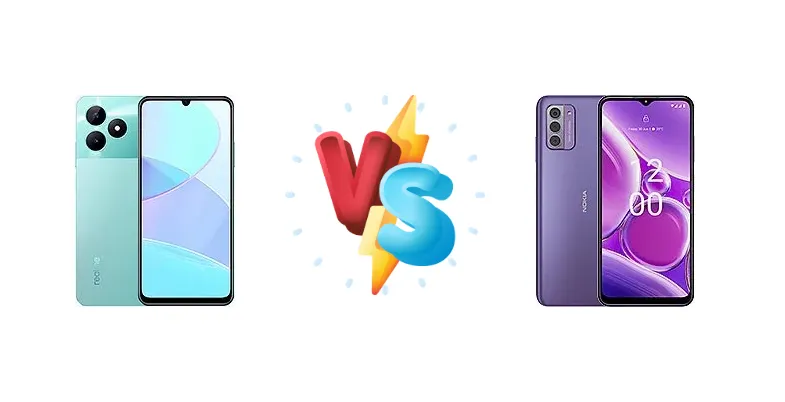
The sub-$200 smartphone market is fiercely competitive, with the Realme C51 and Nokia G42 vying for attention. Both offer 5G connectivity, but they take distinctly different approaches to chipset selection and feature prioritization. This comparison dissects the core differences between the Unisoc-powered Realme C51 and the Snapdragon 480+-equipped Nokia G42, helping you determine which device best suits your needs.
🏆 Quick Verdict
For most users, the Nokia G42 emerges as the stronger choice. While the Realme C51 boasts faster 33W charging, the Nokia G42’s more efficient Snapdragon 480+ chipset, built on an 8nm process, provides a noticeable performance advantage and potentially better long-term software support, making it a more well-rounded package.
| Network |
|---|
| 2G bands | GSM 850 / 900 / 1800 / 1900 | GSM 850 / 900 / 1800 / 1900 |
| 3G bands | HSDPA 850 / 900 / 2100 | HSDPA 850 / 900 / 1700(AWS) / 1900 / 2100 |
| 4G bands | 1, 3, 5, 8, 38, 40, 41 - Africa, India | 1, 2, 3, 4, 5, 7, 8, 12, 17, 13, 20, 28, 38, 39, 40, 41, 66 |
| 5G bands | - | 1, 2, 3, 5, 7, 8, 28, 40, 41, 66, 77, 78 SA/NSA |
| Speed | HSPA, LTE | HSPA, LTE, 5G |
| Technology | GSM / HSPA / LTE | GSM / HSPA / LTE / 5G |
| Launch |
|---|
| Announced | 2023, July 24 | 2023, June 28 |
| Status | Available. Released 2023, August | Available. Released 2023, June 28 |
| Body |
|---|
| Build | Glass front, plastic frame, plastic back | Glass front, plastic back, plastic frame |
| Dimensions | 167.2 x 76.7 x 8 mm (6.58 x 3.02 x 0.31 in) | 165 x 75.8 x 8.6 mm (6.50 x 2.98 x 0.34 in) |
| SIM | Nano-SIM + Nano-SIM | · Nano-SIM· Nano-SIM + Nano-SIM |
| Weight | 186 g (6.56 oz) | 193.8 g (6.84 oz) |
| Display |
|---|
| Protection | - | Corning Gorilla Glass 3 |
| Resolution | 720 x 1600 pixels, 20:9 ratio (~260 ppi density) | 720 x 1612 pixels, 20:9 ratio (~269 ppi density) |
| Size | 6.74 inches, 109.7 cm2 (~85.5% screen-to-body ratio) | 6.56 inches, 103.4 cm2 (~82.7% screen-to-body ratio) |
| Type | IPS LCD, 90Hz, 560 nits (peak) | IPS LCD, 90Hz, 450 nits (typ), 560 nits (peak) |
| Platform |
|---|
| CPU | Octa-core (2x1.8 GHz Cortex-A75 & 6x1.8 GHz Cortex-A55) | Octa-core (2x2.2 GHz Kryo 460 & 6x1.8 GHz Kryo 460) |
| Chipset | Unisoc Tiger T612 (12 nm) | Qualcomm SM4350-AC Snapdragon 480+ 5G (8 nm) |
| GPU | Mali-G57 | Adreno 619 |
| OS | Android 13, Realme UI T | Android 13, upgradable to Android 14 |
| Memory |
|---|
| Card slot | microSDXC (dedicated slot) | microSDXC |
| Internal | 64GB 3GB RAM, 64GB 4GB RAM, 128GB 4GB RAM, 256GB 6GB RAM | 128GB 4GB RAM, 128GB 6GB RAM, 256GB 8GB RAM |
| Main Camera |
|---|
| Features | LED flash, HDR, panorama | LED flash, HDR, panorama |
| Single | 50 MP, f/1.8, 27mm (wide), 1/2.76", 0.64µm, PDAF
Auxiliary lens | - |
| Triple | - | 50 MP, f/1.8, (wide), AF
2 MP (macro)
Auxiliary lens |
| Video | 1080p@30fps | 1080p@30fps |
| Selfie camera |
|---|
| Features | HDR | - |
| Single | 5 MP, f/2.2, 28mm (wide), 1/5.0", 1.12µm | 8 MP |
| Video | 720p@30fps | Yes |
| Sound |
|---|
| 35mm jack | Yes | Yes |
| Loudspeaker | Yes | Yes |
| Comms |
|---|
| Bluetooth | 5.0, A2DP, LE | 5.1, A2DP, LE |
| NFC | Yes, 360˚ (market/region dependent) | Yes (market/region dependent) |
| Positioning | GPS, GLONASS, GALILEO | GPS, GLONASS, GALILEO, BDS |
| Radio | Unspecified | FM radio |
| USB | USB Type-C 2.0, OTG | USB Type-C 2.0, OTG |
| WLAN | Wi-Fi 802.11 a/b/g/n/ac, dual-band | Wi-Fi 802.11 a/b/g/n/ac/6, dual-band |
| Features |
|---|
| Sensors | Fingerprint (side-mounted), accelerometer, proximity, compass | Fingerprint (side-mounted), accelerometer, proximity, compass |
| Battery |
|---|
| Charging | 33W wired, 0-50% in 28 min | 20W wired, PD3.0, QC3 |
| Type | 5000 mAh | Li-Po 5000 mAh |
| Misc |
|---|
| Colors | Mint Green, Carbon Black | Gray, Purple, Red |
| Models | RMX3830 | - |
| Price | About 410 EUR | $ 545.00 / £ 124.99 |
| SAR | 1.18 W/kg (head) 0.78 W/kg (body) | - |
Realme C51
- Faster 33W wired charging
- Potentially lower price point
- Simple and straightforward user experience
- Less powerful Unisoc Tiger T612 chipset
- Likely inferior thermal management
- Potentially limited software support
Nokia G42
- More powerful Snapdragon 480+ chipset
- Better power efficiency and thermal management
- Potential for longer software support from Nokia
- Slower 20W wired charging
- May be slightly more expensive
- Nokia's software update history can be inconsistent
Display Comparison
Neither device boasts a standout display. Both likely utilize LCD panels, a common cost-saving measure in this segment. However, details like peak brightness and color gamut coverage are missing. The focus here is on the internals. The Realme C51’s display specs are unavailable, but given its price point, it’s unlikely to surpass the Nokia G42 in quality. The Nokia G42’s display is adequate for everyday use, but neither phone will impress display enthusiasts.
Camera Comparison
Camera performance is likely to be similar, with both phones targeting the entry-level segment. Details regarding sensor sizes and image processing are absent. However, the Nokia G42’s Snapdragon ISP (Image Signal Processor) generally offers better image quality and processing capabilities than those found in Unisoc chipsets. It’s reasonable to expect slightly better dynamic range and low-light performance from the Nokia G42. The prevalence of 2MP macro lenses on both devices suggests they are largely marketing features and offer limited practical benefit.
Performance
The core difference lies in the chipsets. The Nokia G42’s Qualcomm Snapdragon 480+ (8nm) is a clear step up from the Realme C51’s Unisoc Tiger T612 (12nm). The 8nm process node translates to better power efficiency and thermal management, meaning the Nokia G42 is less likely to throttle under sustained load. While both CPUs feature a similar core configuration (2x performance cores + 6x efficiency cores), the Snapdragon 480+’s Kryo 460 cores operate at a higher clock speed (2.2 GHz vs 1.8 GHz), resulting in snappier performance in applications and games. The Realme C51 will handle basic tasks, but the Nokia G42 offers a more fluid experience, especially when multitasking or playing demanding games.
Battery Life
The Realme C51’s 33W wired charging is its standout feature, promising a 0-50% charge in just 28 minutes. The Nokia G42, with its 20W charging and support for PD3.0 and QC3, is slower. However, the Snapdragon 480+’s superior power efficiency may offset the difference in charging speed. The Nokia G42 is likely to offer comparable, if not better, battery life despite potentially having a similar capacity battery (spec not provided). The faster charging of the Realme C51 is ideal for users who need a quick power boost, while the Nokia G42 prioritizes overall efficiency.
Buying Guide
Buy the Realme C51 if you prioritize extremely fast charging and are primarily focused on basic smartphone tasks like calling, texting, and light social media use. The 33W charging is a significant benefit for those who frequently top up their phones. Buy the Nokia G42 if you value smoother performance for multitasking and gaming, benefit from 5G connectivity, and appreciate the potential for longer software support from Nokia, despite the slower 20W charging.
Frequently Asked Questions
❓ Will the Unisoc Tiger T612 in the Realme C51 struggle with demanding games like PUBG Mobile?
Yes, the Unisoc Tiger T612 is a budget chipset and will likely require significant graphics settings reductions to achieve playable frame rates in PUBG Mobile. Expect noticeable lag and stuttering, especially in intense firefights. The Nokia G42’s Snapdragon 480+ will provide a smoother gaming experience, though it’s still not a gaming powerhouse.
❓ Does the Nokia G42 support carrier aggregation for improved 5G speeds?
The Snapdragon 480+ generally supports carrier aggregation, which can significantly improve 5G download and upload speeds in areas with good network coverage. However, specific carrier aggregation band support varies by region and carrier. Check with your mobile provider to confirm compatibility.
❓ How long can I expect software updates to be supported on the Nokia G42?
Nokia typically promises at least 2 years of software updates and 3 years of security patches for its smartphones. While this is a good commitment, Nokia’s update rollout has sometimes been delayed. The Realme C51’s software support timeline is less clear, as Realme’s update policies can vary.
❓ Is the 20W charging on the Nokia G42 slow compared to other phones?
While 20W is slower than the 33W on the Realme C51, it's still a respectable charging speed for a budget phone. It will take longer to fully charge, but the Snapdragon 480+'s efficiency means you may not need to charge as frequently.