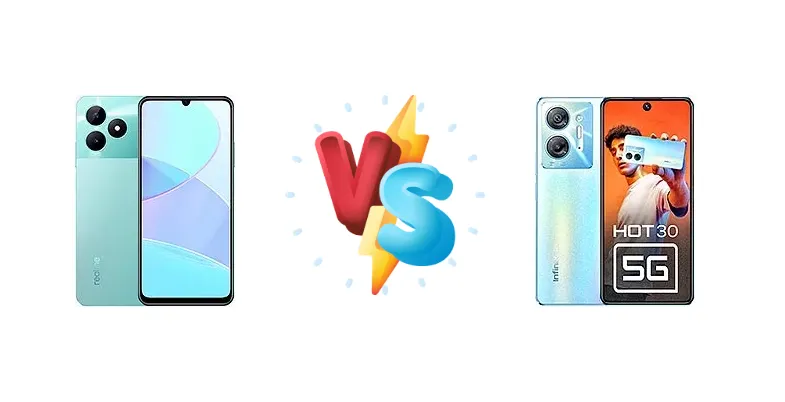
The sub-$200 smartphone market is fiercely competitive, and the Realme C51 and Infinix Hot 30 5G are two contenders vying for dominance. While both offer 5G connectivity, they take distinctly different approaches to achieving it, primarily through their chipset choices. This comparison dissects those differences, focusing on performance, charging, and the user experience each phone delivers.
🏆 Quick Verdict
For the average user prioritizing consistent performance and future-proofing, the Infinix Hot 30 5G is the better choice. Its MediaTek Dimensity 6020, built on a more efficient 7nm process, provides a noticeable performance uplift over the Realme C51’s Unisoc Tiger T612, despite the Realme’s faster 33W charging.
| Network |
|---|
| 2G bands | GSM 850 / 900 / 1800 / 1900 | GSM 850 / 900 / 1800 / 1900 |
| 3G bands | HSDPA 850 / 900 / 2100 | HSDPA 850 / 900 / 1700(AWS) / 1900 / 2100 |
| 4G bands | 1, 3, 5, 8, 38, 40, 41 - Africa, India | LTE |
| 5G bands | - | 1, 3, 5, 8, 28, 38, 40, 41, 77, 78 SA/NSA |
| Speed | HSPA, LTE | HSPA, LTE, 5G |
| Technology | GSM / HSPA / LTE | GSM / HSPA / LTE / 5G |
| Launch |
|---|
| Announced | 2023, July 24 | 2023, July 14 |
| Status | Available. Released 2023, August | Available. Released 2023, July 18 |
| Body |
|---|
| Build | Glass front, plastic frame, plastic back | Glass front, plastic frame, plastic back |
| Dimensions | 167.2 x 76.7 x 8 mm (6.58 x 3.02 x 0.31 in) | 168.5 x 76.5 x 9.2 mm (6.63 x 3.01 x 0.36 in) |
| SIM | Nano-SIM + Nano-SIM | Nano-SIM + Nano-SIM |
| Weight | 186 g (6.56 oz) | 215 g (7.58 oz) |
| Display |
|---|
| Resolution | 720 x 1600 pixels, 20:9 ratio (~260 ppi density) | 1080 x 2460 pixels (~396 ppi density) |
| Size | 6.74 inches, 109.7 cm2 (~85.5% screen-to-body ratio) | 6.78 inches, 109.2 cm2 (~84.7% screen-to-body ratio) |
| Type | IPS LCD, 90Hz, 560 nits (peak) | IPS LCD, 120Hz, 580 nits (peak) |
| Platform |
|---|
| CPU | Octa-core (2x1.8 GHz Cortex-A75 & 6x1.8 GHz Cortex-A55) | Octa-core (2x2.2 GHz Cortex-A76 & 6x2.0 GHz Cortex-A55) |
| Chipset | Unisoc Tiger T612 (12 nm) | Mediatek Dimensity 6020 (7 nm) |
| GPU | Mali-G57 | Mali-G57 MC2 |
| OS | Android 13, Realme UI T | Android 13, XOS 13 |
| Memory |
|---|
| Card slot | microSDXC (dedicated slot) | microSDXC (dedicated slot) |
| Internal | 64GB 3GB RAM, 64GB 4GB RAM, 128GB 4GB RAM, 256GB 6GB RAM | 128GB 4GB RAM, 128GB 8GB RAM |
| Main Camera |
|---|
| Features | LED flash, HDR, panorama | Quad-LED flash, HDR, panorama |
| Single | 50 MP, f/1.8, 27mm (wide), 1/2.76", 0.64µm, PDAF
Auxiliary lens | 50 MP, f/1.6, (wide), 1/2.55", AF
Auxiliary lens |
| Video | 1080p@30fps | 1440p@30fps, 1080p@30fps |
| Selfie camera |
|---|
| Features | HDR | Dual-LED flash |
| Single | 5 MP, f/2.2, 28mm (wide), 1/5.0", 1.12µm | 8 MP, f/2.0, (wide) |
| Video | 720p@30fps | 1080p@30fps |
| Sound |
|---|
| 35mm jack | Yes | Yes |
| Loudspeaker | Yes | Yes, with stereo speakers |
| Comms |
|---|
| Bluetooth | 5.0, A2DP, LE | 5.1, A2DP, LE |
| NFC | Yes, 360˚ (market/region dependent) | No |
| Positioning | GPS, GLONASS, GALILEO | GPS, GLONASS, GALILEO, BDS |
| Radio | Unspecified | FM radio |
| USB | USB Type-C 2.0, OTG | USB Type-C 2.0 |
| WLAN | Wi-Fi 802.11 a/b/g/n/ac, dual-band | Wi-Fi 802.11 a/b/g/n/ac, dual-band |
| Features |
|---|
| Sensors | Fingerprint (side-mounted), accelerometer, proximity, compass | Fingerprint (side-mounted), accelerometer, proximity, compass |
| Battery |
|---|
| Charging | 33W wired, 0-50% in 28 min | 18W wired |
| Type | 5000 mAh | 5000 mAh |
| Misc |
|---|
| Colors | Mint Green, Carbon Black | Knight Black, Aurora Blue |
| Models | RMX3830 | X6832 |
| Price | About 410 EUR | About 140 EUR |
| SAR | 1.18 W/kg (head) 0.78 W/kg (body) | - |
Realme C51
- Faster 33W charging for quick power-ups
- Potentially lower price point
- Unisoc chipset offers decent performance for basic tasks
- Less powerful Unisoc Tiger T612 chipset
- 12nm process less efficient than 7nm
- Likely to struggle with demanding games and apps
Infinix Hot 30 5G
- More powerful MediaTek Dimensity 6020 chipset
- 7nm process for better efficiency and sustained performance
- Smoother multitasking and gaming experience
- Slower 18W charging
- Potentially slightly higher price
- May not be significantly better in extremely light usage scenarios
Display Comparison
Neither device boasts a standout display. Both are likely to feature LCD panels, common in this price bracket. However, detailed specs like resolution and peak brightness are missing. The focus here is on the internal hardware, as display quality is often a secondary consideration for budget buyers. Bezels are expected to be relatively thick on both models, and color accuracy will likely be standard for the segment.
Camera Comparison
Without detailed camera specifications, a direct comparison is difficult. However, it’s safe to assume both phones will feature a primary camera and potentially a depth or macro sensor. The image processing capabilities of the Dimensity 6020 in the Infinix Hot 30 5G may offer slightly better image quality, particularly in low-light conditions, due to its more advanced ISP (Image Signal Processor). The Realme C51 will likely rely more heavily on software processing to compensate for its less powerful chipset.
Performance
The core difference lies in the chipsets. The Infinix Hot 30 5G’s MediaTek Dimensity 6020 (7nm) is a clear upgrade over the Realme C51’s Unisoc Tiger T612 (12nm). The 7nm process allows for greater transistor density and improved power efficiency, translating to better sustained performance and less heat generation. The Dimensity 6020’s CPU configuration – 2x2.2 GHz Cortex-A76 & 6x2.0 GHz Cortex-A55 – also offers a clock speed advantage over the C51’s 2x1.8 GHz Cortex-A75 & 6x1.8 GHz Cortex-A55. This means faster app loading times, smoother multitasking, and a more responsive overall experience. While both phones likely feature similar RAM configurations, the superior chipset will be the bottleneck for the C51.
Battery Life
The Realme C51’s 33W wired charging is a significant advantage, promising a 0-50% charge in just 28 minutes. The Infinix Hot 30 5G is limited to 18W charging, which will take considerably longer. However, the Dimensity 6020’s superior power efficiency may offset some of this difference. The actual battery capacity of both devices is unknown, but the faster charging of the C51 will be appealing to users who prioritize quick top-ups. The 7nm process of the Dimensity 6020 should also contribute to better battery life during typical usage.
Buying Guide
Buy the Realme C51 if you prioritize extremely fast charging and are primarily focused on basic smartphone tasks like calling, texting, and light social media use. The 33W charging will get you back up and running quickly. Buy the Infinix Hot 30 5G if you value smoother multitasking, a more responsive user experience, and better long-term performance, especially if you enjoy mobile gaming or demanding applications. The Dimensity 6020 offers a significant advantage in these areas.
Frequently Asked Questions
❓ Will the Dimensity 6020 in the Infinix Hot 30 5G overheat during prolonged gaming sessions?
The Dimensity 6020’s 7nm process is designed for improved thermal efficiency compared to the Realme C51’s 12nm Unisoc Tiger T612. While some throttling is inevitable, the Hot 30 5G is likely to maintain higher sustained performance for longer periods without significant overheating.
❓ Is the 33W charging on the Realme C51 a game-changer, or is the slower 18W charging on the Infinix Hot 30 5G a dealbreaker?
The 33W charging is a definite advantage for the Realme C51, especially for users who frequently need to top up their battery quickly. However, the Dimensity 6020’s superior power efficiency in the Infinix Hot 30 5G means you may not need to charge as often, mitigating the slower charging speed.
❓ How much of a real-world performance difference will I notice between the Unisoc T612 and the Dimensity 6020?
You'll notice a significant difference in multitasking and app loading times. The Dimensity 6020 will handle more demanding apps and games with greater ease, resulting in a smoother and more responsive user experience. The Unisoc T612 is adequate for basic tasks, but will struggle with heavier workloads.