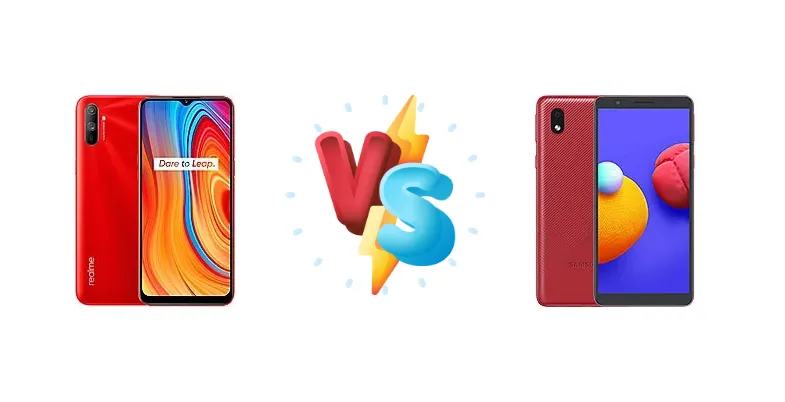
The Realme C3i and Samsung Galaxy A01 Core represent the extreme end of the budget smartphone spectrum. Both aim to deliver basic smartphone functionality at the lowest possible price, but they take drastically different approaches to achieving this. This comparison dissects their core components to determine which offers the best value for users prioritizing affordability.
🏆 Quick Verdict
For the average user, the Realme C3i is the clear winner. Its MediaTek Helio G70 chipset provides a significantly more responsive experience than the Galaxy A01 Core’s aging MT6739, making it better suited for multitasking and even light gaming. While both phones are basic, the C3i offers a tangible performance boost.
| Network |
|---|
| 2G bands | GSM 850 / 900 / 1800 / 1900 | GSM 850 / 900 / 1800 / 1900 |
| 3G bands | HSDPA 850 / 900 / 2100 | HSDPA 850 / 900 / 2100 |
| 4G bands | 1, 3, 5, 8, 38, 40, 41 | 1, 3, 5, 7, 8, 20, 28, 38, 40, 41 |
| Speed | HSPA 42.2/11.5 Mbps, LTE (2CA) Cat6 300/75 Mbps | HSPA 21.1/5.76 Mbps, LTE |
| Technology | GSM / HSPA / LTE | GSM / HSPA / LTE |
| Launch |
|---|
| Announced | 2020, June 24. Released 2020, July 03 | 2020, July 21. Released 2020, August 06 |
| Status | Discontinued | Discontinued |
| Body |
|---|
| Build | Glass front (Gorilla Glass 3), plastic back, plastic frame | Plastic back, plastic frame |
| Dimensions | 164.4 x 75 x 9 mm (6.47 x 2.95 x 0.35 in) | 141.7 x 67.5 x 8.6 mm (5.58 x 2.66 x 0.34 in) |
| SIM | Nano-SIM + Nano-SIM | · Nano-SIM· Nano-SIM + Nano-SIM |
| Weight | 195 g (6.88 oz) | 150 g (5.29 oz) |
| | Weather-sealed ports & loudspeaker | - |
| Display |
|---|
| Protection | Corning Gorilla Glass 3 | - |
| Resolution | 720 x 1600 pixels, 20:9 ratio (~270 ppi density) | 720 x 1480 pixels, 18.5:9 ratio (~311 ppi density) |
| Size | 6.5 inches, 102.0 cm2 (~82.7% screen-to-body ratio) | 5.3 inches, 71.3 cm2 (~74.5% screen-to-body ratio) |
| Type | IPS LCD, 480 nits (typ) | PLS LCD |
| Platform |
|---|
| CPU | Octa-core (2x2.0 GHz Cortex-A75 & 6x1.7 GHz Cortex-A55) | Quad-core 1.5 GHz Cortex-A53 |
| Chipset | Mediatek MT6769V/CB Helio G70 (12 nm) | Mediatek MT6739 (28 nm) |
| GPU | Mali-G52 2EEMC2 | PowerVR GE8100 |
| OS | Android 10, Realme UI | Android 10 (Go edition) |
| Memory |
|---|
| Card slot | microSDXC (dedicated slot) | microSDXC (dedicated slot) |
| Internal | 32GB 2GB RAM | 16GB 1GB RAM, 16GB 2GB RAM, 32GB 2GB RAM |
| | eMMC 5.1 | eMMC 5.1 |
| Main Camera |
|---|
| Dual | 12 MP, f/1.8, 28mm (wide), 1/2.8", 1.25µm, PDAF
Auxiliary lens | - |
| Features | LED flash, HDR, panorama | LED flash |
| Single | - | 8 MP, f/2.2, AF |
| Video | 1080p@30fps, 720p@120fps | 1080p@30fps |
| Selfie camera |
|---|
| Features | HDR, panorama | - |
| Single | 5 MP, f/2.4, 27mm (wide), 1/5.0", 1.12µm | 5 MP, f/2.4 |
| Video | 1080p@30fps | - |
| Sound |
|---|
| 3.5mm jack | Yes | Yes |
| 35mm jack | Yes | Yes |
| Loudspeaker | Yes | Yes |
| Comms |
|---|
| Bluetooth | 5.0, A2DP, LE, aptX | 5.0, A2DP, LE |
| NFC | No | No |
| Positioning | GPS, GLONASS, BDS | GPS |
| Radio | FM radio | FM radio |
| USB | microUSB 2.0, OTG | microUSB 2.0 |
| WLAN | - | Wi-Fi 802.11 b/g/n, Wi-Fi Direct |
| Features |
|---|
| Sensors | Accelerometer, proximity, compass | Accelerometer |
| Battery |
|---|
| Charging | 10W wired | - |
| Type | 5000 mAh | Li-Ion 3000 mAh |
| Misc |
|---|
| Colors | Frozen Blue, Blazing Red | Black, Blue, Red |
| Models | RMX2027, RMX2020 | SM-A013F, SM-A013F/DS, SM-A013G, SM-A013G/DS, SM-A013M |
| Price | About 100 EUR | About 150 EUR |
| SAR EU | - | 0.64 W/kg (head) 1.18 W/kg (body) |
| Tests |
|---|
| Performance |
AnTuTu: 192223 (v8)
GeekBench: 1262 (v5.1)
GFXBench: 15fps (ES 3.1 onscreen) | - |
Realme C3i
- Significantly faster processor (Helio G70)
- More efficient 12nm process
- Better multitasking capabilities
- 10W charging is relatively slow
- Likely similar display quality to A01 Core
Samsung Galaxy A01 Core
- Extremely affordable
- Potentially slightly longer battery life under minimal use
- Simple and easy to use
- Slow and outdated processor (MT6739)
- Inefficient 28nm process
- Limited multitasking capabilities
Display Comparison
Neither device boasts a standout display. Both are likely to feature LCD panels, though specific details like resolution and brightness are not provided. However, the focus here isn't display quality, but the underlying processing power needed to *drive* a display. The C3i's more capable GPU will handle UI animations and video playback with greater fluidity, even if the panel itself is similar in quality to the A01 Core's.
Camera Comparison
Camera performance on both devices is expected to be basic. Without specific sensor details, it's difficult to make a precise comparison. However, the C3i’s more powerful ISP (Image Signal Processor), integrated within the Helio G70, will likely result in better image processing and potentially improved low-light performance compared to the A01 Core. The A01 Core's camera is likely limited by the processing capabilities of the MT6739.
Performance
The performance gap is the most significant differentiator. The Realme C3i’s MediaTek Helio G70, built on a 12nm process, features an octa-core configuration with a mix of Cortex-A75 and A55 cores clocked up to 2.0 GHz. This is a substantial leap over the Samsung Galaxy A01 Core’s MediaTek MT6739, a quad-core processor using the older Cortex-A53 architecture and a less efficient 28nm process. The Helio G70’s architecture allows for faster processing speeds and improved multitasking capabilities, while the 28nm process of the MT6739 will likely result in lower efficiency and potentially more heat generation under load. This translates to a noticeably snappier experience on the C3i.
Battery Life
Both phones feature modest battery capacities, though specific numbers are not provided. The Realme C3i’s 10W charging is standard for this price point. The MT6739 in the A01 Core is less power-hungry, potentially leading to slightly longer battery life under *very* light usage. However, the C3i’s more efficient Helio G70 will likely offset this difference with more moderate use, and the faster processor will allow for quicker task completion, reducing overall screen-on time.
Buying Guide
Buy the Realme C3i if you need a phone capable of handling more than just basic calls and texts. Its more powerful processor makes it suitable for social media, streaming video, and casual gaming. Buy the Samsung Galaxy A01 Core if your primary need is a very basic, reliable phone for essential communication and you prioritize simplicity above all else, and are on an extremely tight budget.
Frequently Asked Questions
❓ Will the Realme C3i handle popular apps like WhatsApp and Facebook smoothly?
Yes, the Helio G70 chipset in the Realme C3i is more than capable of running apps like WhatsApp and Facebook without significant lag. The A01 Core’s MT6739 may struggle with these apps when multiple are open simultaneously.
❓ Can the Samsung Galaxy A01 Core play basic games like Candy Crush?
The Samsung Galaxy A01 Core can play very simple games like Candy Crush, but performance will be limited. More demanding games will likely experience significant lag and may be unplayable. The Realme C3i offers a better gaming experience, even for casual titles.
❓ Is the difference in processor speed noticeable in everyday use?
Absolutely. The Realme C3i’s Helio G70 provides a much snappier experience when opening apps, browsing the web, and switching between tasks. The A01 Core’s MT6739 feels noticeably slower and less responsive.
❓ Does the Realme C3i support fast charging?
No, the Realme C3i supports only 10W wired charging, which is standard for this price range. While not 'fast' charging, it's sufficient for topping up the battery overnight.