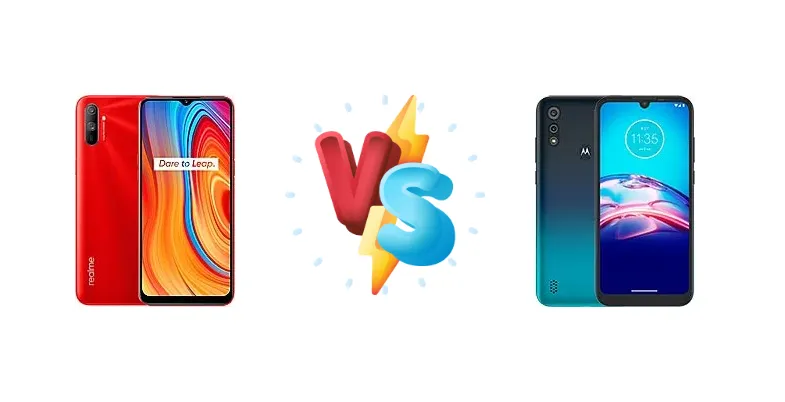
The Realme C3i and Motorola Moto E6s (2020) represent the ultra-budget end of the smartphone spectrum. Both aim to deliver essential functionality at the lowest possible price, but they take different approaches to achieving this. The C3i prioritizes processing power with a newer MediaTek Helio G70, while the Moto E6s relies on the older, more power-efficient Helio P22. This comparison will dissect the key differences to help you determine which device best suits your needs.
🏆 Quick Verdict
For the average user prioritizing responsiveness and occasional gaming, the Realme C3i is the clear winner. Its Helio G70 chipset offers a significant performance uplift over the Moto E6s’ Helio P22, making it noticeably smoother for everyday tasks and capable of handling more demanding applications. However, the Moto E6s may appeal to those seeking maximum battery life and minimal performance demands.
| Network |
|---|
| 2G bands | GSM 850 / 900 / 1800 / 1900 | GSM 850 / 900 / 1800 / 1900 |
| 3G bands | HSDPA 850 / 900 / 2100 | HSDPA 850 / 900 / 1900 / 2100 |
| 4G bands | 1, 3, 5, 8, 38, 40, 41 | 1, 3, 5, 7, 8, 20, 38, 40, 41 |
| Speed | HSPA 42.2/11.5 Mbps, LTE (2CA) Cat6 300/75 Mbps | HSPA, LTE |
| Technology | GSM / HSPA / LTE | GSM / HSPA / LTE |
| Launch |
|---|
| Announced | 2020, June 24. Released 2020, July 03 | 2020, March 17. Released 2020, April 27 |
| Status | Discontinued | Discontinued |
| Body |
|---|
| Build | Glass front (Gorilla Glass 3), plastic back, plastic frame | Glass front, plastic back, plastic frame |
| Dimensions | 164.4 x 75 x 9 mm (6.47 x 2.95 x 0.35 in) | 155.6 x 73 x 8.5 mm (6.13 x 2.87 x 0.33 in) |
| SIM | Nano-SIM + Nano-SIM | · Nano-SIM· Nano-SIM + Nano-SIM |
| Weight | 195 g (6.88 oz) | 160 g (5.64 oz) |
| | Weather-sealed ports & loudspeaker | Water-repellent coating |
| Display |
|---|
| Protection | Corning Gorilla Glass 3 | - |
| Resolution | 720 x 1600 pixels, 20:9 ratio (~270 ppi density) | 720 x 1560 pixels, 19.5:9 ratio (~282 ppi density) |
| Size | 6.5 inches, 102.0 cm2 (~82.7% screen-to-body ratio) | 6.1 inches, 91.3 cm2 (~80.4% screen-to-body ratio) |
| Type | IPS LCD, 480 nits (typ) | IPS LCD |
| Platform |
|---|
| CPU | Octa-core (2x2.0 GHz Cortex-A75 & 6x1.7 GHz Cortex-A55) | Octa-core 2.0 GHz Cortex-A53 |
| Chipset | Mediatek MT6769V/CB Helio G70 (12 nm) | Mediatek MT6762 Helio P22 (12 nm) |
| GPU | Mali-G52 2EEMC2 | PowerVR GE8320 |
| OS | Android 10, Realme UI | Android 9.0 (Pie) |
| Memory |
|---|
| Card slot | microSDXC (dedicated slot) | microSDXC (dedicated slot) |
| Internal | 32GB 2GB RAM | 32GB 2GB RAM, 32GB 4GB RAM, 64GB 2GB RAM, 64GB 4GB RAM |
| | eMMC 5.1 | eMMC 5.1 |
| Main Camera |
|---|
| Dual | 12 MP, f/1.8, 28mm (wide), 1/2.8", 1.25µm, PDAF
Auxiliary lens | 13 MP, f/2.2, 1/3.1", 1.12µm, PDAF
Auxiliary lens |
| Features | LED flash, HDR, panorama | LED flash, HDR, panorama |
| Single | - | 5 MP, AF |
| Video | 1080p@30fps, 720p@120fps | 1080p@30fps |
| Selfie camera |
|---|
| Features | HDR, panorama | HDR , panorama |
| Single | 5 MP, f/2.4, 27mm (wide), 1/5.0", 1.12µm | 5 MP, f/2.2, 1.12µm |
| Video | 1080p@30fps | 1080p@30fps |
| Sound |
|---|
| 3.5mm jack | Yes | Yes |
| 35mm jack | Yes | Yes |
| Loudspeaker | Yes | Yes |
| Comms |
|---|
| Bluetooth | 5.0, A2DP, LE, aptX | 4.2, A2DP, LE |
| NFC | No | No |
| Positioning | GPS, GLONASS, BDS | GPS, GLONASS |
| Radio | FM radio | FM radio |
| USB | microUSB 2.0, OTG | microUSB 2.0, OTG |
| WLAN | - | Wi-Fi 802.11 b/g/n |
| Features |
|---|
| Sensors | Accelerometer, proximity, compass | Fingerprint (rear-mounted), accelerometer, proximity |
| Battery |
|---|
| Charging | 10W wired | - |
| Stand-by | - | Up to 288 h (3G) |
| Talk time | - | Up to 10 h (3G) |
| Type | 5000 mAh | Li-Po 3000 mAh, removable |
| Misc |
|---|
| Colors | Frozen Blue, Blazing Red | Peacock Blue, Sunrise Red |
| Models | RMX2027, RMX2020 | XT2053, XT2053-2 |
| Price | About 100 EUR | About 240 EUR |
| SAR | - | 0.36 W/kg (head) 1.08 W/kg (body) |
| Tests |
|---|
| Performance |
AnTuTu: 192223 (v8)
GeekBench: 1262 (v5.1)
GFXBench: 15fps (ES 3.1 onscreen) | - |
Realme C3i
- Significantly faster processor (Helio G70)
- Better gaming performance
- More responsive user experience
- Potentially shorter battery life
- May run warmer under load
Motorola Moto E6s (2020)
- Longer battery life
- More power-efficient processor
- Lower price (potentially)
- Noticeably slower performance
- Struggles with multitasking and demanding apps
Display Comparison
Neither device boasts a standout display. Both likely utilize LCD panels, typical for this price bracket. The focus here isn't on visual fidelity, but on basic usability. Without specific display specs, it's reasonable to assume both offer similar resolutions (likely 720p+) and brightness levels. The Realme C3i’s slightly more powerful GPU *could* translate to smoother scrolling, but this is unlikely to be a dramatic difference. Bezels are expected to be substantial on both devices, maximizing screen real estate within a compact form factor.
Camera Comparison
Camera performance is likely to be similar in real-world usage, as both phones are expected to feature basic camera setups. Without detailed sensor information, it’s safe to assume both rely on primary sensors around 13MP. The Realme C3i *might* benefit from slightly better image processing capabilities due to its more powerful chipset, potentially resulting in marginally better dynamic range and noise reduction. However, don't expect flagship-level image quality from either device. Any additional sensors (depth, macro) are likely to be low-resolution and offer limited utility.
Performance
The core difference lies in the chipsets. The Realme C3i’s MediaTek Helio G70, built on a 12nm process, features an octa-core configuration with a distinct performance split: two Cortex-A75 cores clocked at 2.0 GHz for demanding tasks and six Cortex-A55 cores at 1.7 GHz for efficiency. This is a significant upgrade over the Motorola Moto E6s’ Helio P22, which uses eight Cortex-A53 cores all clocked at 2.0 GHz. While the P22’s core count is higher, the A53 architecture is less efficient and offers lower single-core performance. The G70’s architecture provides a substantial boost in CPU-intensive tasks and gaming, making the C3i far more capable of handling modern applications. The G70 also includes a more capable GPU, further widening the performance gap.
Battery Life
Both devices likely feature battery capacities around 4000-5000 mAh, typical for this segment. However, the Realme C3i’s more powerful processor will consume more power. The Moto E6s, with its less demanding Helio P22, will likely offer longer battery life on a single charge. Both phones utilize 10W wired charging, meaning charging times will be relatively slow – expect several hours to reach a full charge. The trade-off is clear: the C3i offers more performance at the cost of battery endurance, while the E6s prioritizes longevity.
Buying Guide
Buy the Realme C3i if you need a phone that can handle multitasking, streaming video, and light gaming without significant lag. It’s ideal for users who want a more responsive experience and aren’t afraid to charge their phone more frequently. Buy the Motorola Moto E6s (2020) if you prioritize battery life above all else and primarily use your phone for basic communication – calls, texts, and light social media. It’s a good choice for first-time smartphone users or those on a very tight budget.
Frequently Asked Questions
❓ Will the Realme C3i handle popular games like PUBG Mobile or Call of Duty Mobile?
The Realme C3i’s Helio G70 is capable of running PUBG Mobile and Call of Duty Mobile, but you’ll likely need to lower the graphics settings to medium or low to achieve a playable frame rate. Expect some occasional stuttering, especially in intense firefights. The Moto E6s’ Helio P22 will struggle significantly with these titles.
❓ Is the difference in performance between the Helio G70 and Helio P22 noticeable in everyday tasks like browsing and social media?
Yes, the difference is quite noticeable. The Realme C3i will feel significantly smoother and more responsive when switching between apps, scrolling through webpages, and using social media. The Moto E6s may exhibit noticeable lag and slowdowns, especially with multiple apps open.
❓ How long will it take to fully charge both phones with the 10W charger?
Expect both phones to take approximately 3-4 hours to fully charge from 0% to 100% using the included 10W charger. The Realme C3i’s larger power draw may slightly increase charging time.
❓ Does the Realme C3i support fast charging?
No, the Realme C3i only supports 10W wired charging. While not fast charging by today's standards, it's typical for phones in this price range.