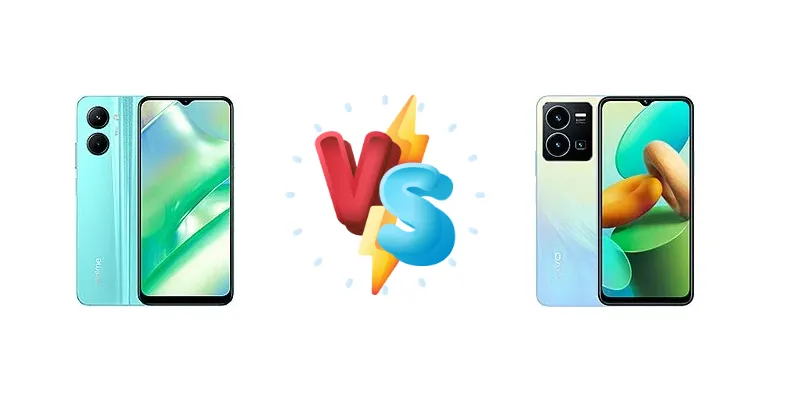
The sub-€200 smartphone market is fiercely competitive. Both the Realme C33 and the vivo Y22s (European variant) aim to deliver essential smartphone functionality at an accessible price. However, they take distinctly different approaches to achieving this, primarily through their chipset choices. This comparison will dissect the key differences to help you determine which device best suits your needs.
🏆 Quick Verdict
For the average user prioritizing efficiency and faster charging, the vivo Y22s (Europe) is the better choice. Its Snapdragon 680, built on a 6nm process, offers superior performance and power efficiency compared to the Realme C33’s Unisoc Tiger T612. While the Realme C33 is cheaper, the Y22s’ 18W charging and more modern chipset justify the price difference.
| Network |
|---|
| 2G bands | GSM 850 / 900 / 1800 / 1900 | GSM 850 / 900 / 1800 / 1900 |
| 3G bands | HSDPA 850 / 900 / 2100 | HSDPA 850 / 900 / 1700(AWS) / 1900 / 2100 |
| 4G bands | 1, 3, 5, 8, 38, 40, 41 | 1, 2, 3, 4, 5, 7, 8, 20, 28, 38, 40, 41 |
| Speed | HSPA, LTE | HSPA, LTE |
| Technology | GSM / HSPA / LTE | GSM / HSPA / LTE |
| Launch |
|---|
| Announced | 2022, September 06 | 2022, November 17 |
| Status | Available. Released 2022, September 12 | Available. Released 2022, November 17 |
| Body |
|---|
| Build | Glass front, plastic frame, plastic back | Glass front, plastic frame, plastic back |
| Dimensions | 164.2 x 75.7 x 8.3 mm (6.46 x 2.98 x 0.33 in) | 164.3 x 76.1 x 8.4 mm (6.47 x 3.00 x 0.33 in) |
| SIM | Nano-SIM + Nano-SIM | Nano-SIM + Nano-SIM |
| Weight | 187 g (6.60 oz) | 192 g (6.77 oz) |
| Display |
|---|
| Resolution | 720 x 1600 pixels, 20:9 ratio (~270 ppi density) | 720 x 1612 pixels, 20:9 ratio (~270 ppi density) |
| Size | 6.5 inches, 102.0 cm2 (~82.1% screen-to-body ratio) | 6.55 inches, 103.1 cm2 (~82.4% screen-to-body ratio) |
| Type | IPS LCD, 400 nits (typ) | IPS LCD, 90Hz |
| Platform |
|---|
| CPU | Octa-core (2x1.8 GHz Cortex-A75 & 6x1.8 GHz Cortex-A55) | Octa-core (4x2.4 GHz Kryo 265 Gold & 4x1.9 GHz Kryo 265 Silver) |
| Chipset | Unisoc Tiger T612 (12 nm) | Qualcomm SM6225 Snapdragon 680 4G (6 nm) |
| GPU | Mali-G57 | Adreno 610 |
| OS | Android 12, Realme UI S | Android 12, Funtouch 12 |
| Memory |
|---|
| Card slot | microSDXC (dedicated slot) | microSDXC (dedicated slot) |
| Internal | 32GB 3GB RAM, 64GB 4GB RAM, 128GB 4GB RAM | 128GB 6GB RAM |
| Main Camera |
|---|
| Dual | 50 MP, (wide), PDAF
Auxiliary lens | - |
| Features | LED flash, HDR, panorama | Dual LED flash |
| Triple | - | 50 MP, f/1.8, (wide), PDAF
2 MP (macro)
Auxiliary lens |
| Video | 1080p@30fps | 1080p@30fps |
| Selfie camera |
|---|
| Features | HDR | - |
| Single | 5 MP, f/2.2, 27mm (wide), 1/5.0", 1.12µm | 8 MP, f/2.0, (wide) |
| Video | 720p@30fps | 1080p@30fps |
| Sound |
|---|
| 3.5mm jack | Yes | - |
| 35mm jack | Yes | Yes |
| Loudspeaker | Yes | Yes |
| Comms |
|---|
| Bluetooth | 5.0, A2DP, LE | 5.0, A2DP, LE |
| NFC | No | Yes |
| Positioning | GPS, GLONASS, GALILEO, BDS | GPS, GALILEO, GLONASS, BDS, QZSS |
| Radio | Unspecified | FM radio |
| USB | microUSB 2.0 | USB Type-C 2.0, OTG |
| WLAN | Wi-Fi 802.11 b/g/n | Wi-Fi 802.11 a/b/g/n/ac, dual-band |
| Features |
|---|
| Sensors | Fingerprint (side-mounted), accelerometer, proximity | Fingerprint (side-mounted), accelerometer, proximity, compass |
| Battery |
|---|
| Charging | 10W wired | 18W wired, 70% in 70 min
Reverse wired |
| Type | 5000 mAh | 5000 mAh |
| Misc |
|---|
| Colors | Sandy Gold, Aqua Blue, Night Sea | Summer Cyan, Starlit Blue |
| Models | RMX3624 | - |
| Price | About 110 EUR | About 250 EUR |
| SAR EU | - | 0.98 W/kg (head) 1.17 W/kg (body) |
Realme C33
- Lower price point makes it very accessible.
- Unisoc T612 is sufficient for basic tasks.
- Potentially longer standby time due to lower power draw during idle states.
- Significantly slower charging at 10W.
- Unisoc T612 struggles with demanding applications.
- Less efficient chipset leads to potential throttling.
vivo Y22s (Europe)
- Faster and more efficient Snapdragon 680 chipset.
- 18W fast charging significantly reduces charging time.
- Reverse wired charging offers added versatility.
- Higher price compared to the Realme C33.
- May not offer a dramatically different camera experience.
- Still lacks premium features like a high refresh rate display.
Display Comparison
Neither device boasts a standout display. Both are likely to feature LCD panels, typical for this price bracket. However, detailed specs like resolution and peak brightness are missing. The focus here is on internal components. The display quality will likely be similar, prioritizing affordability over premium features like high refresh rates or OLED technology.
Camera Comparison
Without detailed camera specifications, a direct comparison is difficult. However, it’s safe to assume both phones will feature a primary camera and potentially depth/macro sensors. The image processing capabilities of Qualcomm’s ISP (Image Signal Processor) within the Snapdragon 680 generally offer better dynamic range and noise reduction compared to Unisoc’s offerings. The absence of OIS (Optical Image Stabilization) on either device suggests reliance on software stabilization, where the Snapdragon’s processing power could again provide an advantage.
Performance
The core difference lies in the chipsets. The vivo Y22s utilizes the Qualcomm Snapdragon 680 (6nm), featuring a Kryo CPU with 4x2.4 GHz Gold and 4x1.9 GHz Silver cores. This contrasts with the Realme C33’s Unisoc Tiger T612 (12nm) with its 2x1.8 GHz Cortex-A75 and 6x1.8 GHz Cortex-A55 configuration. The 6nm process of the Snapdragon 680 is a significant advantage, offering improved power efficiency and thermal performance. This translates to less throttling during sustained tasks and better battery life. While both are octa-core, the Snapdragon 680’s architecture and higher clock speeds on its performance cores provide a noticeable performance edge, particularly in demanding applications and gaming.
Battery Life
Battery capacity is not specified for either device, but the charging capabilities are a key differentiator. The Realme C33 is limited to 10W wired charging, which will require a significant amount of time to fully charge the battery. The vivo Y22s, on the other hand, supports 18W wired charging, claiming 70% charge in 70 minutes. This faster charging speed is a substantial convenience factor. The Snapdragon 680’s efficiency also contributes to potentially longer battery life, even with a similar capacity battery to the Realme C33.
Buying Guide
Buy the Realme C33 if you are on an extremely tight budget and primarily need a phone for basic tasks like calls, messaging, and light social media use. Its lower price point makes it appealing for first-time smartphone users or those needing a reliable secondary device. Buy the vivo Y22s (Europe) if you value smoother multitasking, slightly better gaming performance, and significantly faster charging. The Snapdragon 680 provides a more responsive experience, and the 18W charging will save you considerable time.
Frequently Asked Questions
❓ Will the Snapdragon 680 in the vivo Y22s handle popular games like PUBG Mobile smoothly?
The Snapdragon 680 is capable of running PUBG Mobile at medium settings with reasonable frame rates. While it won't deliver a flagship gaming experience, it provides a significantly smoother experience than the Unisoc Tiger T612, especially during prolonged gaming sessions due to its superior thermal management.
❓ Does the Realme C33’s 10W charging mean I’ll be waiting hours for a full charge?
Yes, 10W charging is quite slow by modern standards. Expect a full charge to take well over 3 hours, potentially closer to 4-5 hours depending on battery capacity. This is a significant drawback compared to the vivo Y22s’ 18W charging.
❓ Is the reverse wired charging feature on the vivo Y22s useful for everyday use?
The reverse wired charging feature, while not a primary selling point, can be a lifesaver in emergencies. It allows you to use the vivo Y22s to charge other devices like wireless earbuds or a smartwatch, providing a convenient backup power source.
❓ How much of a real-world performance difference will I notice between the two chipsets?
You'll notice a difference in app loading times, multitasking smoothness, and overall responsiveness. The Snapdragon 680 will handle multiple apps open simultaneously with less lag, and will generally feel snappier when switching between tasks. The Unisoc T612 will feel adequate for single tasks, but will struggle with heavier workloads.