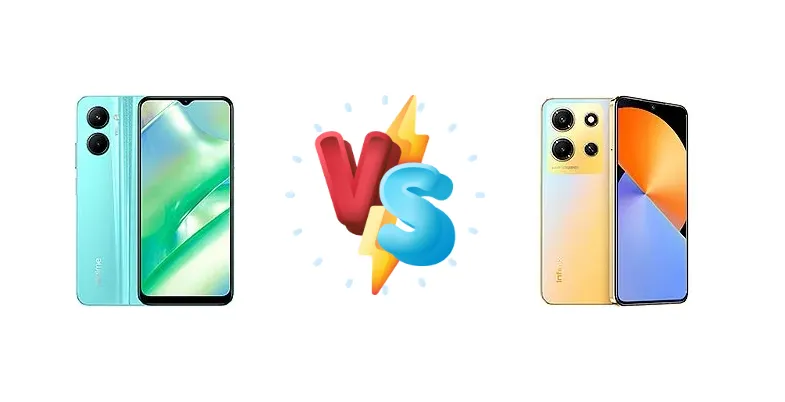
The sub-$150 smartphone market is fiercely competitive. The Realme C33 and Infinix Note 30i both aim to deliver essential features at an accessible price point, but they take different approaches. The C33 focuses on a streamlined experience with a Unisoc chipset, while the Note 30i leverages a MediaTek Helio G85 and significantly faster charging. This comparison dives deep into the specifics to determine which device offers the best overall value.
🏆 Quick Verdict
For most users, the Infinix Note 30i is the superior choice. Its Helio G85 chipset provides a noticeable performance edge over the C33’s Unisoc Tiger T612, and the 33W fast charging is a game-changer, reducing charging times dramatically. While the C33 is adequate for basic tasks, the Note 30i offers a more responsive and convenient experience.
| Network |
|---|
| 2G bands | GSM 850 / 900 / 1800 / 1900 | GSM 850 / 900 / 1800 / 1900 |
| 3G bands | HSDPA 850 / 900 / 2100 | HSDPA 850 / 900 / 1700(AWS) / 1900 / 2100 |
| 4G bands | 1, 3, 5, 8, 38, 40, 41 | LTE |
| Speed | HSPA, LTE | HSPA, LTE |
| Technology | GSM / HSPA / LTE | GSM / HSPA / LTE |
| Launch |
|---|
| Announced | 2022, September 06 | 2023, May 16 |
| Status | Available. Released 2022, September 12 | Available. Released 2023, June |
| Body |
|---|
| Build | Glass front, plastic frame, plastic back | Glass front, plastic frame, glass back or eco leather back |
| Dimensions | 164.2 x 75.7 x 8.3 mm (6.46 x 2.98 x 0.33 in) | 164.5 x 76.7 x 8.2 mm (6.48 x 3.02 x 0.32 in) |
| SIM | Nano-SIM + Nano-SIM | Nano-SIM + Nano-SIM |
| Weight | 187 g (6.60 oz) | 198 g (6.98 oz) |
| | - | IP53 |
| Display |
|---|
| Resolution | 720 x 1600 pixels, 20:9 ratio (~270 ppi density) | 1080 x 2400 pixels, 20:9 ratio (~395 ppi density) |
| Size | 6.5 inches, 102.0 cm2 (~82.1% screen-to-body ratio) | 6.66 inches, 107.1 cm2 (~84.9% screen-to-body ratio) |
| Type | IPS LCD, 400 nits (typ) | AMOLED |
| | - | * the display resolution is unconfirmed |
| Platform |
|---|
| CPU | Octa-core (2x1.8 GHz Cortex-A75 & 6x1.8 GHz Cortex-A55) | Octa-core (2x2.0 GHz Cortex-A75 & 6x1.8 GHz Cortex-A55) |
| Chipset | Unisoc Tiger T612 (12 nm) | Mediatek MT6769 Helio G85 (12 nm) |
| GPU | Mali-G57 | Mali-G52 MC2 |
| OS | Android 12, Realme UI S | Android 13, XOS 13 |
| Memory |
|---|
| Card slot | microSDXC (dedicated slot) | Unspecified |
| Internal | 32GB 3GB RAM, 64GB 4GB RAM, 128GB 4GB RAM | 256GB 8GB RAM |
| Main Camera |
|---|
| Dual | 50 MP, (wide), PDAF
Auxiliary lens | 64 MP, f/1.7, (wide), 1/2.0", PDAF
Auxiliary lens |
| Features | LED flash, HDR, panorama | Quad-LED flash, HDR, panorama |
| Video | 1080p@30fps | 1440p@30fps, 1080p@30fps |
| Selfie camera |
|---|
| Features | HDR | Dual-LED flash |
| Single | 5 MP, f/2.2, 27mm (wide), 1/5.0", 1.12µm | 16 MP, f/2.0 |
| Video | 720p@30fps | 1080p@30fps |
| Sound |
|---|
| 3.5mm jack | Yes | Yes |
| 35mm jack | Yes | Yes |
| Loudspeaker | Yes | Yes, with dual speakers |
| | - | Sound by JBL |
| Comms |
|---|
| Bluetooth | 5.0, A2DP, LE | Yes |
| NFC | No | Yes (market/region dependent) |
| Positioning | GPS, GLONASS, GALILEO, BDS | GPS |
| Radio | Unspecified | FM radio |
| USB | microUSB 2.0 | USB Type-C 2.0, OTG |
| WLAN | Wi-Fi 802.11 b/g/n | Wi-Fi 802.11 a/b/g/n/ac, dual-band |
| Features |
|---|
| Sensors | Fingerprint (side-mounted), accelerometer, proximity | Fingerprint (side-mounted), accelerometer, proximity, compass |
| Battery |
|---|
| Charging | 10W wired | 33W wired, PD3.0, 95% in 60 min
Reverse wired |
| Type | 5000 mAh | 5000 mAh |
| Misc |
|---|
| Colors | Sandy Gold, Aqua Blue, Night Sea | Variable Gold, Obsidian Black, Impression Green |
| Models | RMX3624 | X6716 |
| Price | About 110 EUR | - |
Realme C33
- Potentially cleaner software experience (Realme UI is generally less aggressive than Infinix's)
- Lower price point (likely)
- Sufficient for basic smartphone tasks
- Significantly slower charging (10W)
- Less powerful chipset (Unisoc Tiger T612)
- Limited gaming performance
Infinix Note 30i
- Faster charging (33W with PD3.0)
- More powerful chipset (Helio G85)
- Better multitasking and gaming performance
- Reverse wired charging
- Software can be bloated with pre-installed apps
- Potentially higher price point
- May run warmer under heavy load
Display Comparison
Neither device boasts a standout display. Both utilize 12nm chipsets, suggesting similar power constraints impacting display capabilities. While specific display specs (resolution, panel type) are missing, the focus here is on performance. The absence of high refresh rates on either device indicates a prioritization of battery life over visual fluidity. Bezels are likely comparable given the price bracket, and color accuracy is expected to be standard for this segment.
Camera Comparison
Without detailed camera specifications, a direct comparison is limited. However, it’s safe to assume both devices feature budget-oriented camera systems. The focus will likely be on the main sensor, with auxiliary lenses (often 2MP macro or depth sensors) offering limited utility. Image processing will play a significant role, and Infinix’s software tends to favor vibrant, saturated colors, while Realme often aims for a more natural look. The absence of Optical Image Stabilization (OIS) on either device suggests reliance on software stabilization, which may struggle in low-light conditions.
Performance
The core difference lies in the chipsets. The Infinix Note 30i’s MediaTek Helio G85, with its 2x2.0 GHz Cortex-A75 cores, offers a slight clock speed advantage over the Realme C33’s Unisoc Tiger T612 (2x1.8 GHz Cortex-A75). This translates to a more responsive user experience, particularly when launching apps or multitasking. While both use the same Cortex-A55 efficiency cores, the G85’s higher peak clock speed provides a tangible performance boost. The G85 also benefits from MediaTek’s HyperEngine software, potentially optimizing gaming performance. Thermal management will be crucial; the G85, being more powerful, may generate more heat under sustained load, but the Note 30i’s larger chassis could offer better dissipation.
Battery Life
The Infinix Note 30i’s 33W charging is a clear advantage. The Realme C33’s 10W charging is significantly slower, requiring considerably more time to reach a full charge. While battery capacity isn’t specified, the faster charging of the Note 30i mitigates the impact of a potentially smaller battery. The Note 30i also supports PD3.0 and reverse wired charging, adding versatility. A full charge on the Note 30i is advertised at 95% in 60 minutes, while the C33 will likely take several hours.
Buying Guide
Buy the Realme C33 if you prioritize a minimalist software experience and are primarily focused on essential communication tasks like calls, texts, and light social media use. You’ll need to be patient with charging times. Buy the Infinix Note 30i if you value performance for casual gaming, streaming, and multitasking, and if you want the convenience of significantly faster charging. It’s the better option for users who demand more from their smartphone.
Frequently Asked Questions
❓ Will the Helio G85 in the Infinix Note 30i overheat during prolonged gaming sessions?
The Helio G85 is known to generate some heat under sustained load. However, the Infinix Note 30i’s chassis size likely provides adequate thermal dissipation. While some throttling may occur during extended gaming, it shouldn’t be severe enough to render the phone unusable. Optimizing game settings can also help mitigate heat buildup.
❓ Is the 10W charging on the Realme C33 realistically usable for daily charging?
10W charging is quite slow by modern standards. Expect to spend several hours fully charging the Realme C33, especially if you’re a heavy user. It’s best suited for overnight charging or topping up the battery when you have ample time. The Infinix Note 30i’s 33W charging is a far more practical solution for most users.
❓ Does the Infinix Note 30i support popular streaming services like Netflix and YouTube in HD?
While not explicitly stated, the Helio G85 chipset is capable of decoding HD content. The Infinix Note 30i should support popular streaming services like Netflix and YouTube in 720p or 1080p resolution, depending on the specific app and content licensing. However, the display's resolution will ultimately limit the visual fidelity.