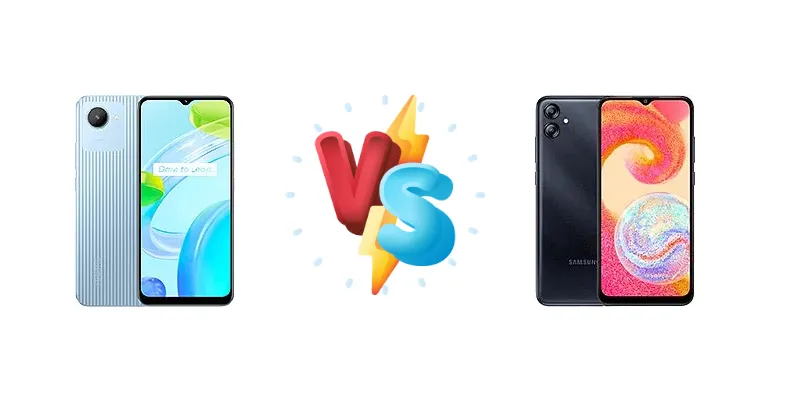
The Realme C30 and Samsung Galaxy M04 represent the extreme end of the smartphone price spectrum, targeting first-time buyers or those needing a reliable secondary device. Both aim to deliver essential functionality at an incredibly low cost, but they take different approaches to achieving this, primarily in their chipset choices and charging capabilities. This comparison dissects those differences to determine which phone offers the best value.
🏆 Quick Verdict
For the average user prioritizing basic performance and slightly faster charging, the Samsung Galaxy M04 edges out the Realme C30. While the Realme C30’s Unisoc Tiger T612 offers a more modern CPU architecture, the Galaxy M04’s Helio P35 provides a higher clock speed, translating to a more responsive experience in everyday tasks. The 15W charging is also a welcome addition.
| Network |
|---|
| 2G bands | GSM 850 / 900 / 1800 / 1900 | GSM 850 / 900 / 1800 / 1900 |
| 3G bands | HSDPA 850 / 900 / 2100 | HSDPA 850 / 900 / 2100 |
| 4G bands | 1, 3, 5, 8, 38, 40, 41 | 1, 3, 5, 7, 8, 20, 28, 38, 40, 41 |
| Speed | HSPA, LTE | HSPA, LTE |
| Technology | GSM / HSPA / LTE | GSM / HSPA / LTE |
| Launch |
|---|
| Announced | 2022, June 20 | 2022, December 10 |
| Status | Available. Released 2022, June 28 | Available. Released 2022, December 16 |
| Body |
|---|
| Build | Glass front, plastic frame, plastic back | Glass front, plastic back, plastic frame |
| Dimensions | 164.1 x 75.6 x 8.5 mm (6.46 x 2.98 x 0.33 in) | 164.2 x 75.9 x 9.1 mm (6.46 x 2.99 x 0.36 in) |
| SIM | Nano-SIM + Nano-SIM | · Nano-SIM· Nano-SIM + Nano-SIM |
| Weight | 182 g (6.42 oz) | 188 g (6.63 oz) |
| Display |
|---|
| Resolution | 720 x 1600 pixels, 20:9 ratio (~270 ppi density) | 720 x 1600 pixels, 20:9 ratio (~270 ppi density) |
| Size | 6.5 inches, 102.0 cm2 (~82.2% screen-to-body ratio) | 6.5 inches, 102.0 cm2 (~81.8% screen-to-body ratio) |
| Type | IPS LCD, 400 nits | PLS LCD |
| Platform |
|---|
| CPU | Octa-core (2x1.8 GHz Cortex-A75 & 6x1.8 GHz Cortex-A55) | Octa-core (4x2.35 GHz Cortex-A53 & 4x1.8 GHz Cortex-A53) |
| Chipset | Unisoc Tiger T612 (12 nm) | Mediatek MT6765 Helio P35 (12 nm) |
| GPU | Mali-G57 | PowerVR GE8320 |
| OS | Android 11, Realme UI Go | Android 12, One UI Core 4.1 |
| Memory |
|---|
| Card slot | microSDXC (dedicated slot) | microSDXC (dedicated slot) |
| Internal | 32GB 2GB RAM, 32GB 3GB RAM, 64GB 4GB RAM | 64GB 4GB RAM, 128GB 4GB RAM |
| | UFS 2.2 | - |
| Main Camera |
|---|
| Dual | - | 13 MP, f/2.2, (wide), AF
Auxiliary lens |
| Features | LED flash, HDR, panorama | LED flash |
| Single | 8 MP, f/2.0, 27mm (wide), 1/4.0", 1.12µm, AF | 5 MP, f/2.2 |
| Video | 1080p@30fps | 1080p@30fps |
| Selfie camera |
|---|
| Features | HDR | - |
| Single | 5 MP, f/2.2, 27mm (wide), 1/5.0", 1.12µm | 5 MP, f/2.2 |
| Video | 720p@30fps | Yes |
| Sound |
|---|
| 3.5mm jack | Yes | Yes |
| 35mm jack | Yes | Yes |
| Loudspeaker | Yes | Yes |
| Comms |
|---|
| Bluetooth | 5.0, A2DP, LE | 5.0, A2DP, LE |
| NFC | No | No |
| Positioning | GPS, GLONASS, GALILEO, BDS | GPS, GLONASS, GALILEO, BDS |
| Radio | FM radio | Unspecified |
| USB | microUSB 2.0, OTG | USB Type-C 2.0 |
| WLAN | Wi-Fi 802.11 b/g/n | Wi-Fi 802.11 b/g/n, Wi-Fi Direct |
| Features |
|---|
| Sensors | Accelerometer, proximity | Accelerometer, proximity |
| Battery |
|---|
| Charging | 10W wired | 15W wired |
| Type | 5000 mAh | Li-Po 5000 mAh |
| Misc |
|---|
| Colors | Lake Blue, Bamboo Green | Sea Glass Green, Shadow Blue |
| Models | RMX3581, RMX3623 | SM-M045F, SM-M045F/DS |
| Price | About 90 EUR | About 100 EUR |
| SAR | 1.02 W/kg (head) 0.68 W/kg (body) | 0.38 W/kg (head) |
| SAR EU | - | 0.29 W/kg (head) 1.11 W/kg (body) |
Realme C30
- More modern CPU architecture (Unisoc T612)
- Potentially better multi-tasking performance
- Competitive price point
- Slower 10W charging
- Potentially less responsive in everyday tasks
Samsung Galaxy M04
- Faster 15W charging
- Higher CPU clock speed (Helio P35)
- More responsive user experience
- Older CPU architecture (Helio P35)
- Potentially less efficient chipset
Display Comparison
Neither device boasts a standout display. Both are likely to feature LCD panels, typical for this price point. Detailed specs like resolution and brightness are missing, but we can assume they are similar – likely 720p+ resolution. The focus here isn’t on visual fidelity, but on basic readability. Bezels are expected to be noticeable on both, contributing to a larger overall footprint for the screen size.
Camera Comparison
Camera performance on both devices will be limited. Both are likely to feature a primary camera alongside basic depth or macro sensors. Given the price point, image quality will be acceptable in good lighting conditions but will struggle in low light. The absence of OIS (Optical Image Stabilization) on either device means shaky hands will result in blurry photos. The 2MP macro cameras found on many phones in this segment are largely marketing features and offer minimal practical benefit. Without specific sensor size information, it’s difficult to declare a clear winner, but the image processing algorithms employed by Samsung often provide slightly more vibrant, albeit sometimes over-saturated, results.
Performance
The core difference lies in the chipsets. The Realme C30’s Unisoc Tiger T612 utilizes a more modern CPU configuration with 2x 1.8 GHz Cortex-A75 cores and 6x 1.8 GHz Cortex-A55 cores. This architecture *should* offer better multi-tasking capabilities compared to the Samsung Galaxy M04’s MediaTek Helio P35, which features 4x 2.35 GHz Cortex-A53 cores and 4x 1.8 GHz Cortex-A53 cores. However, the Helio P35’s higher clock speed on its primary cores provides a noticeable boost in single-core performance, making app launches and basic navigation feel snappier. The T612’s advantage will be more apparent in demanding multi-threaded tasks, but these are less common on entry-level devices. RAM configurations are likely similar, further emphasizing the chipset as the key differentiator.
Battery Life
Both phones likely house batteries in the 5000mAh range, providing all-day battery life with moderate usage. However, the Samsung Galaxy M04’s 15W wired charging is a significant advantage over the Realme C30’s 10W charging. This translates to a faster 0-100% charge time, reducing downtime. While 5W difference may not seem substantial, it can be noticeable for users who frequently need to top up their battery throughout the day.
Buying Guide
Buy the Realme C30 if you prioritize a slightly newer chipset architecture and are comfortable with slower 10W charging. This phone is best suited for users who primarily use their phone for calls, texts, and light social media. Buy the Samsung Galaxy M04 if you prefer a more responsive user experience for everyday tasks and appreciate the convenience of 15W fast charging, even if it means using an older chipset design. This is the better choice for those who multitask or occasionally play less demanding games.
Frequently Asked Questions
❓ Will the Helio P35 in the Samsung Galaxy M04 overheat during prolonged use, like gaming?
The Helio P35 is a relatively power-efficient chipset. While it won't deliver high-end gaming performance, it's unlikely to overheat significantly during moderate gaming sessions. However, sustained, demanding gameplay will likely lead to some thermal throttling, reducing performance slightly. The Realme C30's Unisoc T612 may exhibit similar behavior.
❓ Is the 15W charging on the Samsung Galaxy M04 a significant improvement over the Realme C30's 10W charging?
Yes, the 15W charging is a noticeable improvement. While it won't be as fast as the charging speeds found on more expensive phones, it will reduce the time it takes to fully charge the device by approximately 30-50 minutes, depending on battery capacity and usage patterns. This is particularly beneficial for users who need to quickly top up their battery.
❓ Can either of these phones handle popular games like PUBG Mobile or Call of Duty Mobile?
Both phones can *run* PUBG Mobile and Call of Duty Mobile, but not at high settings. Expect to play at the lowest graphics settings and potentially with reduced frame rates to maintain a playable experience. The Helio P35 in the Galaxy M04 might offer slightly smoother performance due to its higher clock speed, but neither phone is designed for serious mobile gaming.
❓ What type of storage do these phones use, and is it expandable?
Both phones likely utilize eMMC storage, which is standard for this price range. While not as fast as UFS storage, it's sufficient for basic tasks. Both devices also support microSD card expansion, allowing you to increase storage capacity for photos, videos, and other files. Check the specifications for the maximum supported microSD card size.