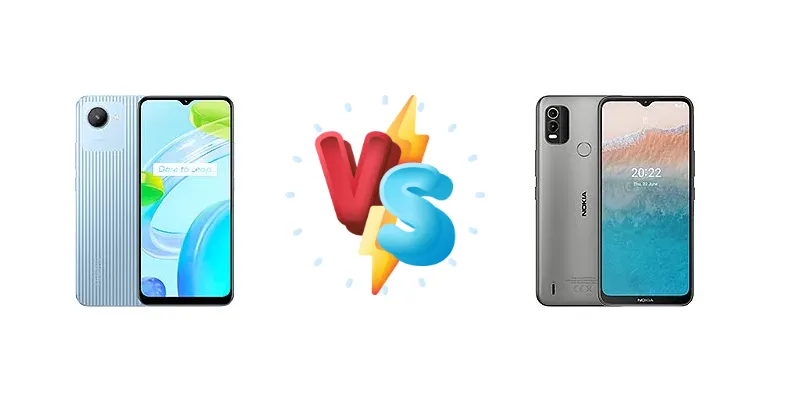
The Realme C30 and Nokia C21 Plus represent the extreme end of the smartphone price spectrum, targeting first-time buyers or those needing a reliable secondary device. Both phones aim to deliver essential functionality at an incredibly low cost, but significant differences in their core hardware – specifically the chipset – dictate which phone offers a better user experience.
🏆 Quick Verdict
For the average user, the Realme C30 is the better choice. Its Unisoc Tiger T612 chipset, built on a more modern 12nm process, provides a noticeable performance advantage over the Nokia C21 Plus’s older 28nm Unisoc SC9863A. While both offer similar battery and charging capabilities, the C30’s processing power makes it more responsive for everyday tasks.
| Network |
|---|
| 2G bands | GSM 850 / 900 / 1800 / 1900 | GSM 850 / 900 / 1800 / 1900 |
| 3G bands | HSDPA 850 / 900 / 2100 | HSDPA 850 / 900 / 2100 |
| 4G bands | 1, 3, 5, 8, 38, 40, 41 | LTE |
| Speed | HSPA, LTE | HSPA 42.2/5.76 Mbps, LTE Cat4 150/50 Mbps |
| Technology | GSM / HSPA / LTE | GSM / HSPA / LTE |
| | - | HSDPA 850 / 900 / 1700(AWS) / 1900 / 2100 |
| Launch |
|---|
| Announced | 2022, June 20 | 2022, February 28 |
| Status | Available. Released 2022, June 28 | Available. Released 2022, April 29 |
| Body |
|---|
| Build | Glass front, plastic frame, plastic back | Glass front, aluminum frame, plastic back |
| Dimensions | 164.1 x 75.6 x 8.5 mm (6.46 x 2.98 x 0.33 in) | 164.8 x 75.9 x 8.6 mm (6.49 x 2.99 x 0.34 in) |
| SIM | Nano-SIM + Nano-SIM | · Nano-SIM· Nano-SIM + Nano-SIM |
| Weight | 182 g (6.42 oz) | 178 g or 191 g (6.28 oz) |
| | - | Splash protection |
| Display |
|---|
| Protection | - | Scratch-resistant glass |
| Resolution | 720 x 1600 pixels, 20:9 ratio (~270 ppi density) | 720 x 1600 pixels, 20:9 ratio (~269 ppi density) |
| Size | 6.5 inches, 102.0 cm2 (~82.2% screen-to-body ratio) | 6.52 inches, 102.6 cm2 (~82.1% screen-to-body ratio) |
| Type | IPS LCD, 400 nits | IPS LCD |
| Platform |
|---|
| CPU | Octa-core (2x1.8 GHz Cortex-A75 & 6x1.8 GHz Cortex-A55) | Octa-core (4x1.6 GHz Cortex-A55 & 4x1.2 GHz Cortex-A55) |
| Chipset | Unisoc Tiger T612 (12 nm) | Unisoc SC9863A (28 nm) |
| GPU | Mali-G57 | IMG8322 |
| OS | Android 11, Realme UI Go | Android 11 (Go edition) |
| Memory |
|---|
| Card slot | microSDXC (dedicated slot) | microSDXC (dedicated slot) |
| Internal | 32GB 2GB RAM, 32GB 3GB RAM, 64GB 4GB RAM | 32GB 2GB RAM, 32GB 3GB RAM, 64GB 2GB RAM, 64GB 3GB RAM, 64GB 4GB RAM |
| | UFS 2.2 | eMMC 5.1 |
| Main Camera |
|---|
| Dual | - | 13 MP, (wide), AF
Auxiliary lens |
| Features | LED flash, HDR, panorama | LED flash, HDR, panorama |
| Single | 8 MP, f/2.0, 27mm (wide), 1/4.0", 1.12µm, AF | 5 MP |
| Video | 1080p@30fps | 1080p@30fps |
| Selfie camera |
|---|
| Features | HDR | LED flash |
| Single | 5 MP, f/2.2, 27mm (wide), 1/5.0", 1.12µm | 5 MP |
| Video | 720p@30fps | 720p |
| Sound |
|---|
| 3.5mm jack | Yes | Yes |
| 35mm jack | Yes | Yes |
| Loudspeaker | Yes | Yes |
| Comms |
|---|
| Bluetooth | 5.0, A2DP, LE | 4.2, A2DP |
| NFC | No | No |
| Positioning | GPS, GLONASS, GALILEO, BDS | GPS |
| Radio | FM radio | FM radio |
| USB | microUSB 2.0, OTG | microUSB 2.0 |
| WLAN | Wi-Fi 802.11 b/g/n | Wi-Fi 802.11 b/g/n |
| Features |
|---|
| Sensors | Accelerometer, proximity | Fingerprint (rear-mounted), accelerometer, proximity |
| Battery |
|---|
| Charging | 10W wired | 10W wired |
| Type | 5000 mAh | Li-Ion 4000/5050 mAh |
| Misc |
|---|
| Colors | Lake Blue, Bamboo Green | Dark Cyan, Warm Gray |
| Models | RMX3581, RMX3623 | TA-1433, TA-1431, TA-1426, TA-1424 |
| Price | About 90 EUR | About 120 EUR |
| SAR | 1.02 W/kg (head) 0.68 W/kg (body) | 0.57 W/kg (head) 0.65 W/kg (body) |
| SAR EU | - | 0.40 W/kg (head) 0.99 W/kg (body) |
Realme C30
- Faster and more efficient Unisoc Tiger T612 chipset
- More responsive user experience
- Potentially better camera image processing
- Less established brand reputation than Nokia
- Software updates may be less frequent
Nokia C21 Plus
- Clean and simple software experience
- Nokia’s reputation for build quality and durability
- Potentially longer software support (though not guaranteed)
- Significantly slower Unisoc SC9863A chipset
- Laggy performance with multitasking
- Less efficient 28nm process node
Display Comparison
Neither Realme nor Nokia provide detailed display specifications beyond resolution. However, given the price point, both likely utilize LCD panels. The real difference lies in the processing power driving them. A smoother UI experience on the C30, thanks to its faster chipset, will translate to more fluid scrolling and app transitions, indirectly improving the perceived display quality.
Camera Comparison
Both phones likely feature basic camera setups, and detailed specifications are scarce. Focusing on the chipset, the C30’s image signal processor (ISP) within the T612 will likely offer faster image processing and potentially better noise reduction compared to the SC9863A. However, without knowing sensor sizes or lens apertures, it’s difficult to definitively declare a camera winner. Expect similar results in good lighting conditions, but the C30 may perform better in low-light scenarios.
Performance
The core differentiator is the chipset. The Realme C30’s Unisoc Tiger T612 (12nm) features an octa-core configuration with two Cortex-A75 performance cores clocked at 1.8GHz, paired with six Cortex-A55 efficiency cores. This is a significantly more capable architecture than the Nokia C21 Plus’s Unisoc SC9863A (28nm), which uses four Cortex-A55 cores at 1.6GHz and another four at 1.2GHz. The 12nm process node of the T612 is far more efficient, leading to better performance per watt and potentially less thermal throttling. The C30 will handle multitasking and app loading times noticeably faster, making it a better choice for anything beyond basic communication.
Battery Life
Both the Realme C30 and Nokia C21 Plus are equipped with 10W wired charging. Given similar battery capacities (likely around 5000mAh, though not explicitly stated), expect similar charge times – roughly 3-4 hours for a full charge. The more efficient Unisoc Tiger T612 in the C30 *could* translate to slightly better battery life in real-world usage, as it consumes less power during typical tasks.
Buying Guide
Buy the Realme C30 if you prioritize responsiveness and smoother multitasking, even if it means sacrificing brand recognition. It’s ideal for users who occasionally browse social media, use messaging apps, or play light games. Buy the Nokia C21 Plus if you value a clean software experience and the Nokia brand’s reputation for durability, and your usage is limited to very basic tasks like calls and texts. It’s a good option for those who want a simple, no-frills phone.
Frequently Asked Questions
❓ Will the Realme C30 struggle with popular apps like WhatsApp and Facebook?
While the Realme C30 won't offer a flagship-level experience, its Unisoc Tiger T612 chipset is capable of running WhatsApp and Facebook smoothly. You might experience slight delays when loading images or videos, but overall, the experience should be usable. The Nokia C21 Plus will likely exhibit more noticeable lag with these apps.
❓ Is the Unisoc SC9863A chipset in the Nokia C21 Plus sufficient for basic calling and texting?
Yes, the Unisoc SC9863A is perfectly adequate for basic calling and texting. These tasks require minimal processing power. However, if you plan to do anything beyond these core functions, the C30’s more powerful chipset will provide a much more enjoyable experience.
❓ How does the 28nm process of the Nokia C21 Plus's chipset affect battery life?
The 28nm process is less efficient than the 12nm process used in the Realme C30's chipset. This means the SC9863A consumes more power for the same tasks, potentially leading to slightly shorter battery life on the Nokia C21 Plus, even with a similar battery capacity.