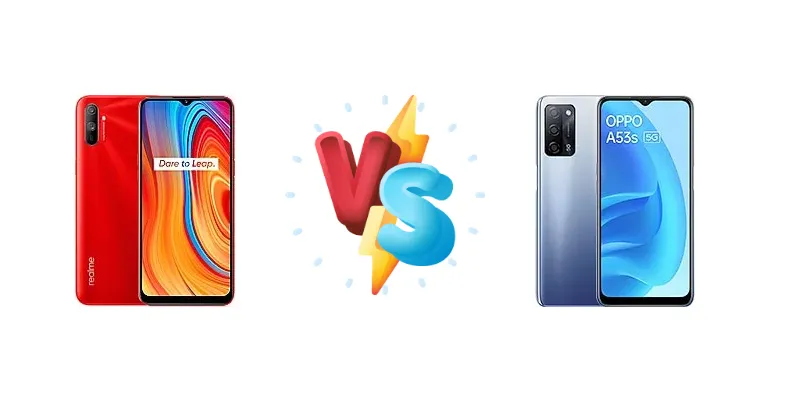
The Realme C3 and Oppo A53s 5G represent two approaches to the budget smartphone market. The C3, leveraging the Helio G70, aims for solid all-around performance at a low price. The A53s 5G, however, prioritizes future-proofing with 5G connectivity powered by the more advanced Dimensity 700 chipset. This comparison dissects the key differences to help you choose the right device.
🏆 Quick Verdict
For most users, the Oppo A53s 5G is the better choice. While both phones share the same 10W charging, the Dimensity 700 chipset offers a significant performance uplift over the Helio G70, particularly in multi-tasking and 5G enabled areas. This makes the A53s 5G a more future-proof investment.
| Network |
|---|
| 2G bands | GSM 850 / 900 / 1800 / 1900 | GSM 850 / 900 / 1800 / 1900 |
| 3G bands | HSDPA 850 / 900 / 2100 | HSDPA 800 / 850 / 900 / 2100 |
| 4G bands | 1, 3, 5, 8, 38, 40, 41 | 1, 3, 5, 8, 34, 38, 39, 40, 41 |
| 5G bands | - | 1, 28, 41, 77, 78 SA/NSA |
| Speed | HSPA 42.2/11.5 Mbps, LTE (2CA) Cat6 300/75 Mbps | HSPA, LTE, 5G |
| Technology | GSM / HSPA / LTE | GSM / HSPA / LTE / 5G |
| Launch |
|---|
| Announced | 2020, February 05. Released 2020, February 14 | 2021, April 27 |
| Status | Discontinued | Available. Released 2021, May 07 |
| Body |
|---|
| Build | Glass front (Gorilla Glass 3), plastic back, plastic frame | - |
| Dimensions | 164.4 x 75 x 9 mm (6.47 x 2.95 x 0.35 in) | 164 x 75.7 x 8.4 mm (6.46 x 2.98 x 0.33 in) |
| SIM | Nano-SIM + Nano-SIM | Nano-SIM + Nano-SIM |
| Weight | 195 g (6.88 oz) | 189.6 g (6.70 oz) |
| | Weather-sealed ports & loudspeaker | - |
| Display |
|---|
| Protection | Corning Gorilla Glass 3 | - |
| Resolution | 720 x 1600 pixels, 20:9 ratio (~270 ppi density) | 720 x 1600 pixels, 20:9 ratio (~269 ppi density) |
| Size | 6.5 inches, 102.0 cm2 (~82.7% screen-to-body ratio) | 6.52 inches, 102.6 cm2 (~82.7% screen-to-body ratio) |
| Type | IPS LCD, 480 nits (typ) | IPS LCD, 480 nits (typ) |
| Platform |
|---|
| CPU | Octa-core (2x2.0 GHz Cortex-A75 & 6x1.7 GHz Cortex-A55) | Octa-core (2x2.2 GHz Cortex-A76 & 6x2.0 GHz Cortex-A55) |
| Chipset | Mediatek MT6769V/CB Helio G70 (12 nm) | Mediatek Dimensity 700 (7 nm) |
| GPU | Mali-G52 2EEMC2 | Mali-G57 MC2 |
| OS | Android 10, Realme UI | Android 11, ColorOS 11.1 |
| Memory |
|---|
| Card slot | microSDXC (dedicated slot) | microSDXC (dedicated slot) |
| Internal | 32GB 2GB RAM, 32GB 3GB RAM, 64GB 3GB RAM, 64GB 4GB RAM | 128GB 6GB RAM, 128GB 8GB RAM |
| | eMMC 5.1 | UFS 2.2 |
| Main Camera |
|---|
| Dual | 12 MP, f/1.8, 28mm (wide), 1/2.8", 1.25µm, PDAF
Auxiliary lens | - |
| Features | LED flash, HDR, panorama | LED flash, HDR, panorama |
| Single | - | 8 MP, f/2.0, 26mm (wide) |
| Triple | - | 13 MP, f/2.2, 25mm (wide), 1/3.06", 1.12µm, PDAF
2 MP (macro)
Auxiliary lens |
| Video | 1080p@30fps | 1080p@30fps |
| Selfie camera |
|---|
| Features | HDR, panorama | HDR |
| Single | 5 MP, f/2.4, 27mm (wide), 1/5.0", 1.12µm | 8 MP, f/2.0, 26mm (wide) |
| Video | 1080p@30fps | 1080p@30fps |
| Sound |
|---|
| 3.5mm jack | Yes | Yes |
| 35mm jack | Yes | Yes |
| Loudspeaker | Yes | Yes |
| Comms |
|---|
| Bluetooth | 5.0, A2DP, LE, aptX | 5.0, A2DP, LE, aptX HD |
| NFC | No | No |
| Positioning | GPS, GLONASS, BDS | GPS, GLONASS, GALILEO, BDS, QZSS |
| Radio | FM radio | No |
| USB | microUSB 2.0, OTG | USB Type-C 2.0, OTG |
| WLAN | Wi-Fi 802.11 b/g/n | Wi-Fi 802.11 a/b/g/n/ac, dual-band, Wi-Fi Direct |
| Features |
|---|
| Sensors | Accelerometer, proximity, compass | Fingerprint (side-mounted), accelerometer, gyro, proximity, compass |
| Battery |
|---|
| Charging | 10W wired | 10W wired |
| Type | 5000 mAh | Li-Po 5000 mAh |
| Misc |
|---|
| Colors | Frozen Blue, Blazing Red, Volcano Grey shade | Crystal Blue, Ink Black |
| Models | RMX2027, RMX2020, RMX2021 | CPH2321 |
| Price | About 90 EUR | About 170 EUR |
| Tests |
|---|
| Performance |
AnTuTu: 192223 (v8)
GeekBench: 1262 (v5.1)
GFXBench: 15fps (ES 3.1 onscreen) | - |
Realme C3
- Potentially lower price point
- Established brand recognition in budget segment
- Adequate performance for basic tasks
- Older chipset (Helio G70)
- No 5G connectivity
- Less efficient processor
Oppo A53s 5G
- 5G connectivity with Dimensity 700
- More powerful processor for smoother performance
- More efficient processor for potentially better battery life
- May be slightly more expensive
- Oppo's software experience isn't universally loved
- 10W charging remains slow
Display Comparison
Neither device's display specifications are provided, so a direct comparison is limited. However, given their price points, both likely utilize LCD panels. The Realme C3, being an older model, may have slightly larger bezels. Color accuracy is likely similar, leaning towards the standard sRGB color gamut. The A53s 5G, being newer, *might* benefit from minor improvements in panel quality, but this is speculative without further data.
Camera Comparison
Without detailed camera specifications, a precise comparison is difficult. However, both phones likely feature a primary camera accompanied by auxiliary lenses (potentially a depth or macro sensor). The image processing capabilities of the Dimensity 700 in the A53s 5G *may* offer slightly better dynamic range and noise reduction. The A53s 5G's ISP (Image Signal Processor) is likely more advanced, leading to improved image quality in challenging lighting conditions. The Realme C3's camera will still be adequate for casual photography, but the A53s 5G has the potential for better results.
Performance
The core difference lies in the chipsets. The Oppo A53s 5G’s Mediatek Dimensity 700 (7nm) is a clear upgrade over the Realme C3’s Helio G70 (12nm). The Dimensity 700 utilizes Cortex-A76 cores clocked at 2.2 GHz, compared to the C3’s Cortex-A75 cores at 2.0 GHz. This architectural shift, combined with the smaller 7nm process, translates to better performance per watt and improved sustained performance under load. The A53s 5G will exhibit faster app loading times, smoother multitasking, and a more responsive user experience. The 5G modem integrated into the Dimensity 700 is a significant advantage for users in areas with 5G coverage.
Battery Life
Both devices are equipped with 10W wired charging, indicating similar charging speeds. While battery capacity isn't specified, the more efficient Dimensity 700 in the Oppo A53s 5G could translate to slightly better battery life despite potentially having a similar capacity. The 7nm process node inherently consumes less power than the 12nm node of the Helio G70, leading to longer usage times between charges. Expect both phones to take a considerable amount of time to fully charge due to the low wattage.
Buying Guide
Buy the Realme C3 if you prioritize a slightly more established brand reputation within the budget segment and are primarily focused on everyday tasks like calling, texting, and light social media use, and 5G isn't a necessity. Buy the Oppo A53s 5G if you want a phone that can handle more demanding applications, benefit from faster 5G connectivity when available, and appreciate the performance gains offered by a newer chipset architecture.
Frequently Asked Questions
❓ Will the Oppo A53s 5G actually get significantly faster download speeds in real-world conditions?
5G speeds depend heavily on network availability and coverage. However, the Dimensity 700's integrated 5G modem supports a wider range of 5G bands than older 4G-only chipsets. If you live in an area with good 5G coverage, you should experience noticeably faster download and upload speeds compared to the Realme C3.
❓ Is the performance difference between the Helio G70 and Dimensity 700 noticeable for everyday apps like Facebook and WhatsApp?
For basic apps like Facebook and WhatsApp, the performance difference will be minimal. Both chipsets are capable of handling these tasks without issue. However, the Dimensity 700 will provide a smoother experience when switching between multiple apps or running more demanding applications like mobile games.
❓ Given the 10W charging on both phones, how long will it take to fully charge the battery?
Expect a full charge to take approximately 2.5 to 3.5 hours with the included 10W charger. This is a relatively slow charging speed compared to modern smartphones with fast charging capabilities. Neither phone is ideal if you frequently need to quickly top up your battery.