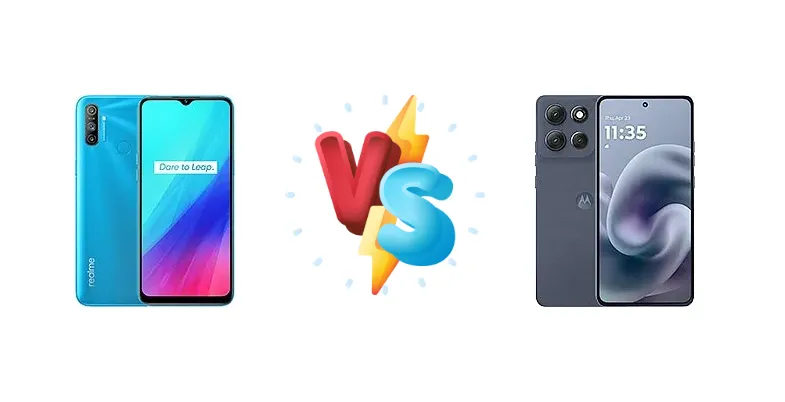
The Realme C3 (3 cameras) and Motorola Moto G86 Power represent distinct approaches to the budget smartphone market. The C3, leveraging the Helio G70, aims for affordability, while the G86 Power, with its Dimensity 7300 (or 7400 in India), prioritizes sustained performance and exceptional battery endurance. This comparison dissects their key differences to help you choose the right device.
🏆 Quick Verdict
For the average user prioritizing long-term performance and battery life, the Motorola Moto G86 Power is the clear winner. Its Dimensity 7300 chipset and impressive 67:39h endurance significantly outperform the Realme C3's Helio G70 and 10W charging, despite the C3's lower price point.
| Network |
|---|
| 2G bands | GSM 850 / 900 / 1800 / 1900 | GSM 850 / 900 / 1800 / 1900 |
| 3G bands | HSDPA 850 / 900 / 2100 | HSDPA 850 / 900 / 1900 / 2100 - International |
| 4G bands | 1, 3, 5, 7, 8, 20, 28, 38, 40, 41 - Global | 1, 2, 3, 5, 7, 8, 20, 26, 28, 32, 38, 40, 41, 42, 71 - EMEA & AP |
| 5G bands | - | 1, 3, 5, 7, 8, 20, 26, 28, 38, 40, 41, 71, 77, 78 SA/NSA/Sub6 - EMEA & AP |
| Speed | HSPA 42.2/11.5 Mbps, LTE (2CA) Cat6 300/75 Mbps | HSPA, LTE, 5G |
| Technology | GSM / HSPA / LTE | GSM / HSPA / LTE / 5G |
| | 1, 3, 5, 7, 8, 38, 40, 41 - India | - |
| Launch |
|---|
| Announced | 2020, February 19. Released 2020, February 20 | 2025, May 29 |
| Status | Discontinued | Available. Released 2025, July 30 |
| Body |
|---|
| Build | Glass front (Gorilla Glass 3), plastic back, plastic frame | Glass front (Gorilla Glass 7i), plastic frame, silicone polymer (eco leather) back |
| Dimensions | 164.4 x 75 x 9 mm (6.47 x 2.95 x 0.35 in) | 161.2 x 74.7 x 8.7 mm (6.35 x 2.94 x 0.34 in) |
| SIM | Nano-SIM + Nano-SIM | · Nano-SIM + eSIM· Nano-SIM + Nano-SIM |
| Weight | 195 g (6.88 oz) | 195 or 198 g (6.98 oz) |
| | Weather-sealed ports & loudspeaker | - |
| Display |
|---|
| Protection | Corning Gorilla Glass 3 | Corning Gorilla Glass 7i, Mohs level 4 |
| Resolution | 720 x 1600 pixels, 20:9 ratio (~270 ppi density) | 1220 x 2712 pixels, 20:9 ratio (~446 ppi density) |
| Size | 6.5 inches, 102.0 cm2 (~82.7% screen-to-body ratio) | 6.67 inches, 107.4 cm2 (~89.2% screen-to-body ratio) |
| Type | IPS LCD, 480 nits (typ) | P-OLED, 1B colors, 120Hz, HDR10+, 4500 nits peak |
| Platform |
|---|
| CPU | Octa-core (2x2.0 GHz Cortex-A75 & 6x1.7 GHz Cortex-A55) | Octa-core (4x2.5 GHz Cortex-A78 & 4x2.0 GHz Cortex-A55) - GlobalOcta-core (4x2.6 GHz Cortex-A78 & 4x2.0 GHz Cortex-A55) - India |
| Chipset | Mediatek MT6769V/CB Helio G70 (12 nm) | Mediatek Dimensity 7300 (4 nm) - GlobalMediatek Dimensity 7400 (4 nm) - India |
| GPU | Mali-G52 2EEMC2 | Mali-G615 MC2 |
| OS | Android 10, Realme UI | Android 15, up to 2 major Android upgrades |
| Memory |
|---|
| Card slot | microSDXC (dedicated slot) | microSDXC (dedicated slot) |
| Internal | 32GB 2GB RAM, 32GB 3GB RAM, 64GB 3GB RAM, 64GB 4GB RAM | 128GB 8GB RAM, 256GB 8GB RAM, 256GB 12GB RAM, 512GB 8GB RAM, 512GB 12GB RAM |
| | eMMC 5.1 | - |
| Main Camera |
|---|
| Dual | - | 50 MP, f/1.9, 25mm (wide), 1/1.95", 0.8µm, dual pixel PDAF, OIS
8 MP, f/2.2, 12mm, 118˚ (ultrawide), 1.12µm, AF |
| Features | LED flash, HDR, panorama | LED flash, HDR, panorama |
| Triple | 12 MP, f/1.8, 28mm (wide), 1/2.8", 1.25µm, PDAF
2 MP (macro)
Auxiliary lens | - |
| Video | 1080p@30fps | 4K@30/60fps, 1080p@30/60/120fps, gyro-EIS |
| Selfie camera |
|---|
| Features | HDR, panorama | HDR |
| Single | 5 MP, f/2.4, 27mm (wide), 1/5.0", 1.12µm | 32 MP, f/2.2, (wide), 0.7µm |
| Video | 1080p@30fps | 4K@30fps, 1080p@30fps, gyro-EIS |
| Sound |
|---|
| 3.5mm jack | Yes | - |
| 35mm jack | Yes | No |
| Loudspeaker | Yes | Yes, with stereo speakers (with Dolby Atmos) |
| Comms |
|---|
| Bluetooth | 5.0, A2DP, LE, aptX | 5.4, A2DP, LE |
| NFC | No | Yes |
| Positioning | GPS, GLONASS, BDS | GPS, GLONASS, GALILEO, BDS, QZSS |
| Radio | FM radio | No |
| USB | microUSB 2.0, OTG | USB Type-C 2.0 |
| WLAN | Wi-Fi 802.11 b/g/n | Wi-Fi 802.11 a/b/g/n/ac/6, dual-band |
| Features |
|---|
| Sensors | Fingerprint (rear-mounted), accelerometer, proximity, compass | Fingerprint (under display, optical), accelerometer, gyro, proximity, compass |
| Battery |
|---|
| Charging | 10W wired
Reverse wired | 30W wired |
| Type | 5000 mAh | 6720 mAh |
| Misc |
|---|
| Colors | Frozen Blue, Blazing Red | Pantone: Spellbound, Golden Cypress, Cosmic Sky, Chrysanthemum |
| Models | - | XT2527-7 |
| Price | About 150 EUR | $ 472.00 / € 269.90 / ₹ 17,000 |
| EU LABEL |
|---|
| Battery | - | 67:39h endurance, 1000 cycles |
| Energy | - | Class A |
| Free fall | - | Class B (180 falls) |
| Repairability | - | Class B |
Realme C3 (3 cameras)
- Very affordable price point
- Decent performance for basic tasks
- Reverse wired charging capability
- Slow 10W charging
- Less powerful processor
- Likely lower quality display
Motorola Moto G86 Power
- Exceptional battery life (67:39h endurance)
- Faster 30W charging
- More powerful and efficient Dimensity 7300/7400 chipset
- Higher price compared to Realme C3
- Camera specifications not fully detailed
- Display details are missing
Display Comparison
Display specifications are not provided for the Realme C3. However, given its market segment, it likely features a 720p LCD panel. The Moto G86 Power, while lacking detailed display specs, benefits from the power efficiency of its Dimensity chipset, potentially allowing for a larger, brighter display without significant battery drain. The difference in chipsets suggests the G86 Power will likely have a more responsive and fluid user experience, especially during scrolling and animations.
Camera Comparison
The Realme C3 features a triple-camera setup, but details on sensor sizes and image processing are absent. The Moto G86 Power’s camera specifications are also not provided, but the chipset’s ISP (Image Signal Processor) is more advanced, enabling better noise reduction, dynamic range, and overall image quality. Without specific sensor details, it’s difficult to make a definitive judgment, but the G86 Power’s superior processing power gives it an edge in computational photography, potentially improving low-light performance and image stabilization.
Performance
The Motorola Moto G86 Power’s Mediatek Dimensity 7300 (Global) or 7400 (India), built on a 4nm process, represents a substantial leap in performance and efficiency over the Realme C3’s 12nm Mediatek Helio G70. The G86 Power’s CPU configuration – Cortex-A78 cores clocked up to 2.6 GHz – delivers significantly faster processing speeds for demanding tasks and gaming. The Helio G70’s Cortex-A75 cores, while capable, are less efficient and slower. This translates to smoother multitasking, quicker app loading times, and a more enjoyable gaming experience on the G86 Power. The 4nm node also means less heat generation, reducing the likelihood of performance throttling during extended use.
Battery Life
The Motorola Moto G86 Power boasts an impressive 67:39h endurance rating, indicating exceptional battery life. This is coupled with 30W wired charging, allowing for significantly faster recharge times compared to the Realme C3’s slow 10W charging. While the C3 may have a comparable or even slightly larger battery capacity (spec not provided), the G86 Power’s more efficient chipset and faster charging capabilities provide a far superior user experience. The G86 Power’s battery is also rated for 1000 cycles, suggesting long-term reliability.
Buying Guide
Buy the Realme C3 (3 cameras) if you need a very affordable smartphone for basic tasks like calling, texting, and light social media use, and are willing to compromise on performance and battery life. Buy the Motorola Moto G86 Power if you prefer a phone that can handle more demanding applications, offers significantly longer battery life, and supports faster 30W charging, even if it comes at a slightly higher cost.
Frequently Asked Questions
❓ Does the Mediatek Dimensity 7300/7400 in the Moto G86 Power get hot during prolonged gaming sessions?
The Dimensity 7300/7400 is built on a 4nm process, which is significantly more efficient than the 12nm Helio G70 in the Realme C3. This improved efficiency translates to lower heat generation, reducing the likelihood of significant throttling during extended gaming. While some heat is inevitable, the G86 Power is better equipped to maintain consistent performance over longer periods.
❓ Is the 10W charging on the Realme C3 a significant drawback in daily use?
Yes, the 10W charging on the Realme C3 is a considerable limitation. It will take significantly longer to fully charge the device compared to the Moto G86 Power’s 30W charging. This means more downtime and less convenience, especially for users who rely heavily on their smartphones throughout the day.
❓ Given the lack of detailed camera specs, how much of an improvement can I expect from the Moto G86 Power's camera?
While specific sensor details are missing, the Moto G86 Power benefits from a more powerful ISP (Image Signal Processor) within the Dimensity 7300/7400 chipset. This ISP enables better noise reduction, improved dynamic range, and more sophisticated computational photography features, leading to noticeably better image quality, particularly in challenging lighting conditions.