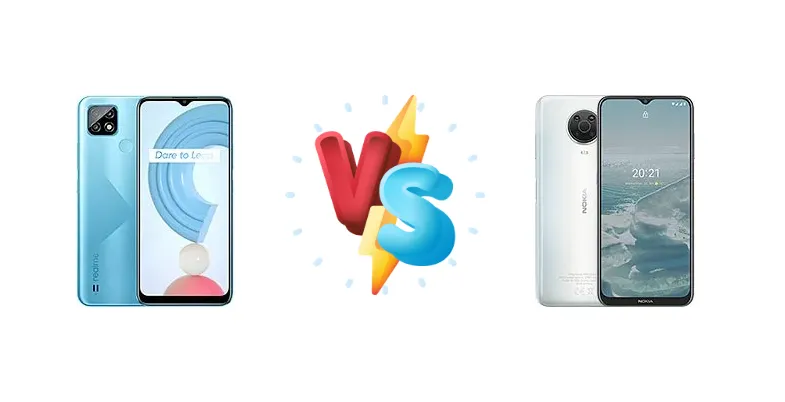
The Realme C21 and Nokia G20 occupy the fiercely competitive ultra-budget smartphone segment. Both aim to deliver essential smartphone functionality at the lowest possible price point. While appearing similar on paper, subtle differences in software and brand philosophy can significantly impact the user experience. This comparison dissects their shared hardware and highlights where each phone excels.
🏆 Quick Verdict
For the average user prioritizing a clean software experience and potential for longer software support, the Nokia G20 is the better choice. However, the Realme C21 offers a slightly more streamlined experience and potentially better value if found at a significantly lower price. Both are limited by their Helio G35 chipset.
| Network |
|---|
| 2G bands | GSM 850 / 900 / 1800 / 1900 | GSM 850 / 900 / 1800 / 1900 |
| 3G bands | HSDPA 850 / 900 / 2100 | HSDPA 850 / 900 / 1900 / 2100 - International |
| 4G bands | 1, 3, 5, 7, 8, 20, 28, 38, 40, 41 - International | 1, 3, 5, 7, 8, 20, 28, 38, 40, 41 - International |
| Speed | HSPA, LTE | HSPA 42.2/5.76 Mbps, LTE Cat4 150/50 Mbps |
| Technology | GSM / HSPA / LTE | GSM / HSPA / LTE |
| | 1, 3, 5, 8, 38, 40, 41 - India | 1, 2, 3, 4, 5, 7, 8, 12, 17, 28, 66 - LATAM |
| Launch |
|---|
| Announced | 2021, March 05 | 2021, April 08 |
| Status | Available. Released 2021, March 05 | Available. Released 2021, May 17 |
| Body |
|---|
| Build | Glass front, plastic back, plastic frame | - |
| Dimensions | 165.2 x 76.4 x 8.9 mm (6.50 x 3.01 x 0.35 in) | 164.9 x 76 x 9.2 mm (6.49 x 2.99 x 0.36 in) |
| SIM | Nano-SIM + Nano-SIM | · Nano-SIM· Nano-SIM + Nano-SIM |
| Weight | 190 g (6.70 oz) | 197 g (6.95 oz) |
| | - | Splash protection |
| Display |
|---|
| Resolution | 720 x 1600 pixels, 20:9 ratio (~270 ppi density) | 720 x 1600 pixels, 20:9 ratio (~269 ppi density) |
| Size | 6.5 inches, 102.0 cm2 (~80.8% screen-to-body ratio) | 6.52 inches, 102.6 cm2 (~81.9% screen-to-body ratio) |
| Type | IPS LCD, 400 nits (typ) | IPS LCD |
| Platform |
|---|
| CPU | Octa-core (4x2.3 GHz Cortex-A53 & 4x1.8 GHz Cortex-A53) | Octa-core (4x2.3 GHz Cortex-A53 & 4x1.8 GHz Cortex-A53) |
| Chipset | Mediatek MT6765G Helio G35 (12 nm) | Mediatek MT6765G Helio G35 (12 nm) |
| GPU | PowerVR GE8320 | PowerVR GE8320 |
| OS | Android 10, Realme UI | Android 11, upgradable to Android 13 |
| Memory |
|---|
| Card slot | microSDXC (dedicated slot) | microSDXC (dedicated slot) |
| Internal | 32GB 3GB RAM, 64GB 4GB RAM | 64GB 4GB RAM, 128GB 4GB RAM |
| | eMMC 5.1 | - |
| Main Camera |
|---|
| Dual | 13 MP, f/2.2, 26mm (wide), 1/3.06", 1.12µm, PDAF
2 MP (macro)
Auxiliary lens | - |
| Features | LED flash, HDR, panorama | LED flash, HDR, panorama |
| Quad | - | 48 MP, f/1.8, (wide), PDAF
5 MP, (ultrawide)
2 MP (macro)
Auxiliary lens |
| Single | 5 MP, f/2.2, (wide), 1/5.0", 1.12µm | 8 MP, (wide) |
| Video | 1080p@30fps | 1080p@30fps |
| Selfie camera |
|---|
| Features | HDR, panorama | - |
| Single | 5 MP, f/2.2, (wide), 1/5.0", 1.12µm | 8 MP, (wide) |
| Video | 1080p@30fps | 1080p@30fps |
| Sound |
|---|
| 3.5mm jack | Yes | Yes |
| 35mm jack | Yes | Yes |
| Loudspeaker | Yes | Yes |
| Comms |
|---|
| Bluetooth | 5.0, A2DP, LE | 5.0, A2DP, LE |
| NFC | No | Yes (market/region dependent) |
| Positioning | GPS, GLONASS, BDS | GPS, GLONASS, BDS |
| Radio | FM radio | FM radio |
| USB | microUSB 2.0, OTG | USB Type-C 2.0, OTG |
| WLAN | Wi-Fi 802.11 b/g/n | Wi-Fi 802.11 b/g/n |
| Features |
|---|
| Sensors | Fingerprint (rear-mounted), accelerometer, proximity, compass | Fingerprint (side-mounted), accelerometer, gyro, proximity |
| Battery |
|---|
| Charging | 10W wired
Reverse wired | 10W wired |
| Type | 5000 mAh | Li-Po 5050 mAh |
| Misc |
|---|
| Colors | Cross Black, Cross Blue | Glacier, Night |
| Models | RMX3201 | TA-1336, TA-1343, TA-1347, TA-1372, TA-1365 |
| Price | About 410 EUR | About 90 EUR |
| SAR | - | 1.01 W/kg (head) 1.02 W/kg (body) |
| SAR EU | - | 0.49 W/kg (head) 1.13 W/kg (body) |
Realme C21
- Potentially lower price point
- Realme UI offers customization options
- Streamlined user experience (subjective)
- Realme UI can include bloatware
- Potentially shorter software support
Nokia G20
- Cleaner, near-stock Android experience
- Nokia's commitment to software updates
- Understated and minimalist design
- May be slightly more expensive
- Less customization options compared to Realme UI
Display Comparison
Both the Realme C21 and Nokia G20 lack detailed display specifications in the provided data. Given their price point, it's safe to assume both utilize LCD panels with 720p+ resolution. The absence of information regarding peak brightness, color gamut coverage, or refresh rates suggests neither phone prioritizes display quality. Bezels are likely to be substantial on both devices, maximizing screen real estate within a budget-friendly form factor. Color accuracy will likely be standard for this segment, leaning towards warmer tones.
Camera Comparison
Camera performance is expected to be similar on both devices, given the lack of differentiating specs. Both likely feature a primary camera, potentially accompanied by auxiliary sensors (depth or macro) of limited utility. The absence of Optical Image Stabilization (OIS) suggests image quality will suffer in low-light conditions. Image processing will likely focus on enhancing colors and contrast, but detail preservation will be limited by the sensor and chipset capabilities. The 2MP macro cameras often found in this segment are unlikely to deliver significant improvements in image quality.
Performance
Both devices are powered by the Mediatek MT6765G Helio G35 chipset, featuring an octa-core CPU configuration with 4x2.3 GHz Cortex-A53 and 4x1.8 GHz Cortex-A53 cores. This chipset is designed for basic tasks like calling, texting, social media, and light web browsing. The shared chipset means performance will be virtually identical in day-to-day use. Gaming is limited to less demanding titles at low settings. The lack of information on RAM type and speed (LPDDR4X is likely) further reinforces the expectation of similar performance. Thermal management will likely be passive, relying on the phone's chassis to dissipate heat, potentially leading to some throttling under sustained load.
Battery Life
Both the Realme C21 and Nokia G20 support 10W wired charging. While the battery capacity isn't specified, both likely feature batteries in the 5000mAh range, common for this price point. 10W charging is slow, requiring several hours for a full charge (estimated 3-4 hours from 0-100%). Real-world battery life will depend heavily on usage patterns, but both phones should comfortably last a full day with moderate use. The efficiency of the Helio G35 chipset and software optimization will play a crucial role in determining actual battery endurance.
Buying Guide
Buy the Realme C21 if you need a basic, functional smartphone with a focus on simplicity and are comfortable with Realme UI. It's ideal for first-time smartphone users or those needing a reliable secondary device. Buy the Nokia G20 if you value a cleaner Android experience, potentially longer software updates (thanks to Nokia's commitment), and prefer a more understated design. It's suited for users who appreciate a near-stock Android feel and prioritize software longevity.
Frequently Asked Questions
❓ Will the Helio G35 struggle with popular apps like WhatsApp and Facebook?
The Helio G35 is capable of running apps like WhatsApp and Facebook, but expect some lag when multitasking or switching between apps quickly. These apps are relatively lightweight, but the chipset's limited processing power and RAM constraints will become apparent with heavier usage.
❓ How long will software updates be supported on the Nokia G20?
Nokia typically provides a guaranteed number of years of software updates and security patches for its smartphones. While the exact duration for the G20 isn't specified here, Nokia generally offers better software support than many other brands in this price segment, potentially extending the phone's usable lifespan.
❓ Is the 10W charging speed acceptable for daily use?
10W charging is slow by modern standards. Expect a full charge to take around 3-4 hours. It's best to charge the phone overnight to ensure it's fully powered for the next day. This is a common trade-off in the ultra-budget segment.