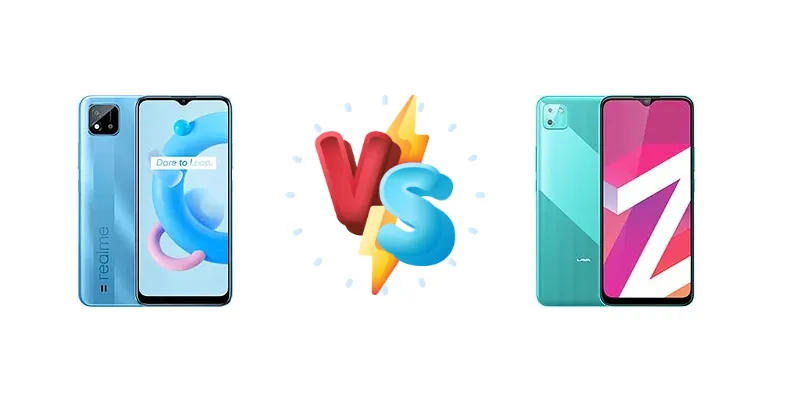
The Realme C20 and Lava Z2 Max represent the extreme end of the smartphone price spectrum. Both aim to deliver essential functionality at a minimal cost, but they take drastically different approaches to achieving this. The Realme C20 leverages a modern, if entry-level, octa-core chipset, while the Lava Z2 Max opts for a simpler quad-core design. This comparison will dissect these choices and determine which device offers the best experience for the price-conscious consumer.
🏆 Quick Verdict
For the average user prioritizing responsiveness and multitasking, the Realme C20 is the clear winner. Its Mediatek Helio G35 chipset, with its eight cores, provides a significantly more fluid experience than the Lava Z2 Max's quad-core processor. While the Lava Z2 Max may offer slightly better battery life due to lower power consumption, the performance trade-off is substantial.
| Network |
|---|
| 2G bands | GSM 850 / 900 / 1800 / 1900 | GSM 850 / 900 / 1800 / 1900 |
| 3G bands | HSDPA 850 / 900 / 2100 | HSDPA 900 / 2100 |
| 4G bands | 1, 3, 5, 8, 38, 40, 41 | 1, 3, 5, 8, 40, 41 |
| Speed | HSPA, LTE | HSPA 42.2/5.76 Mbps, LTE Cat4 150/50 Mbps |
| Technology | GSM / HSPA / LTE | GSM / HSPA / LTE |
| Launch |
|---|
| Announced | 2021, January 19 | 2021, May 11 |
| Status | Available. Released 2021, January 19 | Available. Released 2021, May 11 |
| Body |
|---|
| Build | Glass front (Gorilla Glass 3), plastic frame, plastic back | Glass front, plastic back, plastic frame |
| Dimensions | 165.2 x 76.4 x 8.9 mm (6.50 x 3.01 x 0.35 in) | 174.7 x 78.6 x 9.1 mm (6.88 x 3.09 x 0.36 in) |
| SIM | Nano-SIM + Nano-SIM | Nano-SIM + Nano-SIM |
| Weight | 190 g (6.70 oz) | 216 g (7.62 oz) |
| | Splash-resistant design | - |
| Display |
|---|
| Protection | Corning Gorilla Glass 3 | Corning Gorilla Glass 3 |
| Resolution | 720 x 1600 pixels, 20:9 ratio (~270 ppi density) | 720 x 1640 pixels (~256 ppi density) |
| Size | 6.5 inches, 102.0 cm2 (~80.8% screen-to-body ratio) | 7.0 inches, 116.4 cm2 (~84.7% screen-to-body ratio) |
| Type | IPS LCD, 400 nits (typ) | IPS LCD |
| Platform |
|---|
| CPU | Octa-core (4x2.3 GHz Cortex-A53 & 4x1.8 GHz Cortex-A53) | Quad-core 1.8 GHz |
| Chipset | Mediatek MT6765G Helio G35 (12 nm) | - |
| GPU | PowerVR GE8320 | - |
| OS | Android 10, Realme UI | Android 10 (Go edition) |
| Memory |
|---|
| Card slot | microSDXC (dedicated slot) | microSDXC (dedicated slot) |
| Internal | 32GB 2GB RAM | 32GB 2GB RAM |
| | eMMC 5.1 | eMMC 5.1 |
| Main Camera |
|---|
| Dual | - | 13 MP, f/1.9, (wide), 1/3.0", 1.12µm, AF
Auxiliary lens |
| Features | LED flash, HDR, panorama | LED flash |
| Single | 8 MP, f/2.0, (wide), 1/4.0", 1.12µm, AF | 8 MP, f/2.0, (wide), 1.12µm |
| Video | 1080p@30fps | 720p@30fps |
| Selfie camera |
|---|
| Features | HDR | - |
| Single | 5 MP, f/2.2, (wide), 1/5.0", 1.12µm | 8 MP, f/2.0, (wide), 1.12µm |
| Video | 1080p@30fps | - |
| Sound |
|---|
| 3.5mm jack | Yes | Yes |
| 35mm jack | Yes | Yes |
| Loudspeaker | Yes | Yes |
| Comms |
|---|
| Bluetooth | 5.1, A2DP, LE | 5.0, A2DP, LE |
| NFC | No | No |
| Positioning | GPS, GLONASS, BDS | GPS |
| Radio | FM radio | FM radio |
| USB | microUSB 2.0, OTG | USB Type-C 2.0, OTG |
| WLAN | Wi-Fi 802.11 a/b/g/n/ac, dual-band, Wi-Fi Direct | Wi-Fi 802.11 b/g/n, Wi-Fi Direct |
| Features |
|---|
| Sensors | Accelerometer, proximity, compass | Accelerometer |
| Battery |
|---|
| Charging | 10W wired
Reverse wired | - |
| Type | 5000 mAh | Li-Po 6000 mAh |
| Misc |
|---|
| Colors | Cool Gray, Cool Blue | Stroked Blue, Stroked Cyan |
| Models | RMX3063, RMX3061 | LS0001 |
| Price | About 90 EUR | About 90 EUR |
| SAR | 0.98 W/kg (head) 0.50 W/kg (body) | - |
Realme C20
- Significantly faster processor for smoother multitasking.
- Octa-core architecture offers better responsiveness.
- 10W reverse wired charging provides added utility.
- 10W charging is relatively slow.
- Display quality likely average for the price point.
Lava Z2 Max
- Potentially longer battery life due to lower power consumption.
- Simpler software may result in a slightly cleaner user experience.
- Likely the more affordable option.
- Quad-core processor struggles with multitasking and demanding apps.
- Noticeable lag during everyday use.
- Limited gaming capabilities.
Display Comparison
Neither device's display specifications are provided, so a direct comparison is limited. However, given their price points, both likely utilize LCD panels with 720p+ resolutions. The Realme C20, benefiting from a slightly higher market positioning, *may* have a marginally brighter panel. Bezels are expected to be substantial on both devices, reflecting their budget nature. Color accuracy is unlikely to be a strong point on either model, with standard sRGB coverage being the most probable outcome.
Camera Comparison
Without specific camera sensor details, a detailed comparison is impossible. However, it's safe to assume both devices feature basic camera setups geared towards casual photography. Given the market segment, image quality will likely be heavily reliant on software processing. The Realme C20, due to its more powerful processor, *may* have slightly more sophisticated image processing capabilities. The presence of a 2MP macro camera on either device is largely a marketing gimmick, offering minimal practical benefit.
Performance
The core difference lies in the chipset. The Realme C20's Mediatek Helio G35 is an octa-core processor built on a 12nm process, featuring a combination of Cortex-A53 cores clocked at 2.3 GHz and 1.8 GHz. This configuration allows for better parallel processing and responsiveness compared to the Lava Z2 Max's quad-core 1.8 GHz CPU. The Helio G35 also includes a modest GPU, enabling basic gaming. The Lava Z2 Max, with its simpler CPU, will struggle with even moderately demanding tasks, exhibiting noticeable lag during app switching and multitasking. The Realme C20's architecture provides a tangible advantage in everyday usability.
Battery Life
Battery capacity isn't specified for either device. However, the Lava Z2 Max, with its less power-hungry quad-core processor, will likely exhibit slightly longer battery life under similar usage conditions. The Realme C20's 10W charging is relatively slow, but adequate for overnight charging. The Lava Z2 Max's charging speed is unknown, but likely similar. The difference in battery life is unlikely to be dramatic, and the performance advantage of the Realme C20 outweighs a potentially marginal gain in endurance.
Buying Guide
Buy the Realme C20 if you need a smartphone capable of handling basic multitasking, social media, and light gaming without significant lag. It's ideal for first-time smartphone users or those seeking a reliable secondary device. Buy the Lava Z2 Max if your primary needs are limited to calls, texts, and very basic app usage, and you prioritize maximizing battery life above all else. It's a suitable option for users who are extremely budget-constrained and have minimal performance expectations.
Frequently Asked Questions
❓ Will the Realme C20 be able to run popular social media apps like Facebook and Instagram smoothly?
Yes, the Realme C20's Mediatek Helio G35 processor is capable of running social media apps without significant lag. The octa-core architecture provides enough processing power for these everyday tasks, offering a more fluid experience than the Lava Z2 Max.
❓ Is the Lava Z2 Max suitable for playing mobile games like PUBG or Call of Duty?
No, the Lava Z2 Max's quad-core processor is not powerful enough to run demanding games like PUBG or Call of Duty at playable frame rates. You will likely experience significant lag and stuttering, making the gaming experience frustrating. The Realme C20, while not a gaming powerhouse, will offer a slightly better experience for light gaming.
❓ How much storage does each phone offer, and can it be expanded?
Storage capacity isn't specified in the provided data. However, both devices likely offer limited internal storage (32GB or 64GB) and support microSD card expansion. This is a common feature in this price segment, allowing users to increase storage for photos, videos, and apps.