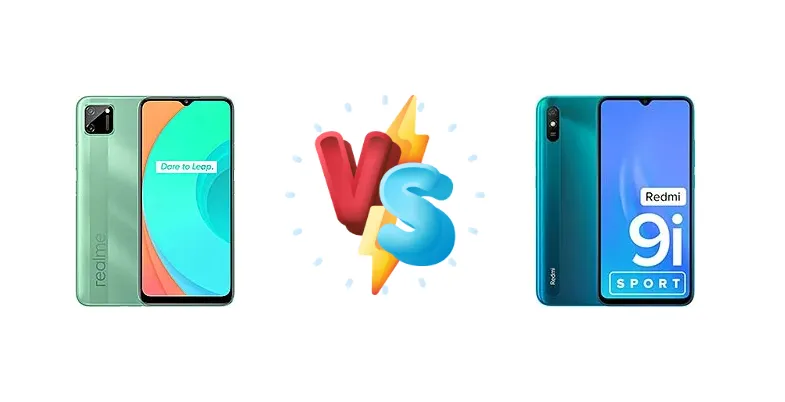
The Realme C11 and Xiaomi Redmi 9i Sport represent the fiercely competitive entry-level smartphone market. Both aim to deliver essential smartphone functionality at an incredibly affordable price point. This comparison dissects their core components to determine which device offers the best balance of performance and value for users prioritizing basic tasks and occasional entertainment.
🏆 Quick Verdict
For the average user focused on everyday tasks like calling, messaging, and light social media, the Realme C11 edges out the Redmi 9i Sport. Its slightly faster CPU clock speeds in the primary cores, powered by the Helio G35, translate to a marginally smoother experience, despite both phones sharing similar RAM and storage configurations.
| Network |
|---|
| 2G bands | GSM 850 / 900 / 1800 / 1900 | GSM 850 / 900 / 1800 / 1900 |
| 3G bands | HSDPA 850 / 900 / 2100 | HSDPA 850 / 900 / 2100 |
| 4G bands | 1, 3, 5, 7, 8, 20, 28, 38, 40, 41 - International | 1, 3, 5, 8, 40, 41 |
| Speed | HSPA, LTE | HSPA, LTE |
| Technology | GSM / HSPA / LTE | GSM / HSPA / LTE |
| Launch |
|---|
| Announced | 2020, June 30. Released 2020, July 07 | 2021, September 28 |
| Status | Discontinued | Available. Released 2021, September 28 |
| Body |
|---|
| Dimensions | 164.4 x 75.9 x 9.1 mm (6.47 x 2.99 x 0.36 in) | 164.9 x 77.1 x 9 mm (6.49 x 3.04 x 0.35 in) |
| SIM | Nano-SIM + Nano-SIM | Nano-SIM + Nano-SIM |
| Weight | 196 g (6.91 oz) | 194 g (6.84 oz) |
| | - | Water-repellent coating |
| Display |
|---|
| Resolution | 720 x 1560 pixels, 19.5:9 ratio (~264 ppi density) | 720 x 1600 pixels, 20:9 ratio (~269 ppi density) |
| Size | 6.5 inches, 103.7 cm2 (~83.1% screen-to-body ratio) | 6.53 inches, 102.9 cm2 (~81.0% screen-to-body ratio) |
| Type | IPS LCD | IPS LCD, 400 nits (typ) |
| Platform |
|---|
| CPU | Octa-core (4x2.3 GHz Cortex-A53 & 4x1.8 GHz Cortex-A53) | Octa-core (4x2.0 GHz Cortex-A53 & 4x1.5 GHz Cortex-A53) |
| Chipset | Mediatek MT6765G Helio G35 (12 nm) | Mediatek MT6762G Helio G25 (12 nm) |
| GPU | PowerVR GE8320 | PowerVR GE8320 |
| OS | Android 10, Realme UI | Android 10, MIUI 12 |
| Memory |
|---|
| Card slot | microSDXC (dedicated slot) | microSDXC (dedicated slot) |
| Internal | 32GB 2GB RAM, 32GB 3GB RAM | 64GB 4GB RAM, 128GB 4GB RAM |
| | eMMC 5.1 | eMMC 5.1 |
| Main Camera |
|---|
| Dual | 13 MP, f/2.2, (wide), PDAF
Auxiliary lens | - |
| Features | LED flash, HDR, panorama | LED flash, HDR |
| Single | - | 13 MP, f/2.2, 28mm (wide), 1.0µm, PDAF |
| Video | 1080p@30fps | 1080p@30fps |
| Selfie camera |
|---|
| Features | HDR, panorama | HDR |
| Single | 5 MP, f/2.4, 27mm (wide) | 5 MP, f/2.2, (wide), 1.12µm |
| Video | 1080p@30fps | 1080p@30fps |
| Sound |
|---|
| 3.5mm jack | Yes | Yes |
| 35mm jack | Yes | Yes |
| Loudspeaker | Yes | Yes |
| Comms |
|---|
| Bluetooth | 5.0, A2DP, LE, aptX | 5.0, A2DP, LE |
| NFC | No | No |
| Positioning | GPS, GLONASS, BDS | GPS, GLONASS, BDS |
| Radio | FM radio | FM radio |
| USB | microUSB 2.0, OTG | microUSB 2.0, OTG |
| WLAN | Wi-Fi 802.11 b/g/n | Wi-Fi 802.11 а/b/g/n, Wi-Fi Direct |
| Features |
|---|
| Sensors | Accelerometer, proximity, compass | Accelerometer, proximity, compass |
| Battery |
|---|
| Charging | 10W wired | 10W wired |
| Type | 5000 mAh | Li-Po 5000 mAh |
| Misc |
|---|
| Colors | Mint Green, Pepper Grey | Carbon Black, Coral Green, Metallic Blue |
| Models | RMX2185 | - |
| Price | About 90 EUR | About 100 EUR |
Realme C11
- Slightly faster CPU clock speeds for improved responsiveness.
- Helio G35 offers a marginal gaming performance boost.
- Potentially more efficient power management with the G35.
- 10W charging is slow compared to modern standards.
- Camera performance is likely basic.
Xiaomi Redmi 9i Sport
- Often available at a slightly lower price point.
- Adequate performance for basic tasks.
- Similar battery life to the Realme C11.
- Slower CPU clock speeds compared to the Realme C11.
- Potentially less responsive user experience.
Display Comparison
Neither the Realme C11 nor the Redmi 9i Sport are display champions. Both likely utilize standard IPS LCD panels, typical for this price bracket. Specifics like resolution and peak brightness are not provided, but we can assume they are similar, aiming for a functional viewing experience rather than vibrant color accuracy or high brightness. Bezels are expected to be noticeable on both devices, contributing to a larger overall footprint. The absence of features like high refresh rates or HDR support is standard for this segment.
Camera Comparison
Camera performance on both devices is expected to be basic. Without sensor size or aperture information, it’s difficult to make definitive claims. However, given the price point, both likely feature a primary camera paired with auxiliary lenses of limited utility (often 2MP macro or depth sensors). Image processing will be crucial, and Xiaomi’s software often leans towards more saturated colors, while Realme tends towards a more natural look. Users shouldn’t expect exceptional low-light performance or detailed images from either device.
Performance
The core difference lies in the chipsets: the Realme C11 features the Mediatek Helio G35, while the Redmi 9i Sport uses the Helio G25. Both are 12nm chips, indicating similar power efficiency. However, the G35 boasts a CPU configuration of 4x2.3 GHz Cortex-A53 cores paired with 4x1.8 GHz Cortex-A53 cores, compared to the G25’s 4x2.0 GHz Cortex-A53 and 4x1.5 GHz Cortex-A53. This higher clock speed on the primary cores of the G35 suggests a slight advantage in single-core performance, impacting app launch times and general responsiveness. Both rely on an integrated PowerVR GPU, but the G35’s GPU is likely clocked slightly higher, offering a marginal improvement in gaming performance. The impact of this difference will be most noticeable in graphically demanding applications.
Battery Life
Both phones feature 10W wired charging, indicating similar charging speeds – expect around 2.5 to 3 hours for a full charge. Battery capacity isn’t specified, but typical capacities for phones in this segment range from 5000mAh to 5050mAh. The 12nm process node of both chipsets contributes to reasonable power efficiency, suggesting all-day battery life with moderate usage. The slightly more powerful G35 in the Realme C11 might consume marginally more power under heavy load, but the difference is unlikely to be significant in real-world scenarios.
Buying Guide
Buy the Realme C11 if you need a phone that feels a bit more responsive during app switching and basic multitasking. Its Helio G35 chipset offers a small performance advantage for those who occasionally play less demanding mobile games. Buy the Xiaomi Redmi 9i Sport if you prioritize a slightly lower price point and are content with a phone that handles essential tasks adequately, understanding that performance will be comparable but potentially a touch slower in certain scenarios.
Frequently Asked Questions
❓ Will the Realme C11 handle popular games like PUBG Mobile or Call of Duty Mobile?
While both phones can *run* these games, expect to play at the lowest graphics settings and potentially experience frame drops. The Helio G35 in the Realme C11 offers a slight advantage, but neither chipset is designed for demanding gaming experiences. Lowering the resolution and graphics settings is crucial for playable performance.
❓ How long will it take to fully charge either the Realme C11 or the Redmi 9i Sport?
With both phones utilizing 10W charging, a full charge from 0% to 100% will likely take approximately 2.5 to 3 hours. This is a relatively slow charging speed compared to modern smartphones, so overnight charging is recommended.
❓ Is the difference in CPU clock speed between the Helio G35 and Helio G25 noticeable in everyday use?
The difference is subtle but present. The Realme C11 with the Helio G35 will likely feel slightly more responsive when launching apps, switching between tasks, and browsing the web. However, for basic tasks like calling and texting, the difference will be minimal.
❓ Which phone is better for watching videos on YouTube?
Both phones will provide an adequate viewing experience for YouTube videos, but neither excels in display quality. Expect standard IPS LCD performance with limited color accuracy and brightness. The viewing experience will be similar on both devices.