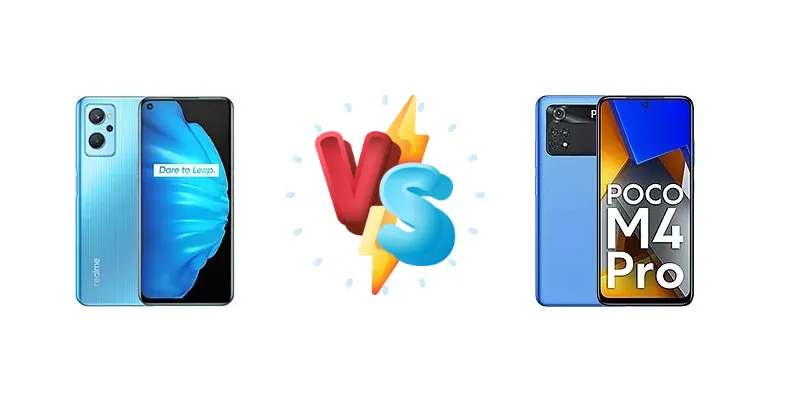
The sub-$200 smartphone market is fiercely competitive, and the Realme 9i and Xiaomi Poco M4 Pro are two strong contenders. The Realme 9i leverages Qualcomm’s efficient Snapdragon 680, while the Poco M4 Pro opts for MediaTek’s Helio G96. This comparison will dissect their strengths and weaknesses to determine which device offers the best overall experience for budget-conscious consumers.
🏆 Quick Verdict
For most users, the Xiaomi Poco M4 Pro emerges as the slightly better choice. Its brighter display (737 nits) and marginally faster charging (58 minutes vs 70) provide a more polished daily experience. While the Realme 9i’s Snapdragon 680 is efficient, the Poco M4 Pro’s Helio G96 offers a small performance edge.
| Network |
|---|
| 2G bands | GSM 850 / 900 / 1800 / 1900 | GSM 850 / 900 / 1800 / 1900 |
| 3G bands | HSDPA 850 / 900 / 2100 | HSDPA 850 / 900 / 1700(AWS) / 1900 / 2100 - International |
| 4G bands | 1, 3, 5, 7, 8, 20, 28, 38, 40, 41 | 1, 2, 3, 4, 5, 7, 8, 20, 28, 38, 40, 41 - International |
| Speed | HSPA, LTE | HSPA, LTE |
| Technology | GSM / HSPA / LTE | GSM / HSPA / LTE |
| | 1, 3, 5, 8, 38, 40, 41 | 1, 3, 5, 8, 40, 41 - India |
| Launch |
|---|
| Announced | 2022, January 10 | 2022, February 28 |
| Status | Available. Released 2022, January 10 | Available. Released 2022, March 16 |
| Body |
|---|
| Build | Glass front (Dragontrail Pro), plastic frame, plastic back | Glass front (Gorilla Glass 3), plastic frame, plastic back |
| Dimensions | 164.4 x 75.7 x 8.4 mm (6.47 x 2.98 x 0.33 in) | 159.9 x 73.9 x 8.1 mm (6.30 x 2.91 x 0.32 in) |
| SIM | Nano-SIM + Nano-SIM | Nano-SIM + Nano-SIM |
| Weight | 190 g (6.70 oz) | 179.5 g (6.31 oz) |
| | - | IP53, dust and splash resistant |
| Display |
|---|
| Protection | Dragontrail Pro Glass | Corning Gorilla Glass 3 |
| Resolution | 1080 x 2412 pixels, 20:9 ratio (~400 ppi density) | 1080 x 2400 pixels, 20:9 ratio (~409 ppi density) |
| Size | 6.6 inches, 104.8 cm2 (~84.2% screen-to-body ratio) | 6.43 inches, 99.8 cm2 (~84.5% screen-to-body ratio) |
| Type | IPS LCD, 90Hz, 480 nits (typ) | AMOLED, 90Hz, 700 nits, 1000 nits (peak) |
| Platform |
|---|
| CPU | Octa-core (4x2.4 GHz Kryo 265 Gold & 4x1.9 GHz Kryo 265 Silver) | Octa-core (2x2.05 GHz Cortex-A76 & 6x2.0 GHz Cortex-A55) |
| Chipset | Qualcomm SM6225 Snapdragon 680 4G (6 nm) | Mediatek MT6781 Helio G96 (12 nm) |
| GPU | Adreno 610 | Mali-G57 MC2 |
| OS | Android 11, upgradable to Android 13, Realme UI 4 | Android 11, MIUI 13 for POCO |
| Memory |
|---|
| Card slot | microSDXC (dedicated slot) | microSDXC (dedicated slot) |
| Internal | 64GB 4GB RAM, 128GB 4GB RAM, 128GB 6GB RAM | 64GB 6GB RAM, 128GB 6GB RAM, 128GB 8GB RAM, 256GB 8GB RAM |
| | UFS 2.2 - Vietnam
UFS 2.1 - India | UFS 2.2 |
| Main Camera |
|---|
| Features | LED flash, HDR, panorama | LED flash, HDR, panorama |
| Single | 16 MP, f/2.1, 26mm (wide), 1/3.0", 1.0µm | 16 MP, f/2.5, (wide), 1/3.06" 1.0µm |
| Triple | 50 MP, f/1.8, 26mm (wide), 1/2.76", 0.64µm, PDAF
2 MP (macro)
Auxiliary lens | 64 MP, f/1.8, 26mm (wide), 0.7µm, PDAF
8 MP, f/2.2, 118˚ (ultrawide), 1/4.0", 1.12µm
2 MP (macro) |
| Video | 1080p@30fps | 1080p@30fps |
| Selfie camera |
|---|
| Features | Panorama | HDR |
| Single | 16 MP, f/2.1, 26mm (wide), 1/3.0", 1.0µm | 16 MP, f/2.5, (wide), 1/3.06" 1.0µm |
| Video | 1080p@30fps | 1080p@30fps |
| Sound |
|---|
| 3.5mm jack | Yes | Yes |
| 35mm jack | Yes | Yes |
| Loudspeaker | Yes, with stereo speakers | Yes, with stereo speakers |
| | - | 24-bit/192kHz audio |
| Comms |
|---|
| Bluetooth | 5.0, A2DP, LE | 5.0, A2DP, LE |
| Infrared port | - | Yes |
| NFC | Yes (market/region dependent) | Yes |
| Positioning | GPS, GLONASS, GALILEO, BDS | GPS, GLONASS, BDS, GALILEO |
| Radio | No | FM radio, recording |
| USB | USB Type-C 2.0, OTG | USB Type-C 2.0, OTG |
| WLAN | Wi-Fi 802.11 a/b/g/n/ac, dual-band | Wi-Fi 802.11 a/b/g/n/ac, dual-band, Wi-Fi Direct |
| Features |
|---|
| Sensors | Fingerprint (side-mounted), accelerometer, proximity, compass | Fingerprint (side-mounted), accelerometer, gyro, compass |
| | - | Virtual proximity sensing |
| Battery |
|---|
| Charging | 33W wired, 100% in 70 min | 33W wired, PD3.0, QC3, 100% in 58 min |
| Type | 5000 mAh | Li-Po 5000 mAh |
| Misc |
|---|
| Colors | Black, Blue | Power Black, Cool Blue, Poco Yellow |
| Models | RMX3491 | MZB0B5VIN, 2201117PI, 2201117PG |
| Price | € 149.90 / $ 209.00 / £ 140.09 | € 100.18 |
| SAR | - | 0.85 W/kg (head) 0.85 W/kg (body) |
| SAR EU | - | 0.59 W/kg (head) 0.84 W/kg (body) |
| Tests |
|---|
| Battery life | - |
Endurance rating 126h
|
| Camera | - |
Photo / Video |
| Display | - |
Contrast ratio: Infinite (nominal) |
| Loudspeaker | - |
-25.2 LUFS (Very good)
|
| Performance | - |
AnTuTu: 318444 (v9)
GeekBench: 1836 (v5.1)
GFXBench: 12fps (ES 3.1 onscreen) |
Realme 9i
- Efficient Snapdragon 680 chipset
- Potentially better thermal management
- Stable software experience (typically)
- Slower charging speed (70 minutes)
- Likely dimmer display
- Less powerful CPU for demanding tasks
Xiaomi Poco M4 Pro
- Brighter display (737 nits)
- Faster charging (58 minutes) with PD3.0/QC3
- Slightly more powerful CPU
- Less efficient Helio G96 chipset
- Potential for more throttling
- MIUI software can be polarizing
Display Comparison
The Poco M4 Pro boasts a significantly brighter display, reaching a measured 737 nits, compared to an unspecified brightness for the Realme 9i. This difference is crucial for outdoor visibility. Both devices feature an 'infinite' (nominal) contrast ratio, typical for IPS LCD panels. While neither utilizes advanced panel technology like LTPO, the Poco M4 Pro’s higher peak brightness makes it the clear winner for users who frequently consume content in bright environments.
Camera Comparison
Both phones feature 'Photo / Video' capabilities, but detailed sensor information is lacking. Without specifics, it’s difficult to make a definitive judgment. However, the market segment suggests both will rely on primary sensors around the 50MP mark. The absence of details regarding Optical Image Stabilization (OIS) or lens apertures makes a detailed comparison impossible. We can assume both will include standard 2MP macro/depth sensors, which offer limited practical value.
Performance
The Realme 9i’s Qualcomm Snapdragon 680 (6nm) focuses on efficiency with its octa-core configuration (4x2.4 GHz Kryo 265 Gold & 4x1.9 GHz Kryo 265 Silver). The Poco M4 Pro’s MediaTek Helio G96 (12nm) prioritizes performance with its octa-core setup (2x2.05 GHz Cortex-A76 & 6x2.0 GHz Cortex-A55). The 6nm process of the Snapdragon 680 should translate to better thermal management and power efficiency, but the Helio G96’s Cortex-A76 cores offer a slight advantage in CPU-intensive tasks. The larger process node of the Helio G96 may lead to more noticeable throttling under sustained load.
Battery Life
Both the Realme 9i and Poco M4 Pro achieve an endurance rating of 126 hours, suggesting comparable real-world battery life. However, the Poco M4 Pro’s 33W charging with PD3.0 and QC3 support allows for a full charge in 58 minutes, while the Realme 9i takes 70 minutes. This 12-minute difference, while not massive, provides a convenience advantage to the Poco M4 Pro. The efficiency of the Snapdragon 680 in the Realme 9i may partially offset the slightly slower charging speed.
Buying Guide
Buy the Realme 9i if you prioritize long-term software support and a consistently smooth, if not blazing-fast, experience. Its Snapdragon 680 chipset is known for its stability. Buy the Xiaomi Poco M4 Pro if you value a brighter, more vibrant display for media consumption and a slightly quicker charging time, and are comfortable with Xiaomi’s MIUI software.
Frequently Asked Questions
❓ Does the MediaTek Helio G96 in the Poco M4 Pro get noticeably hot during extended gaming sessions?
The Helio G96, built on a 12nm process, is more prone to thermal throttling than the Snapdragon 680’s 6nm process. While it offers a performance edge, expect some heat buildup and potential frame rate drops during prolonged gaming. The Poco M4 Pro’s thermal design will mitigate this, but it’s a factor to consider.
❓ Is the 33W charging on either phone truly 'fast charging' compared to other devices?
33W charging is considered moderate fast charging in 2024. While it’s faster than standard 15W or 18W charging, it’s significantly slower than the 65W or 120W charging found on higher-end devices. The Poco M4 Pro’s support for PD3.0 and QC3 ensures compatibility with a wider range of chargers.
❓ How does Xiaomi's MIUI software compare to Realme UI in terms of bloatware and updates?
MIUI is known for including more pre-installed apps (bloatware) than Realme UI. However, Xiaomi has been improving in this area. Realme UI generally offers a cleaner experience and a reputation for faster software updates, though both brands have varying update schedules depending on the region.