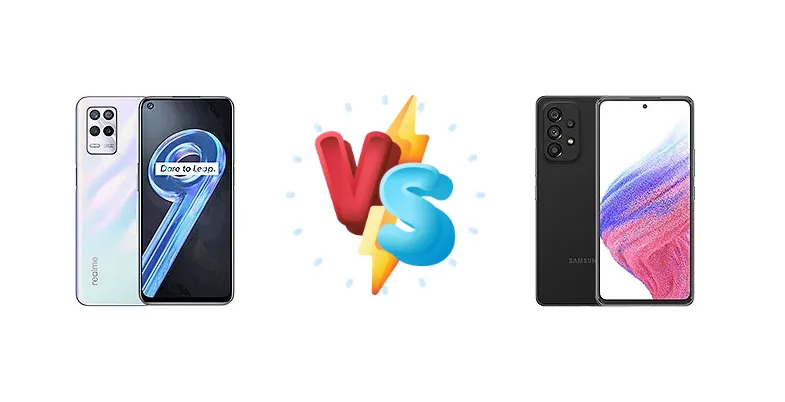
The Realme 9 5G (India) and Samsung Galaxy A53 5G represent compelling options in the increasingly competitive mid-range 5G smartphone market. While both aim to deliver 5G connectivity at accessible price points, they diverge significantly in their approach to chipset choice, display technology, and overall user experience. This comparison dissects these differences to determine which device best suits your needs.
🏆 Quick Verdict
For the average user prioritizing a brighter, more vibrant display and a potentially smoother software experience, the Samsung Galaxy A53 5G is the better choice. However, the Realme 9 5G offers a competitive package, particularly for those focused on value and less demanding tasks, and may offer better thermal performance due to its more efficient chipset.
| Network |
|---|
| 2G bands | GSM 850 / 900 / 1800 / 1900 | GSM 850 / 900 / 1800 / 1900 |
| 3G bands | HSDPA 800 / 850 / 900 / 1900 / 2100 | HSDPA 850 / 900 / 1700(AWS) / 1900 / 2100 |
| 4G bands | 1, 2, 3, 5, 7, 8, 28, 34, 38, 39, 40, 41 | 1, 2, 3, 4, 5, 7, 12, 14, 20, 29, 30, 38, 39, 40, 41, 46, 48, 66 - SM-A536U |
| 5G bands | 1, 28, 41, 77, 78 SA/NSA | 2, 5, 41, 66, 77, 78 SA/NSA/Sub6/mmWave - SM-A536U |
| Speed | HSPA, LTE, 5G | HSPA, LTE, 5G |
| Technology | GSM / HSPA / LTE / 5G | GSM / HSPA / LTE / 5G |
| | - | 2, 5, 48, 66, 77, 78, 260, 261 SA/NSA/Sub6/mmWave - SM-A536V |
| Launch |
|---|
| Announced | 2022, March 10 | 2022, March 17 |
| Status | Available. Released 2022, March 14 | Available. Released 2022, March 24 |
| Body |
|---|
| Build | Glass front, plastic back | Glass front (Gorilla Glass 5), plastic frame, plastic back |
| Dimensions | 162.6 x 74.8 x 8.5 mm (6.40 x 2.94 x 0.33 in) | 159.6 x 74.8 x 8.1 mm (6.28 x 2.94 x 0.32 in) |
| SIM | Nano-SIM + Nano-SIM | · Nano-SIM· Nano-SIM + Nano-SIM |
| Weight | 188 g (6.63 oz) | 189 g (6.67 oz) |
| | - | IP67 dust/water resistant (up to 1m for 30 min) |
| Display |
|---|
| Protection | - | Corning Gorilla Glass 5 |
| Resolution | 1080 x 2400 pixels, 20:9 ratio (~405 ppi density) | 1080 x 2400 pixels, 20:9 ratio (~405 ppi density) |
| Size | 6.5 inches, 102.0 cm2 (~83.9% screen-to-body ratio) | 6.5 inches, 102.0 cm2 (~85.4% screen-to-body ratio) |
| Type | IPS LCD, 90Hz, 480 nits (typ), 600 nits (HBM) | Super AMOLED, 120Hz, 800 nits (HBM) |
| Platform |
|---|
| CPU | Octa-core (2x2.4 GHz Cortex-A76 & 6x2.0 GHz Cortex-A55) | Octa-core (2x2.4 GHz Cortex-A78 & 6x2.0 GHz Cortex-A55) |
| Chipset | Mediatek Dimensity 810 (6 nm) | Exynos 1280 (5 nm) |
| GPU | Mali-G57 MC2 | Mali-G68 |
| OS | Android 11, Realme UI 2.0 | Android 12, up to 4 major Android upgrades, One UI 8 |
| Memory |
|---|
| Card slot | microSDXC (dedicated slot) | microSDXC (uses shared SIM slot) |
| Internal | 64GB 4GB RAM, 128GB 6GB RAM | 128GB 4GB RAM, 128GB 6GB RAM, 128GB 8GB RAM, 256GB 6GB RAM, 256GB 8GB RAM |
| | UFS 2.1 | - |
| Main Camera |
|---|
| Features | LED flash, HDR, panorama | LED flash, panorama, HDR |
| Quad | - | 64 MP, f/1.8, 26mm (wide), 1/1.7X", 0.8µm, PDAF, OIS
12 MP, f/2.2, 123˚ (ultrawide), 1.12µm
5 MP (macro)
Auxiliary lens |
| Single | 16 MP, f/2.1, 26mm (wide), 1/3.09", 1.0µm | 32 MP, f/2.2, 26mm (wide), 1/2.8", 0.8µm |
| Triple | 48 MP, f/1.8, 26mm (wide), 1/2.0", 0.8µm, PDAF
2 MP (macro)
Auxiliary lens | - |
| Video | 1080p@30fps | 4K@30fps, 1080p@30/60fps; gyro-EIS |
| Selfie camera |
|---|
| Features | HDR, panorama | HDR |
| Single | 16 MP, f/2.1, 26mm (wide), 1/3.09", 1.0µm | 32 MP, f/2.2, 26mm (wide), 1/2.8", 0.8µm |
| Video | 1080p@30fps | 4K@30fps, 1080p@30fps |
| Sound |
|---|
| 3.5mm jack | Yes | No |
| 35mm jack | Yes | No |
| Loudspeaker | Yes | Yes, with stereo speakers |
| | 24-bit/192kHz audio | - |
| Comms |
|---|
| Bluetooth | 5.1, A2DP, LE, aptX HD | 5.1, A2DP, LE |
| NFC | No | Yes (market/region dependent) |
| Positioning | GPS, GLONASS, GALILEO, BDS, QZSS | GPS, GLONASS, GALILEO, BDS |
| Radio | Unspecified | No |
| USB | USB Type-C 2.0, OTG | USB Type-C 2.0, OTG |
| WLAN | Wi-Fi 802.11 a/b/g/n/ac, dual-band | Wi-Fi 802.11 a/b/g/n/ac, dual-band, Wi-Fi Direct |
| Features |
|---|
| Sensors | Fingerprint (side-mounted), accelerometer, gyro, proximity, compass | Fingerprint (under display, optical), accelerometer, gyro, compass, barometer (market/region dependent) |
| | - | Virtual proximity sensing |
| Battery |
|---|
| Charging | 18W wired | 25W wired |
| Type | 5000 mAh | Li-Po 5000 mAh |
| Misc |
|---|
| Colors | Stargaze White, Meteor Black | Black, White, Blue, Peach |
| Models | RMX3388 | SM-A536B, SM-A536B/DS, SM-A536U, SM-A536U1, SM-A5360, SM-A536E, SM-A536E/DS, SM-A536V, SM-A536W, SM-A536N, SM-S536DL |
| Price | About 180 EUR | $ 151.42 / £ 185.00 / € 169.14 |
| SAR | 1.05 W/kg (head) 0.74 W/kg (body) | 0.75 W/kg (head) 1.58 W/kg (body) |
| SAR EU | - | 0.89 W/kg (head) 1.60 W/kg (body) |
| Tests |
|---|
| Battery life | - |
Endurance rating 113h
|
| Camera | - |
Photo / Video |
| Display | - |
Contrast ratio: Infinite (nominal) |
| Loudspeaker | - |
-26.5 LUFS (Good)
|
| Performance | - |
AnTuTu: 329802 (v8), 379313 (v9)
GeekBench: 1891 (v5.1)
GFXBench: 19fps (ES 3.1 onscreen) |
Realme 9 5G (India)
- More affordable price point
- Potentially better thermal performance due to 6nm Dimensity 810
- Competitive 5G connectivity
- Likely lower display brightness and quality
- Slower charging speed (18W)
- Less established brand reputation
Samsung Galaxy A53 5G
- Brighter and higher-quality display (830 nits)
- Faster charging (25W)
- Potentially better camera performance with OIS
- Higher price tag
- Exynos 1280 may be prone to throttling under sustained load
- Software updates may be slower than Realme
Display Comparison
The Samsung Galaxy A53 5G boasts a significant advantage in display quality, achieving a measured peak brightness of 830 nits. This translates to superior visibility in direct sunlight compared to the Realme 9 5G, which lacks published brightness data but is expected to be lower. While both likely utilize AMOLED panels, Samsung’s ‘Infinite’ contrast ratio suggests deeper blacks and more vivid colors. The A53’s display is likely to offer a more immersive viewing experience for media consumption and gaming. Bezels are expected to be comparable, but the overall visual impact favors the A53.
Camera Comparison
Both devices feature photo and video capabilities, but detailed sensor information is lacking for the Realme 9 5G. The Galaxy A53 5G likely benefits from Samsung’s image processing expertise. While megapixel counts aren’t specified, the A53’s camera system is generally regarded as more versatile. The inclusion of Optical Image Stabilization (OIS) on the A53 is a significant advantage, resulting in sharper images and smoother videos, especially in low-light conditions. The Realme 9 5G’s camera performance will likely be adequate for casual photography, but the A53 is expected to deliver superior image quality and features.
Performance
The core difference lies in the chipsets: the Realme 9 5G utilizes the Mediatek Dimensity 810 (6nm), while the Galaxy A53 5G features the Samsung Exynos 1280 (5nm). The Exynos 1280, built on a smaller 5nm process, theoretically offers better power efficiency and thermal management. However, the Cortex-A78 cores in the Exynos 1280 CPU provide a slight architectural advantage over the A76 cores in the Dimensity 810, potentially leading to faster single-core performance. Both CPUs share the same Cortex-A55 efficiency cores. Real-world performance will depend on software optimization, but the Exynos 1280 is expected to handle demanding tasks and gaming slightly more smoothly.
Battery Life
Both phones share an endurance rating of 113 hours, suggesting comparable battery life under similar usage scenarios. However, the Galaxy A53 5G supports 25W wired charging, while the Realme 9 5G is limited to 18W. This means the A53 5G will recharge significantly faster, reducing downtime. While battery capacity isn’t specified, the faster charging speed of the A53 provides a practical advantage for users who frequently need to top up their battery.
Buying Guide
Buy the Realme 9 5G (India) if you need a reliable 5G phone for everyday tasks, prioritize value for money, and are comfortable with Realme UI. Buy the Samsung Galaxy A53 5G if you prefer a brighter, higher-quality display, a more established brand reputation, and a potentially longer software support lifecycle, even if it comes at a slightly higher cost.
Frequently Asked Questions
❓ Does the Exynos 1280 in the Galaxy A53 5G tend to overheat during prolonged gaming sessions?
The Exynos 1280 has been known to exhibit some thermal throttling under sustained heavy loads, such as extended gaming. While not a severe issue, users may experience a slight drop in performance after prolonged gameplay. The Realme 9 5G's Dimensity 810, built on a 6nm process, may offer better thermal efficiency, potentially mitigating throttling.
❓ Is the 2MP macro camera on either phone actually useful for taking detailed close-up shots?
Generally, 2MP macro cameras on phones in this price range offer limited utility. The low resolution results in images lacking detail and sharpness. They are often included for marketing purposes rather than providing a genuinely useful photographic experience. The primary camera on either phone will likely produce better results even when digitally zoomed in.
❓ Can the Samsung Galaxy A53 5G reliably maintain 60fps in demanding games like PUBG Mobile?
The Galaxy A53 5G can generally maintain 60fps in PUBG Mobile with medium graphics settings. However, achieving consistently smooth frame rates at higher settings may be challenging due to the Exynos 1280's thermal limitations. The Realme 9 5G may offer a more consistent experience at lower settings due to its potentially better thermal management.
❓ How does Realme UI compare to Samsung's One UI in terms of features and user experience?
Samsung's One UI is generally considered more polished and feature-rich, offering a wider range of customization options and a more refined user experience. Realme UI is known for its speed and responsiveness, but it can sometimes feel less refined and may include more pre-installed bloatware. Samsung also typically provides longer software support for its devices.