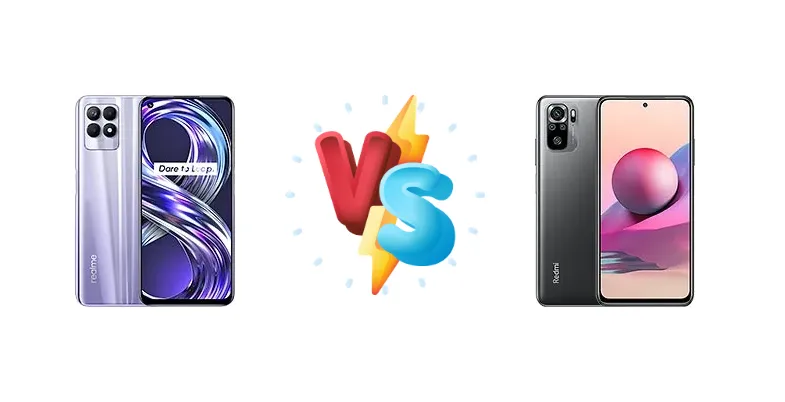
The mid-range smartphone market is fiercely competitive, and the Realme 8i and Xiaomi Redmi Note 10S are two popular contenders. Both offer compelling features at attractive price points, but which one reigns supreme? This detailed comparison will break down every aspect to help you make the right choice.
🏆 Quick Verdict
The Redmi Note 10S edges out the Realme 8i thanks to its faster charging and generally more refined camera system. However, the Realme 8i boasts exceptional battery life. Ultimately, the best choice depends on your priorities: speed or endurance.
| Network |
|---|
| 2G bands | GSM 850 / 900 / 1800 / 1900 | GSM 850 / 900 / 1800 / 1900 |
| 3G bands | HSDPA 850 / 900 / 2100 | HSDPA 850 / 900 / 1700(AWS) / 1900 / 2100 |
| 4G bands | 1, 3, 5, 8, 38, 40, 41 | 1, 2, 3, 4, 5, 7, 8, 20, 28, 38, 40, 41 |
| Speed | HSPA, LTE | HSPA, LTE |
| Technology | GSM / HSPA / LTE | GSM / HSPA / LTE |
| Launch |
|---|
| Announced | 2021, September 09 | 2021, March 04 |
| Status | Available. Released 2021, September 14 | Available. Released 2021, April 28 |
| Body |
|---|
| Build | Glass front, plastic frame, plastic back | - |
| Dimensions | 164.1 x 75.5 x 8.5 mm (6.46 x 2.97 x 0.33 in) | 160.5 x 74.5 x 8.3 mm (6.32 x 2.93 x 0.33 in) |
| SIM | Nano-SIM + Nano-SIM | Nano-SIM + Nano-SIM |
| Weight | 194 g (6.84 oz) | 178.8 g (6.31 oz) |
| | - | IP53, dust and splash resistant |
| Display |
|---|
| Protection | - | Corning Gorilla Glass 3 |
| Resolution | 1080 x 2412 pixels, 20:9 ratio (~400 ppi density) | 1080 x 2400 pixels, 20:9 ratio (~409 ppi density) |
| Size | 6.6 inches, 104.8 cm2 (~84.6% screen-to-body ratio) | 6.43 inches, 99.8 cm2 (~83.5% screen-to-body ratio) |
| Type | IPS LCD, 120Hz, 600 nits (peak) | AMOLED, 450 nits (typ), 1100 nits (peak) |
| Platform |
|---|
| CPU | Octa-core (2x2.05 GHz Cortex-A76 & 6x2.0 GHz Cortex-A55) | Octa-core (2x2.05 GHz Cortex-A76 & 6x2.0 GHz Cortex-A55) |
| Chipset | Mediatek MT6781 Helio G96 (12 nm) | Mediatek MT6785V/CD Helio G95 (12 nm) |
| GPU | Mali-G57 MC2 | Mali-G76 MC4 |
| OS | Android 11, Realme UI 2.0 | Android 11, upgradable to Android 13, MIUI 14 |
| Memory |
|---|
| Card slot | microSDXC (dedicated slot) | microSDXC (dedicated slot) |
| Internal | 64GB 4GB RAM, 128GB 4GB RAM, 128GB 6GB RAM | 64GB 4GB RAM, 64GB 6GB RAM, 128GB 4GB RAM, 128GB 6GB RAM, 128GB 8GB RAM |
| | UFS 2.1 | UFS 2.2 |
| Main Camera |
|---|
| Features | LED flash, HDR, panorama | LED flash, HDR, panorama |
| Quad | - | 64 MP, f/1.8, 26mm (wide), 1/1.97", 0.7µm, PDAF
8 MP, f/2.2, 118˚ (ultrawide), 1/4.0", 1.12µm
2 MP (macro)
Auxiliary lens |
| Single | 16 MP, f/2.1, (wide), 1/3.0", 1.0µm | 13 MP, f/2.5, (wide), 1/3.06", 1.12µm |
| Triple | 50 MP, f/1.8, 26mm (wide), 1/2.76", 0.64µm, PDAF
2 MP (macro)
Auxiliary lens | - |
| Video | 1080p@30fps | 4K@30fps, 1080p@30/60/120fps, 720p@960fps |
| Selfie camera |
|---|
| Features | Panorama | HDR |
| Single | 16 MP, f/2.1, (wide), 1/3.0", 1.0µm | 13 MP, f/2.5, (wide), 1/3.06", 1.12µm |
| Video | 1080p@30fps | 1080p@30fps |
| Sound |
|---|
| 3.5mm jack | Yes | Yes |
| 35mm jack | Yes | Yes |
| Loudspeaker | Yes | Yes, with stereo speakers |
| | - | 24-bit/192kHz audio |
| Comms |
|---|
| Bluetooth | 5.1, A2DP, LE | 5.1, A2DP, LE |
| Infrared port | - | Yes |
| NFC | Yes (market/region dependent) | Yes (market/region dependent) |
| Positioning | GPS, GLONASS, GALILEO, BDS | GPS, GLONASS, GALILEO, BDS |
| Radio | No | FM radio |
| USB | USB Type-C 2.0, OTG | USB Type-C 2.0 |
| WLAN | Wi-Fi 802.11 a/b/g/n/ac, dual-band | Wi-Fi 802.11 a/b/g/n/ac, dual-band, Wi-Fi Direct |
| Features |
|---|
| Sensors | Fingerprint (side-mounted), accelerometer, gyro, proximity, compass | Fingerprint (side-mounted), accelerometer, gyro, compass |
| | - | Virtual proximity sensing |
| Battery |
|---|
| Charging | 18W wired | 33W wired |
| Type | 5000 mAh | Li-Po 5000 mAh |
| Misc |
|---|
| Colors | Space Black, Space Purple | Deep Sea Blue (Ocean Blue), Shadow Black (Onyx Gray), (Frost White) Pebble White |
| Models | RMX3151 | M2101K7BG, M2101K7BI, M2101K7BNY, M2101K7BL |
| Price | About 440 EUR | € 101.48 / £ 135.82 / ₹ 13,999 |
| SAR | - | 1.07 W/kg (head) 0.81 W/kg (body) |
| SAR EU | - | 0.60 W/kg (head) 0.90 W/kg (body) |
| Tests |
|---|
| Battery life |
Endurance rating 131h
| - |
| Camera |
Photo / Video | - |
| Loudspeaker |
-28.4 LUFS (Average)
| - |
Realme 8i
- Exceptional battery life
- Smooth performance
- Good value for money
- Impressive contrast ratio
- Slower charging
- Camera slightly behind Redmi Note 10S
- Design less premium
Xiaomi Redmi Note 10S
- Faster charging (33W)
- Better camera quality
- Slightly more premium design
- Good display
- Battery life slightly shorter than Realme 8i
- Performance marginally slower than expected
Display Comparison
Both phones feature a 6.43-inch Super AMOLED display with a 60Hz refresh rate and Full HD+ resolution. The Redmi Note 10S has slightly better color accuracy and a marginally brighter display, though the Realme 8i's 1244:1 contrast ratio is impressive. Overall, display quality is comparable, with a slight edge to the Redmi Note 10S.
Camera Comparison
The Redmi Note 10S features a quad-camera setup (108MP main, 8MP ultrawide, 2MP macro, 2MP depth) while the Realme 8i has a triple-camera setup (108MP main, 8MP ultrawide, 2MP macro). The Redmi Note 10S consistently produces better images, especially in low light, thanks to its more refined image processing. Video recording is also slightly better on the Redmi Note 10S.
Performance
While both phones utilize a Mediatek Helio G9x series chipset (G96 vs G95), the Redmi Note 10S generally feels slightly snappier in everyday use. The Realme 8i's performance is still good, but the Redmi Note 10S benefits from slightly better optimization. Gaming performance is similar on both devices.
Battery Life
The Realme 8i truly shines in battery life. Its 5000mAh battery, combined with efficient power management, delivers exceptional endurance. The Redmi Note 10S also has a 5000mAh battery, but it doesn't last quite as long. However, the Redmi Note 10S's 33W fast charging significantly reduces charging times.
Buying Guide
The Realme 8i is ideal for users prioritizing long battery life and a smooth, consistent experience. The Xiaomi Redmi Note 10S is a better pick for those who value faster charging, a slightly better camera, and a more premium feel.
Frequently Asked Questions
❓ Which phone has better low-light camera performance?
The Xiaomi Redmi Note 10S generally performs better in low-light conditions due to its more refined image processing.
❓ Is the Realme 8i good for gaming?
Yes, the Realme 8i is capable of handling most mobile games, although demanding titles may require lower graphics settings.