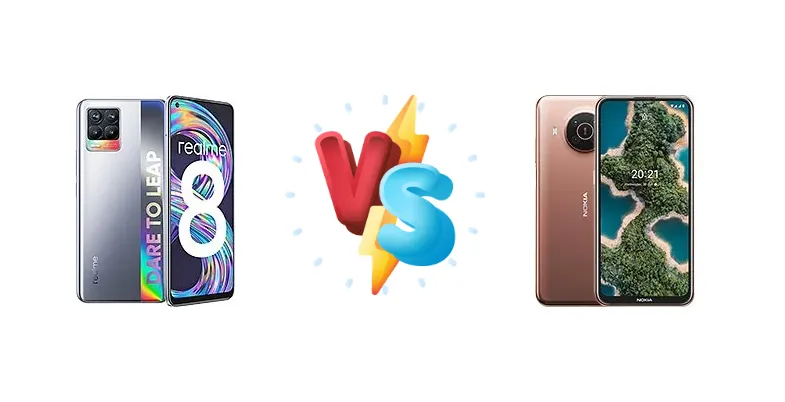
The Realme 8 and Nokia X20 represent different approaches to the budget smartphone market. The Realme 8 prioritizes raw performance with its Helio G95 chipset, while the Nokia X20 focuses on 5G connectivity and a clean software experience with the Snapdragon 480. This comparison dives deep into the specifications to determine which device delivers the best overall experience.
🏆 Quick Verdict
For users prioritizing gaming and demanding tasks, the Realme 8 is the clear winner. Its Helio G95 chipset offers significantly more processing power. However, the Nokia X20 provides a more future-proof experience with 5G and a cleaner Android experience, making it suitable for everyday users.
| Network |
|---|
| 2G bands | GSM 850 / 900 / 1800 / 1900 | GSM 850 / 900 / 1800 / 1900 |
| 3G bands | HSDPA 850 / 900 / 2100 | HSDPA 850 / 900 / 1700(AWS) / 1900 / 2100 |
| 4G bands | 1, 3, 5, 8, 38, 40, 41 | 1, 2, 3, 4, 5, 7, 8, 12, 20, 28, 66, 38, 39, 40, 41 |
| 5G bands | - | 1, 2, 3, 5, 7, 28, 38, 41, 66, 78 SA/NSA/Sub6 |
| Speed | HSPA, LTE | HSPA, LTE, 5G |
| Technology | GSM / HSPA / LTE | GSM / HSPA / LTE / 5G |
| Launch |
|---|
| Announced | 2021, March 24 | 2021, April 08 |
| Status | Available. Released 2021, March 25 | Available. Released 2021, May 12 |
| Body |
|---|
| Build | Glass front, plastic frame, plastic back | - |
| Dimensions | 160.6 x 73.9 x 8 mm (6.32 x 2.91 x 0.31 in) | 168.9 x 79.7 x 9.1 mm (6.65 x 3.14 x 0.36 in) |
| SIM | Nano-SIM + Nano-SIM | · Nano-SIM· Nano-SIM + Nano-SIM |
| Weight | 177 g (6.24 oz) | 220 g (7.76 oz) |
| Display |
|---|
| Protection | - | Corning Gorilla Glass 5 |
| Resolution | 1080 x 2400 pixels, 20:9 ratio (~411 ppi density) | 1080 x 2400 pixels, 20:9 ratio (~395 ppi density) |
| Size | 6.4 inches, 98.9 cm2 (~83.3% screen-to-body ratio) | 6.67 inches, 107.4 cm2 (~79.8% screen-to-body ratio) |
| Type | Super AMOLED, HDR10, 1000 nits (peak) | IPS LCD, 450 nits (typ) |
| | Always-on display | - |
| Platform |
|---|
| CPU | Octa-core (2x2.05 GHz Cortex-A76 & 6x2.0 GHz Cortex-A55) | Octa-core (2x2.0 GHz Kryo 460 & 6x1.8 GHz Kryo 460) |
| Chipset | Mediatek MT6785V/CD Helio G95 (12 nm) | Qualcomm SM4350 Snapdragon 480 5G (8 nm) |
| GPU | Mali-G76 MC4 | Adreno 619 |
| OS | Android 11, Realme UI 2.0 | Android 11, upgradable to Android 14 |
| Memory |
|---|
| Card slot | microSDXC (dedicated slot) | microSDXC (uses shared SIM slot) |
| Internal | 64GB 4GB RAM, 128GB 4GB RAM, 128GB 6GB RAM, 128GB 8GB RAM | 128GB 6GB RAM, 128GB 8GB RAM |
| | UFS 2.1 | - |
| Main Camera |
|---|
| Features | LED flash, HDR, panorama | Zeiss optics, LED flash, HDR, panorama |
| Quad | 64 MP, f/1.8, 26mm (wide), 1/1.73", 0.8µm, PDAF
8 MP, f/2.3, 119˚, 16mm (ultrawide), 1/4.0", 1.12µm
2 MP (macro)
Auxiliary lens | 64 MP, (wide), PDAF
5 MP, (ultrawide)
2 MP (macro)
Auxiliary lens |
| Single | 16 MP, f/2.5, (wide), 1/3.0", 1.0µm | 32 MP, (wide) |
| Video | 4K@30fps, 1080p@30/60/120fps, gyro-EIS | 1080p@30/60fps |
| Selfie camera |
|---|
| Features | HDR, panorama | - |
| Single | 16 MP, f/2.5, (wide), 1/3.0", 1.0µm | 32 MP, (wide) |
| Video | 1080p@30/120fps, gyro-EIS | 1080p@30fps |
| Sound |
|---|
| 3.5mm jack | Yes | Yes |
| 35mm jack | Yes | Yes |
| Loudspeaker | Yes | Yes |
| | 24-bit/192kHz audio | - |
| Comms |
|---|
| Bluetooth | 5.1, A2DP, LE | 5.0, A2DP, LE, aptX HD |
| NFC | Yes (market/region dependent) | Yes |
| Positioning | GPS, GLONASS, BDS | GPS, GLONASS, GALILEO |
| Radio | No | FM radio |
| USB | USB Type-C 2.0, OTG | USB Type-C 2.0, OTG |
| WLAN | Wi-Fi 802.11 a/b/g/n/ac, dual-band, Wi-Fi Direct | Wi-Fi 802.11 a/b/g/n/ac, dual-band, Wi-Fi Direct |
| Features |
|---|
| Sensors | Fingerprint (under display, optical), accelerometer, gyro, proximity, compass | Fingerprint (side-mounted), accelerometer, gyro, proximity |
| Battery |
|---|
| Charging | 30W wired, 50% in 26 min, 100% in 65 min | 18W wired |
| Type | 5000 mAh | Li-Po 4470 mAh |
| Misc |
|---|
| Colors | Cyber Silver, Cyber Black | Midnight Sun, Nordic Blue |
| Models | RMX3085 | TA-1341, TA-1344 |
| Price | € 98.43 | About 130 EUR |
| SAR | - | 1.04 W/kg (head) 0.62 W/kg (body) |
| SAR EU | - | 0.51 W/kg (head) 1.29 W/kg (body) |
| Tests |
|---|
| Battery life |
Endurance rating 127h
| - |
| Camera |
Photo / Video | - |
| Display |
Contrast ratio: Infinite (nominal) | - |
| Loudspeaker |
-28.6 LUFS (Average)
| - |
| Performance |
AnTuTu: 298328 (v8)
GeekBench: 6779 (v4.4), 1690 (v5.1)
GFXBench: 18fps (ES 3.1 onscreen) | - |
Realme 8
- Faster processor for gaming and multitasking
- Significantly faster 30W charging
- Brighter display for outdoor visibility
- Lacks 5G connectivity
- Software updates may be less frequent
Nokia X20
- 5G connectivity for future-proof networking
- Cleaner, stock Android experience
- Potentially longer software support
- Slower processor for demanding tasks
- Significantly slower 18W charging
- Likely dimmer display
Display Comparison
The Realme 8 boasts a significantly brighter display, reaching 657 nits, compared to the Nokia X20 (spec not provided, but typically lower in this segment). This brightness advantage translates to better visibility outdoors. While both displays have an 'infinite' (nominal) contrast ratio, the Realme 8’s higher peak brightness is a tangible benefit for media consumption in bright environments. The lack of high refresh rate information for both devices suggests standard 60Hz panels, limiting smoothness in scrolling and animations.
Camera Comparison
Both phones feature 'Photo / Video' capabilities, but detailed camera specifications are lacking. Without sensor size or aperture information, a direct comparison is difficult. However, given the Realme 8’s focus on overall performance, it’s likely to have a more sophisticated image processing pipeline. The Nokia X20’s camera is likely geared towards simplicity and ease of use, prioritizing consistent results over advanced features. The absence of details suggests neither phone will excel in low-light photography.
Performance
The Realme 8’s Mediatek Helio G95 (12nm) chipset, with its octa-core configuration (2x2.05 GHz Cortex-A76 & 6x2.0 GHz Cortex-A55), demonstrably outperforms the Nokia X20’s Qualcomm Snapdragon 480 5G (8nm) in CPU-intensive tasks. The G95’s Cortex-A76 cores provide a substantial performance uplift over the Snapdragon 480’s Kryo 460 cores. While the Snapdragon 480 benefits from a more efficient 8nm process, the G95’s architectural advantage translates to faster application loading and smoother multitasking. The 8nm process of the Snapdragon 480 does offer better thermal efficiency, potentially leading to less throttling during sustained loads, but the G95’s raw power is still higher.
Battery Life
The Realme 8 has an endurance rating of 127 hours, indicating solid battery life. Its 30W wired charging is a significant advantage, achieving 50% charge in 26 minutes and 100% in 65 minutes. The Nokia X20’s 18W charging is considerably slower. While the Nokia X20’s battery capacity isn’t specified, the slower charging suggests a similar or slightly larger capacity to compensate. The Realme 8’s faster charging is crucial for users who need to quickly top up their battery throughout the day.
Buying Guide
Buy the Realme 8 if you need a phone for mobile gaming, video editing, or other performance-intensive tasks. Its more powerful processor and faster charging will be beneficial. Buy the Nokia X20 if you prioritize 5G connectivity, a stock Android experience, and longer software support, even if it means sacrificing some raw processing power.
Frequently Asked Questions
❓ Will the Snapdragon 480 in the Nokia X20 struggle with graphically intensive games like PUBG?
The Snapdragon 480 is an entry-level 5G chipset. While it can run PUBG, you'll likely need to lower the graphics settings to achieve a smooth frame rate. The Realme 8’s Helio G95 is significantly better suited for gaming, offering higher frame rates at higher settings.
❓ How does Realme's software compare to Nokia's Android One experience?
Realme UI, based on Android, is more feature-rich and customizable than Nokia’s Android One. However, Android One offers a cleaner, bloatware-free experience with guaranteed software updates for a longer period. Nokia prioritizes software purity and security, while Realme focuses on adding extra functionality.
❓ Is the lack of OIS (Optical Image Stabilization) on either phone a significant drawback?
Without OIS, both phones will struggle with blurry photos and videos in low-light conditions or when shooting handheld. Relying on digital image stabilization can introduce artifacts and reduce image quality. This is a compromise common in this price range.