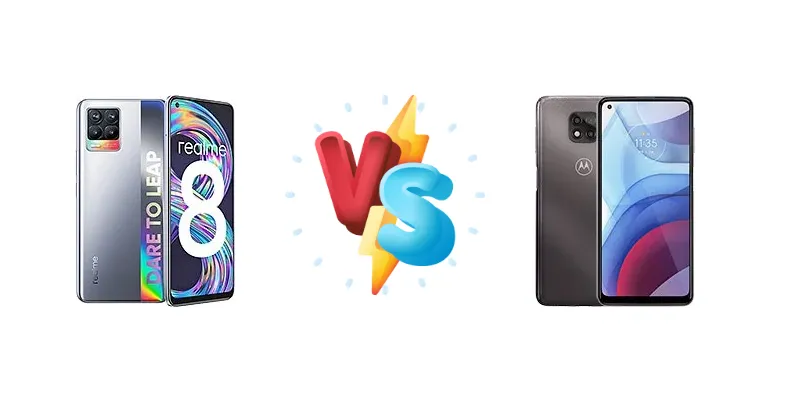
The Realme 8 and Motorola Moto G Power (2021) represent distinct approaches to the budget smartphone market. The Realme 8 prioritizes performance and charging speed, while the Moto G Power focuses on maximizing battery endurance. This comparison dissects their key specifications to determine which device best suits your priorities.
🏆 Quick Verdict
For users prioritizing performance and quick charging, the Realme 8 is the clear winner. Its Helio G95 chipset and 30W charging significantly outperform the Moto G Power’s Snapdragon 662 and 15W charging. However, the Moto G Power’s exceptional battery life makes it ideal for users who need multi-day usage.
| Network |
|---|
| 2G bands | GSM 850 / 900 / 1800 / 1900 | GSM 850 / 900 / 1800 / 1900 |
| 3G bands | HSDPA 850 / 900 / 2100 | HSDPA 850 / 900 / 1700(AWS) / 1900 / 2100 |
| 4G bands | 1, 3, 5, 8, 38, 40, 41 | 1, 2, 3, 4, 5, 7, 8, 12, 13, 14, 17, 25, 26, 29, 30, 38, 41, 66, 71 |
| Speed | HSPA, LTE | HSPA, LTE |
| Technology | GSM / HSPA / LTE | GSM / CDMA / HSPA / EVDO / LTE |
| | - | CDMA2000 1xEV-DO |
| Launch |
|---|
| Announced | 2021, March 24 | 2021, January 08 |
| Status | Available. Released 2021, March 25 | Available. Released 2021, January 14 |
| Body |
|---|
| Build | Glass front, plastic frame, plastic back | Glass front, plastic back, plastic frame |
| Dimensions | 160.6 x 73.9 x 8 mm (6.32 x 2.91 x 0.31 in) | 165.3 x 75.9 x 9.5 mm (6.51 x 2.99 x 0.37 in) |
| SIM | Nano-SIM + Nano-SIM | Nano-SIM |
| Weight | 177 g (6.24 oz) | 206.5 g (7.30 oz) |
| | - | Water-repellent coating |
| Display |
|---|
| Resolution | 1080 x 2400 pixels, 20:9 ratio (~411 ppi density) | 720 x 1600 pixels, 20:9 ratio (~266 ppi density) |
| Size | 6.4 inches, 98.9 cm2 (~83.3% screen-to-body ratio) | 6.6 inches, 105.2 cm2 (~83.8% screen-to-body ratio) |
| Type | Super AMOLED, HDR10, 1000 nits (peak) | IPS LCD |
| | Always-on display | - |
| Platform |
|---|
| CPU | Octa-core (2x2.05 GHz Cortex-A76 & 6x2.0 GHz Cortex-A55) | Octa-core (4x2.0 GHz Kryo 260 Gold & 4x1.8 GHz Kryo 260 Silver) |
| Chipset | Mediatek MT6785V/CD Helio G95 (12 nm) | Qualcomm SM6115 Snapdragon 662 (11 nm) |
| GPU | Mali-G76 MC4 | Adreno 610 |
| OS | Android 11, Realme UI 2.0 | Android 10 |
| Memory |
|---|
| Card slot | microSDXC (dedicated slot) | microSDXC (dedicated slot) |
| Internal | 64GB 4GB RAM, 128GB 4GB RAM, 128GB 6GB RAM, 128GB 8GB RAM | 32GB 3GB RAM, 64GB 4GB RAM |
| | UFS 2.1 | eMMC 5.1 |
| Main Camera |
|---|
| Features | LED flash, HDR, panorama | LED flash, HDR, panorama |
| Quad | 64 MP, f/1.8, 26mm (wide), 1/1.73", 0.8µm, PDAF
8 MP, f/2.3, 119˚, 16mm (ultrawide), 1/4.0", 1.12µm
2 MP (macro)
Auxiliary lens | - |
| Single | 16 MP, f/2.5, (wide), 1/3.0", 1.0µm | - |
| Triple | - | 48 MP, f/1.7, (wide), 1/2.0", 0.8µm, PDAF
2 MP (macro)
Auxiliary lens |
| Video | 4K@30fps, 1080p@30/60/120fps, gyro-EIS | 1080p@30/60fps, gyro-EIS |
| Selfie camera |
|---|
| Features | HDR, panorama | HDR |
| Single | 16 MP, f/2.5, (wide), 1/3.0", 1.0µm | 8 MP, f/2.0, 1.12µm |
| Video | 1080p@30/120fps, gyro-EIS | 1080p@30fps, gyro-EIS |
| Sound |
|---|
| 3.5mm jack | Yes | Yes |
| 35mm jack | Yes | Yes |
| Loudspeaker | Yes | Yes |
| | 24-bit/192kHz audio | - |
| Comms |
|---|
| Bluetooth | 5.1, A2DP, LE | 5.0, A2DP, LE |
| NFC | Yes (market/region dependent) | No |
| Positioning | GPS, GLONASS, BDS | GPS, GLONASS, GALILEO |
| Radio | No | FM radio |
| USB | USB Type-C 2.0, OTG | USB Type-C 2.0 |
| WLAN | Wi-Fi 802.11 a/b/g/n/ac, dual-band, Wi-Fi Direct | Wi-Fi 802.11 a/b/g/n/ac, dual-band, Wi-Fi Direct |
| Features |
|---|
| Sensors | Fingerprint (under display, optical), accelerometer, gyro, proximity, compass | Fingerprint (side-mounted), accelerometer, gyro, proximity, compass, barometer |
| Battery |
|---|
| Charging | 30W wired, 50% in 26 min, 100% in 65 min | 15W wired |
| Type | 5000 mAh | Li-Po 5000 mAh |
| Misc |
|---|
| Colors | Cyber Silver, Cyber Black | Flash Gray, Polar Silver |
| Models | RMX3085 | - |
| Price | € 98.43 | About 60 EUR |
| Tests |
|---|
| Battery life |
Endurance rating 127h
| - |
| Camera |
Photo / Video | - |
| Display |
Contrast ratio: Infinite (nominal) | - |
| Loudspeaker |
-28.6 LUFS (Average)
| - |
| Performance |
AnTuTu: 298328 (v8)
GeekBench: 6779 (v4.4), 1690 (v5.1)
GFXBench: 18fps (ES 3.1 onscreen) | - |
Realme 8
- Faster charging (30W)
- More powerful processor (Helio G95)
- Brighter display (657 nits)
- Potentially lower battery endurance in real-world use due to less efficient chipset
- Limited camera specification details
Motorola Moto G Power (2021)
- Exceptional battery life (127h endurance)
- More power-efficient chipset (Snapdragon 662)
- Reliable performance for everyday tasks
- Slow charging (15W)
- Less powerful processor for gaming and demanding apps
Display Comparison
The Realme 8 boasts a brighter display, reaching a measured 657 nits, compared to the Moto G Power’s unspecified brightness. While both likely utilize IPS LCD panels, the Realme 8’s higher peak brightness translates to better visibility outdoors. Contrast ratios are nominally infinite for both, typical of LCD technology. The Realme 8’s display is geared towards a more vibrant viewing experience, while the Moto G Power likely prioritizes power efficiency.
Camera Comparison
Both phones feature photo and video capabilities, but detailed camera specifications are limited. Without sensor size or aperture information, a direct comparison is difficult. However, given the market positioning, the Realme 8 likely prioritizes image processing for more vibrant and shareable photos, while the Moto G Power likely focuses on accurate color reproduction. The inclusion of a 2MP macro lens on either device is largely a marketing feature with limited practical benefit.
Performance
The Realme 8’s Mediatek Helio G95 (12nm) chipset offers a performance advantage over the Moto G Power’s Qualcomm Snapdragon 662 (11nm). The G95 features a more powerful CPU configuration – octa-core with 2x2.05 GHz Cortex-A76 and 6x2.0 GHz Cortex-A55 cores – versus the Snapdragon 662’s octa-core (4x2.0 GHz Kryo 260 Gold & 4x1.8 GHz Kryo 260 Silver). The 12nm process node on the G95 is slightly less efficient than the 11nm on the Snapdragon 662, but the architectural improvements in the G95’s cores provide a noticeable performance boost, particularly in gaming. This means smoother multitasking and a better experience with demanding applications for the Realme 8.
Battery Life
The Motorola Moto G Power (2021) excels in battery endurance, with an estimated 127-hour rating, matching the Realme 8. However, the charging speeds differ dramatically. The Realme 8 supports 30W wired charging, achieving 50% charge in 26 minutes and 100% in 65 minutes. The Moto G Power is limited to 15W charging, resulting in a significantly longer charge time. This means while both offer similar longevity, the Realme 8 offers far greater convenience when a top-up is needed.
Buying Guide
Buy the Realme 8 if you need a phone capable of handling moderate gaming and benefit from significantly faster charging speeds. It’s ideal for users who frequently consume media and want a responsive experience. Buy the Motorola Moto G Power (2021) if you prioritize battery life above all else, needing a phone that can reliably last through two or even three days on a single charge, even with moderate use. It’s the perfect choice for travelers or those with limited access to power outlets.
Frequently Asked Questions
❓ Does the Realme 8’s Helio G95 chipset generate excessive heat during prolonged gaming sessions?
The Helio G95 is known to run warmer than some competing chipsets. While the Realme 8’s thermal management is adequate for moderate gaming, extended sessions with graphically demanding titles may lead to some throttling to prevent overheating. The Snapdragon 662 in the Moto G Power is generally more thermally efficient.
❓ How does the 15W charging on the Moto G Power impact its usability for users accustomed to fast charging?
The 15W charging on the Moto G Power is significantly slower than the 30W charging on the Realme 8. Expect a full charge to take well over two hours. This is a trade-off for the exceptional battery life; the slower charging allows for more cycles and less degradation over time, but requires more planning around charging opportunities.
❓ Is the difference in CPU performance between the Helio G95 and Snapdragon 662 noticeable in everyday tasks like browsing and social media?
For basic tasks like browsing, social media, and email, the difference in CPU performance between the two phones is unlikely to be noticeable. Both chipsets are capable of handling these tasks smoothly. The performance gap becomes more apparent when running demanding applications or multitasking heavily.