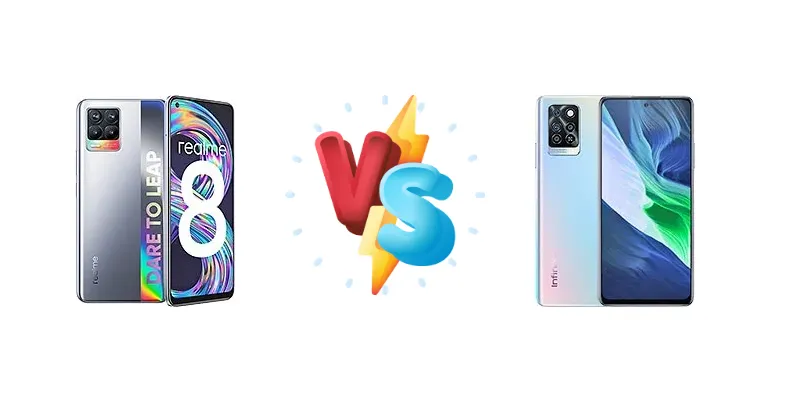
The Realme 8 and Infinix Note 10 Pro NFC both target the competitive mid-range smartphone market, powered by the same Mediatek Helio G95 chipset. However, subtle differences in charging speeds and measured display performance create a distinct choice for users prioritizing either rapid power-ups or brighter visuals. This comparison dissects these nuances to determine the optimal pick.
🏆 Quick Verdict
For the average user, the Realme 8 emerges as the slightly better choice. Its measured 657 nits peak brightness provides a more usable outdoor experience, and the 30W charging, while only marginally slower than the Infinix's 33W, delivers a full charge in a respectable 65 minutes. Both phones offer identical processing power.
| Network |
|---|
| 2G bands | GSM 850 / 900 / 1800 / 1900 | GSM 850 / 900 / 1800 / 1900 |
| 3G bands | HSDPA 850 / 900 / 2100 | HSDPA 850 / 900 / 1700(AWS) / 1900 / 2100 |
| 4G bands | 1, 3, 5, 8, 38, 40, 41 | 1, 2, 3, 4, 5, 7, 8, 20, 28, 38, 41, 40, 66 |
| Speed | HSPA, LTE | HSPA, LTE |
| Technology | GSM / HSPA / LTE | GSM / HSPA / LTE |
| | - | 1, 3, 7, 8, 20, 28 |
| Launch |
|---|
| Announced | 2021, March 24 | 2021, May 12 |
| Status | Available. Released 2021, March 25 | Available. Released 2021, June 07 |
| Body |
|---|
| Build | Glass front, plastic frame, plastic back | - |
| Dimensions | 160.6 x 73.9 x 8 mm (6.32 x 2.91 x 0.31 in) | 172.8 x 78.3 x 7.8 mm (6.80 x 3.08 x 0.31 in) |
| SIM | Nano-SIM + Nano-SIM | Nano-SIM + Nano-SIM |
| Weight | 177 g (6.24 oz) | - |
| Display |
|---|
| Resolution | 1080 x 2400 pixels, 20:9 ratio (~411 ppi density) | 1080 x 2460 pixels (~387 ppi density) |
| Size | 6.4 inches, 98.9 cm2 (~83.3% screen-to-body ratio) | 6.95 inches, 114.7 cm2 (~84.8% screen-to-body ratio) |
| Type | Super AMOLED, HDR10, 1000 nits (peak) | IPS LCD, 90Hz |
| | Always-on display | - |
| Platform |
|---|
| CPU | Octa-core (2x2.05 GHz Cortex-A76 & 6x2.0 GHz Cortex-A55) | Octa-core (2x2.05 GHz Cortex-A76 & 6x2.0 GHz Cortex-A55) |
| Chipset | Mediatek MT6785V/CD Helio G95 (12 nm) | Mediatek MT6785V/CD Helio G95 (12 nm) |
| GPU | Mali-G76 MC4 | Mali-G76 MC4 |
| OS | Android 11, Realme UI 2.0 | Android 11, XOS 7.6 |
| Memory |
|---|
| Card slot | microSDXC (dedicated slot) | microSDXC (dedicated slot) |
| Internal | 64GB 4GB RAM, 128GB 4GB RAM, 128GB 6GB RAM, 128GB 8GB RAM | 128GB 6GB RAM, 256GB 8GB RAM |
| | UFS 2.1 | UFS 2.2 |
| Main Camera |
|---|
| Features | LED flash, HDR, panorama | Quad-LED flash, HDR, panorama |
| Quad | 64 MP, f/1.8, 26mm (wide), 1/1.73", 0.8µm, PDAF
8 MP, f/2.3, 119˚, 16mm (ultrawide), 1/4.0", 1.12µm
2 MP (macro)
Auxiliary lens | 64 MP, f/1.9, (wide), 1/1.72", 0.8µm, PDAF
8 MP, f/2.3, 120˚ (ultrawide)
2 MP, f/2.4, (monochrome)
Auxiliary lens |
| Single | 16 MP, f/2.5, (wide), 1/3.0", 1.0µm | 16 MP, (wide) |
| Video | 4K@30fps, 1080p@30/60/120fps, gyro-EIS | 4K@30fps, 1080p@30fps |
| Selfie camera |
|---|
| Features | HDR, panorama | - |
| Single | 16 MP, f/2.5, (wide), 1/3.0", 1.0µm | 16 MP, f/2.0, (wide), 1/3.09" |
| Video | 1080p@30/120fps, gyro-EIS | 1080p@30fps |
| Sound |
|---|
| 3.5mm jack | Yes | Yes |
| 35mm jack | Yes | Yes |
| Loudspeaker | Yes | Yes, with dual speakers |
| | 24-bit/192kHz audio | - |
| Comms |
|---|
| Bluetooth | 5.1, A2DP, LE | 5.0, A2DP, LE |
| NFC | Yes (market/region dependent) | Yes |
| Positioning | GPS, GLONASS, BDS | GPS |
| Radio | No | FM radio |
| USB | USB Type-C 2.0, OTG | USB Type-C 2.0, OTG |
| WLAN | Wi-Fi 802.11 a/b/g/n/ac, dual-band, Wi-Fi Direct | Wi-Fi 802.11 a/b/g/n/ac, dual-band, Wi-Fi Direct |
| Features |
|---|
| Sensors | Fingerprint (under display, optical), accelerometer, gyro, proximity, compass | Fingerprint (side-mounted), accelerometer, gyro, proximity, compass |
| Battery |
|---|
| Charging | 30W wired, 50% in 26 min, 100% in 65 min | 33W wired |
| Type | 5000 mAh | 5000 mAh |
| Misc |
|---|
| Colors | Cyber Silver, Cyber Black | Black, Purple, Nordic Secret |
| Models | RMX3085 | X695C |
| Price | € 98.43 | - |
| Tests |
|---|
| Battery life |
Endurance rating 127h
| - |
| Camera |
Photo / Video | - |
| Display |
Contrast ratio: Infinite (nominal) | - |
| Loudspeaker |
-28.6 LUFS (Average)
| - |
| Performance |
AnTuTu: 298328 (v8)
GeekBench: 6779 (v4.4), 1690 (v5.1)
GFXBench: 18fps (ES 3.1 onscreen) | - |
Realme 8
- Brighter display for outdoor use (657 nits)
- Established brand reputation
- Respectable 65-minute full charge time
- Charging speed slightly slower than Infinix
- Limited camera specification details
Infinix Note 10 Pro NFC
- Faster 33W charging
- NFC functionality included
- Potentially lower price point
- Display brightness likely lower than Realme 8
- Less established brand recognition
Display Comparison
Both the Realme 8 and Infinix Note 10 Pro NFC lack detailed display specifications beyond the presence of a display. However, the Realme 8 boasts a measured peak brightness of 657 nits, a significant advantage for outdoor visibility. While both likely utilize IPS LCD panels, the Realme 8’s higher brightness translates to a more comfortable viewing experience in direct sunlight. Contrast ratios are listed as 'Infinite (nominal)' for the Realme 8, a standard marketing term that doesn't reveal much about actual black levels or color reproduction.
Camera Comparison
Both phones list 'Photo / Video' capabilities, but lack specific details regarding sensor size, aperture, or image stabilization. This makes a direct comparison difficult. The absence of detailed camera specs suggests a focus on general-purpose photography rather than high-end imaging. It's reasonable to assume both phones include a standard set of lenses, potentially including a main sensor, ultrawide, and macro, but the quality will likely be comparable given the shared price point and chipset.
Performance
The core of both devices is the Mediatek Helio G95 (12 nm) chipset, featuring an octa-core CPU configuration with 2x2.05 GHz Cortex-A76 and 6x2.0 GHz Cortex-A55 cores. This means identical CPU and GPU performance is expected in most real-world scenarios, including gaming and multitasking. Neither manufacturer specifies RAM type or speed, but performance will be largely dictated by the chipset rather than minor RAM differences. Thermal throttling, a common issue with the G95, will likely be similar on both devices, requiring careful consideration for extended gaming sessions.
Battery Life
The Realme 8 has an endurance rating of 127 hours, indicating solid battery life. While the Infinix Note 10 Pro NFC’s battery capacity isn’t specified, the 33W wired charging is slightly faster than the Realme 8’s 30W. The Realme 8 achieves 50% charge in 26 minutes and 100% in 65 minutes. The Infinix Note 10 Pro NFC’s faster charging will likely shave off a few minutes from a full charge, appealing to users who prioritize quick top-ups. However, the Realme 8’s 127-hour endurance suggests it can comfortably last a full day of moderate use.
Buying Guide
Buy the Realme 8 if you prioritize a brighter, more visible display for outdoor use and value a slightly more established brand reputation. Buy the Infinix Note 10 Pro NFC if you absolutely need the fastest possible charging speeds and NFC functionality is a must-have, potentially finding it at a lower price point. Both are excellent choices for budget-conscious gamers.
Frequently Asked Questions
❓ Will the Helio G95 in either phone struggle with demanding games like PUBG or Call of Duty?
The Helio G95 is capable of running PUBG and Call of Duty, but expect to use medium graphics settings for a consistently smooth experience. Both phones will likely experience some thermal throttling during extended gaming sessions, potentially leading to frame rate drops. Optimizing in-game settings and using a cooling accessory can help mitigate this.
❓ Does the Infinix Note 10 Pro NFC's faster charging significantly impact battery health over the long term?
While faster charging is convenient, it can contribute to slightly faster battery degradation over time. However, modern smartphones employ charging management systems to minimize this effect. The difference in degradation between 30W and 33W charging is likely to be minimal and outweighed by the convenience for most users.
❓ Is the lack of detailed camera specs a major drawback for both phones?
Yes, the lack of information regarding sensor size, aperture, and image stabilization makes it difficult to assess camera performance. Both phones likely offer adequate image quality for casual photography, but don't expect flagship-level results, especially in low-light conditions.