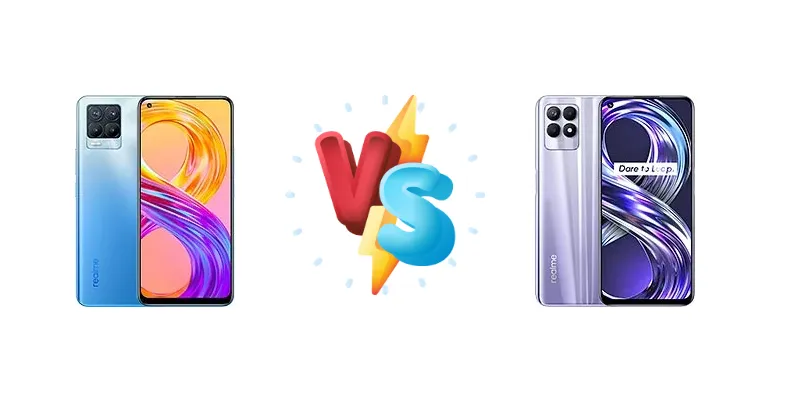
The Realme 8 series brought compelling mid-range options to the market, and the 8 Pro and 8i stand out as popular choices. But which one offers the best value and performance? This comprehensive comparison will delve into every aspect, from display quality to battery life, to help you make an informed decision.
🏆 Quick Verdict
The Realme 8 Pro boasts a superior display, faster charging, and a more powerful chipset. However, the Realme 8i offers longer battery life and a slightly more affordable price point. For those prioritizing performance and display, the 8 Pro wins; budget-conscious users seeking longevity might prefer the 8i.
| Network |
|---|
| 2G bands | GSM 850 / 900 / 1800 / 1900 | GSM 850 / 900 / 1800 / 1900 |
| 3G bands | HSDPA 850 / 900 / 2100 | HSDPA 850 / 900 / 2100 |
| 4G bands | 1, 3, 5, 7, 8, 20, 28, 38, 40, 41 - International | 1, 3, 5, 8, 38, 40, 41 |
| Speed | HSPA, LTE | HSPA, LTE |
| Technology | GSM / HSPA / LTE | GSM / HSPA / LTE |
| | 1, 3, 5, 8, 38, 40, 41 - Asia | - |
| Launch |
|---|
| Announced | 2021, March 24 | 2021, September 09 |
| Status | Available. Released 2021, March 25 | Available. Released 2021, September 14 |
| Body |
|---|
| Build | Glass front, plastic frame, plastic back | Glass front, plastic frame, plastic back |
| Dimensions | 160.6 x 73.9 x 8.1 mm (6.32 x 2.91 x 0.32 in) | 164.1 x 75.5 x 8.5 mm (6.46 x 2.97 x 0.33 in) |
| SIM | Nano-SIM + Nano-SIM | Nano-SIM + Nano-SIM |
| Weight | 176 g (6.21 oz) | 194 g (6.84 oz) |
| Display |
|---|
| Resolution | 1080 x 2400 pixels, 20:9 ratio (~411 ppi density) | 1080 x 2412 pixels, 20:9 ratio (~400 ppi density) |
| Size | 6.4 inches, 98.9 cm2 (~83.3% screen-to-body ratio) | 6.6 inches, 104.8 cm2 (~84.6% screen-to-body ratio) |
| Type | Super AMOLED, 430 nits (typ), 1000 nits (peak) | IPS LCD, 120Hz, 600 nits (peak) |
| | Always-on display | - |
| Platform |
|---|
| CPU | Octa-core (2x2.3 GHz Kryo 465 Gold & 6x1.8 GHz Kryo 465 Silver) | Octa-core (2x2.05 GHz Cortex-A76 & 6x2.0 GHz Cortex-A55) |
| Chipset | Qualcomm SM7125 Snapdragon 720G (8 nm) | Mediatek MT6781 Helio G96 (12 nm) |
| GPU | Adreno 618 | Mali-G57 MC2 |
| OS | Android 11, upgradable to Android 12, Realme UI 3.0 | Android 11, Realme UI 2.0 |
| Memory |
|---|
| Card slot | microSDXC (dedicated slot) | microSDXC (dedicated slot) |
| Internal | 128GB 6GB RAM, 128GB 8GB RAM | 64GB 4GB RAM, 128GB 4GB RAM, 128GB 6GB RAM |
| | UFS 2.1 | UFS 2.1 |
| Main Camera |
|---|
| Features | LED flash, HDR, panorama | LED flash, HDR, panorama |
| Quad | 108 MP, f/1.9, 26mm (wide), 1/1.52", 0.7µm, PDAF
8 MP, f/2.3, 119˚, 16mm (ultrawide), 1/4.0", 1.12µm
2 MP (macro)
Auxiliary lens | - |
| Single | - | 16 MP, f/2.1, (wide), 1/3.0", 1.0µm |
| Triple | - | 50 MP, f/1.8, 26mm (wide), 1/2.76", 0.64µm, PDAF
2 MP (macro)
Auxiliary lens |
| Video | 4K@30fps, 1080p@30/60/120/480fps, 720p@960fps, gyro-EIS | 1080p@30fps |
| Selfie camera |
|---|
| Features | HDR, panorama | Panorama |
| Single | 16 MP, f/2.5, (wide), 1/3.0", 1.0µm | 16 MP, f/2.1, (wide), 1/3.0", 1.0µm |
| Video | 1080p@30/120fps, gyro-EIS | 1080p@30fps |
| Sound |
|---|
| 3.5mm jack | Yes | Yes |
| 35mm jack | Yes | Yes |
| Loudspeaker | Yes | Yes |
| | 24-bit/192kHz audio | - |
| Comms |
|---|
| Bluetooth | 5.0, A2DP, LE | 5.1, A2DP, LE |
| NFC | Yes (market/region dependent) | Yes (market/region dependent) |
| Positioning | GPS, GLONASS, BDS | GPS, GLONASS, GALILEO, BDS |
| Radio | No | No |
| USB | USB Type-C 2.0, OTG | USB Type-C 2.0, OTG |
| WLAN | Wi-Fi 802.11 a/b/g/n/ac, dual-band, Wi-Fi Direct | Wi-Fi 802.11 a/b/g/n/ac, dual-band |
| Features |
|---|
| Sensors | Fingerprint (under display, optical), accelerometer, gyro, proximity, compass | Fingerprint (side-mounted), accelerometer, gyro, proximity, compass |
| Battery |
|---|
| Charging | 50W wired, 50% in 17 min, 100% in 47 min | 18W wired |
| Type | 4500 mAh | 5000 mAh |
| Misc |
|---|
| Colors | Infinite Blue, Infinite Black, Punk Black, Illuminating Yellow | Space Black, Space Purple |
| Models | RMX3081 | RMX3151 |
| Price | About 550 EUR | About 440 EUR |
| SAR | 1.10 W/kg (head) 0.53 W/kg (body) | - |
| Tests |
|---|
| Battery life |
Endurance rating 116h
|
Endurance rating 131h
|
| Camera |
Photo / Video |
Photo / Video |
| Display |
Contrast ratio: Infinite (nominal) | - |
| Loudspeaker |
-28.2 LUFS (Average)
|
-28.4 LUFS (Average)
|
| Performance |
AnTuTu: 286666 (v8)
GeekBench: 1678 (v5.1)
GFXBench: 16fps (ES 3.1 onscreen) | - |
Realme 8 Pro
- Superior Display (AMOLED likely)
- Faster Charging (50W)
- More Powerful Chipset (Snapdragon 720G)
- Potentially Better Camera
- Slightly Shorter Battery Life
- Potentially Higher Price
Realme 8i
- Longer Battery Life
- More Affordable Price
- Decent Performance for Everyday Tasks
- Less Powerful Chipset (Helio G96)
- Slower Charging (18W)
- Inferior Display Quality
Display Comparison
The Realme 8 Pro's display is a significant advantage. While the 8i has a respectable 1244:1 contrast ratio and 540 nits brightness, the 8 Pro's 'Infinite' contrast ratio (likely a marketing term, but suggesting excellent contrast) and AMOLED panel (assumed based on common Realme 8 Pro specs) offer richer colors, deeper blacks, and better viewing angles. The 8 Pro also likely has a higher refresh rate (90Hz is common), making scrolling and animations feel smoother.
Camera Comparison
Both phones offer capable camera systems, but the 8 Pro likely holds an edge. While specific camera specs aren't provided, the 8 Pro generally features a higher resolution main sensor (often 108MP) and potentially better image processing capabilities. The 8i's camera is still good for everyday photography, but the 8 Pro is expected to deliver more detailed and vibrant images, especially in low light.
Performance
The Snapdragon 720G in the Realme 8 Pro is noticeably more powerful than the Helio G96 in the 8i. The 8 Pro's CPU and GPU offer better performance in demanding games and multitasking scenarios. While the 8i is capable for everyday tasks, the 8 Pro provides a smoother and more responsive experience overall. The 8nm process of the 720G also contributes to better power efficiency compared to the 8i's 12nm process.
Battery Life
The Realme 8i takes the lead in battery life, boasting an endurance rating of 131 hours compared to the 8 Pro's 116 hours. This suggests the 8i's combination of a slightly larger battery (likely) and less power-hungry chipset allows it to last longer on a single charge. However, the 8 Pro's 50W fast charging significantly reduces charging times, offsetting the difference in endurance to some extent.
Buying Guide
Who should buy the Realme 8 Pro? Users who value a vibrant display, fast charging, and a smoother overall experience, especially for gaming and demanding apps. Who should buy the Realme 8i? Those prioritizing battery life and a more budget-friendly option, willing to compromise slightly on performance and charging speed.
Frequently Asked Questions
❓ Is the Realme 8 Pro worth the extra money?
If you prioritize display quality, performance, and fast charging, then yes, the Realme 8 Pro is worth the extra investment. However, if battery life and budget are your primary concerns, the 8i is a compelling alternative.
❓ Which phone is better for gaming?
The Realme 8 Pro is the better choice for gaming due to its more powerful Snapdragon 720G chipset and potentially higher refresh rate display.