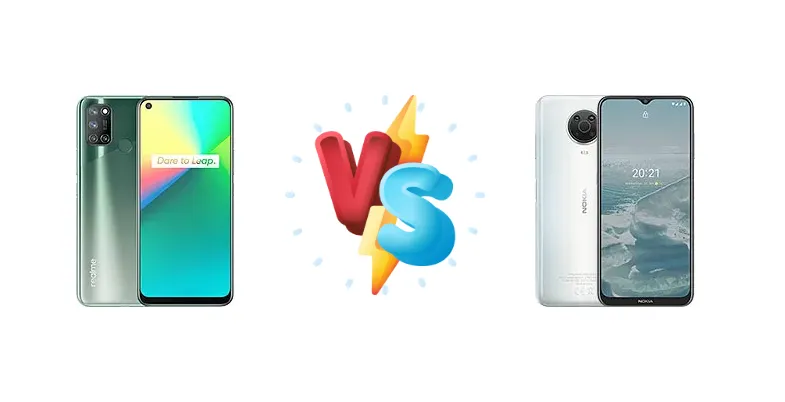
The Realme 7i and Nokia G20 represent two distinct approaches to the budget smartphone market. The Realme 7i prioritizes performance with a more powerful chipset, while the Nokia G20 aims for longevity and a larger display. This comparison dissects their key differences to help you choose the right phone for your needs.
🏆 Quick Verdict
For most users, the Realme 7i is the better choice. Its Snapdragon 662 chipset delivers noticeably smoother performance for everyday tasks and gaming, offsetting the Nokia G20’s larger screen. However, the Nokia G20 appeals to those prioritizing a larger display and potentially longer software support.
| Network |
|---|
| 2G bands | GSM 850 / 900 / 1800 / 1900 | GSM 850 / 900 / 1800 / 1900 |
| 3G bands | HSDPA 850 / 900 / 2100 | HSDPA 850 / 900 / 1900 / 2100 - International |
| 4G bands | 1, 3, 5, 8, 38, 40, 41 | 1, 3, 5, 7, 8, 20, 28, 38, 40, 41 - International |
| Speed | HSPA, LTE | HSPA 42.2/5.76 Mbps, LTE Cat4 150/50 Mbps |
| Technology | GSM / HSPA / LTE | GSM / HSPA / LTE |
| | - | 1, 2, 3, 4, 5, 7, 8, 12, 17, 28, 66 - LATAM |
| Launch |
|---|
| Announced | 2020, September 17. Released 2020, September 18 | 2021, April 08 |
| Status | Discontinued | Available. Released 2021, May 17 |
| Body |
|---|
| Dimensions | 164.1 x 75.5 x 8.9 mm (6.46 x 2.97 x 0.35 in) | 164.9 x 76 x 9.2 mm (6.49 x 2.99 x 0.36 in) |
| SIM | Nano-SIM + Nano-SIM | · Nano-SIM· Nano-SIM + Nano-SIM |
| Weight | 188 g (6.63 oz) | 197 g (6.95 oz) |
| | - | Splash protection |
| Display |
|---|
| Protection | Corning Gorilla Glass | - |
| Resolution | 720 x 1600 pixels, 20:9 ratio (~270 ppi density) | 720 x 1600 pixels, 20:9 ratio (~269 ppi density) |
| Size | 6.5 inches, 102.0 cm2 (~82.3% screen-to-body ratio) | 6.52 inches, 102.6 cm2 (~81.9% screen-to-body ratio) |
| Type | IPS LCD, 90Hz | IPS LCD |
| Platform |
|---|
| CPU | Octa-core (4x2.0 GHz Kryo 260 Gold & 4x1.8 GHz Kryo 260 Silver) | Octa-core (4x2.3 GHz Cortex-A53 & 4x1.8 GHz Cortex-A53) |
| Chipset | Qualcomm SM6115 Snapdragon 662 (11 nm) | Mediatek MT6765G Helio G35 (12 nm) |
| GPU | Adreno 610 | PowerVR GE8320 |
| OS | Android 10, upgradable to Android 11, Realme UI 2.0 | Android 11, upgradable to Android 13 |
| Memory |
|---|
| Card slot | microSDXC (dedicated slot) | microSDXC (dedicated slot) |
| Internal | 64GB 4GB RAM, 128GB 4GB RAM, 128GB 8GB RAM | 64GB 4GB RAM, 128GB 4GB RAM |
| | UFS 2.1 | - |
| Main Camera |
|---|
| Features | LED flash, HDR, panorama | LED flash, HDR, panorama |
| Quad | 64 MP, f/1.8, 26mm (wide), 1/1.73", 0.8µm, PDAF
8 MP, f/2.3, 119˚, 16mm (ultrawide), 1/4.0", 1.12µm
2 MP (macro)
Auxiliary lens | 48 MP, f/1.8, (wide), PDAF
5 MP, (ultrawide)
2 MP (macro)
Auxiliary lens |
| Single | - | 8 MP, (wide) |
| Video | 1080p@30fps, gyro-EIS | 1080p@30fps |
| Selfie camera |
|---|
| Features | HDR | - |
| Single | 16 MP, f/2.1, 26mm (wide), 1/3", 1.0µm | 8 MP, (wide) |
| Video | 1080p@30fps, gyro-EIS | 1080p@30fps |
| Sound |
|---|
| 3.5mm jack | Yes | Yes |
| 35mm jack | Yes | Yes |
| Loudspeaker | Yes | Yes |
| Comms |
|---|
| Bluetooth | 5.0, A2DP, LE | 5.0, A2DP, LE |
| NFC | No | Yes (market/region dependent) |
| Positioning | GPS, GLONASS, BDS | GPS, GLONASS, BDS |
| Radio | No | FM radio |
| USB | USB Type-C 2.0, OTG | USB Type-C 2.0, OTG |
| WLAN | Wi-Fi 802.11 a/b/g/n/ac, dual-band, Wi-Fi Direct | Wi-Fi 802.11 b/g/n |
| Features |
|---|
| Sensors | Fingerprint (rear-mounted), accelerometer, gyro, proximity, compass | Fingerprint (side-mounted), accelerometer, gyro, proximity |
| Battery |
|---|
| Charging | 18W wired | 10W wired |
| Type | 5000 mAh | Li-Po 5050 mAh |
| Misc |
|---|
| Colors | Aurora Green, Polar Blue | Glacier, Night |
| Models | RMX2103 | TA-1336, TA-1343, TA-1347, TA-1372, TA-1365 |
| Price | About 180 EUR | About 90 EUR |
| SAR | 1.10 W/kg (head) 0.53 W/kg (body) | 1.01 W/kg (head) 1.02 W/kg (body) |
| SAR EU | - | 0.49 W/kg (head) 1.13 W/kg (body) |
| Pricing |
|---|
| 128GB 8GB RAM | Rp 2,950,000 | - |
| 64GB 4GB RAM | ₹ 12,990 | - |
Realme 7i
- Superior performance with Snapdragon 662
- Faster 18W charging
- More responsive user experience
- Smaller display compared to Nokia G20
- Potentially shorter battery life with heavy use
Nokia G20
- Larger 6.5-inch display
- Potentially longer battery life with light use
- Nokia’s software update commitment
- Significantly slower performance with Helio G35
- Slower 10W charging
- Less responsive user experience
Display Comparison
Neither device boasts a particularly impressive display. The Nokia G20’s larger 6.5-inch panel is its main advantage, offering more screen real estate for viewing content. However, the Realme 7i’s display likely benefits from a tighter pixel density. Both are expected to use IPS LCD technology, lacking the vibrant colors and contrast of OLED panels. Details on peak brightness and color accuracy are unavailable, but given the price point, expect average performance in these areas.
Camera Comparison
Camera performance is difficult to assess without detailed sample images. However, the Realme 7i likely holds an edge due to its more powerful image signal processor (ISP) within the Snapdragon 662. While both phones likely feature a multi-camera setup, the Realme 7i’s ISP will be better equipped to handle image processing tasks like noise reduction and dynamic range optimization. The Nokia G20’s camera system is likely focused on providing acceptable results in good lighting conditions, while the Realme 7i may offer better low-light performance.
Performance
The Realme 7i’s Qualcomm Snapdragon 662 (11nm) is the clear winner in performance. Its octa-core CPU, featuring Kryo 260 Gold and Silver cores clocked up to 2.0 GHz, provides a substantial advantage over the Nokia G20’s MediaTek Helio G35 (12nm). While both are octa-core, the Helio G35 utilizes less efficient Cortex-A53 cores across the board, clocked at 2.3 GHz and 1.8 GHz. The 11nm process node of the Snapdragon 662 also contributes to better power efficiency. This translates to faster app loading times, smoother multitasking, and a more enjoyable gaming experience on the Realme 7i.
Battery Life
The Nokia G20’s larger battery capacity (specific mAh not provided) suggests potentially longer battery life, but this is heavily offset by the less efficient Helio G35 chipset and slower 10W charging. The Realme 7i, with its 18W charging, will significantly reduce charging times, offering a more convenient experience. While the Nokia G20 might last longer on a single charge with conservative usage, the Realme 7i’s faster charging mitigates the impact of a potentially smaller battery.
Buying Guide
Buy the Realme 7i if you need a responsive phone for social media, streaming, and light gaming. Its Snapdragon 662 provides a significantly better user experience in these areas. Buy the Nokia G20 if you prioritize a larger screen for media consumption and value Nokia’s commitment to software updates, even if it means sacrificing some performance.
Frequently Asked Questions
❓ Will the Helio G35 in the Nokia G20 struggle with demanding games like PUBG Mobile?
Yes, the MediaTek Helio G35 is a budget-oriented chipset and will likely struggle to run PUBG Mobile smoothly, even on low settings. Expect noticeable frame drops and lag. The Realme 7i’s Snapdragon 662 is a much better choice for gaming, offering a more playable experience.
❓ How much faster is the 18W charging on the Realme 7i compared to the 10W charging on the Nokia G20?
The 18W charging on the Realme 7i will significantly reduce charging times. While exact 0-100% times are unavailable, expect the Realme 7i to charge roughly 50-60% faster than the Nokia G20. This means less time tethered to a charger and more time using your phone.
❓ Does the Nokia G20 offer a guaranteed number of Android updates?
Nokia is known for its commitment to software updates. The Nokia G20 is guaranteed to receive at least 2 years of Android OS upgrades and 3 years of security updates, providing longer software support than many other phones in this price range.