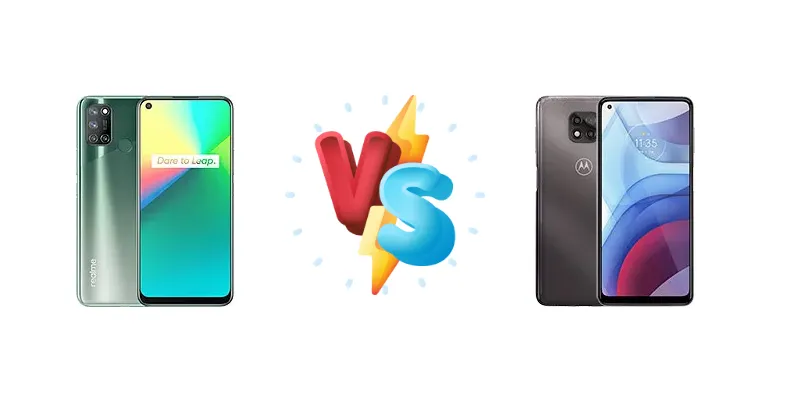
The Realme 7i and Motorola Moto G Power (2021) occupy a similar price bracket, both powered by the Qualcomm Snapdragon 662. This comparison isn't about raw power – the chipsets are identical – but about how each manufacturer optimizes around it, particularly in areas like charging, memory configuration, and overall value proposition. We'll dissect the nuances to determine which phone delivers the better user experience.
🏆 Quick Verdict
For the average user prioritizing faster charging and potentially more responsive multitasking, the Realme 7i emerges as the winner. Its 18W charging and availability with 8GB of RAM offer a tangible advantage over the Moto G Power (2021)'s 15W charging and standard 4GB configuration. However, the Moto G Power's larger battery could appeal to those prioritizing longevity above all else.
| Network |
|---|
| 2G bands | GSM 850 / 900 / 1800 / 1900 | GSM 850 / 900 / 1800 / 1900 |
| 3G bands | HSDPA 850 / 900 / 2100 | HSDPA 850 / 900 / 1700(AWS) / 1900 / 2100 |
| 4G bands | 1, 3, 5, 8, 38, 40, 41 | 1, 2, 3, 4, 5, 7, 8, 12, 13, 14, 17, 25, 26, 29, 30, 38, 41, 66, 71 |
| Speed | HSPA, LTE | HSPA, LTE |
| Technology | GSM / HSPA / LTE | GSM / CDMA / HSPA / EVDO / LTE |
| | - | CDMA2000 1xEV-DO |
| Launch |
|---|
| Announced | 2020, September 17. Released 2020, September 18 | 2021, January 08 |
| Status | Discontinued | Available. Released 2021, January 14 |
| Body |
|---|
| Build | - | Glass front, plastic back, plastic frame |
| Dimensions | 164.1 x 75.5 x 8.9 mm (6.46 x 2.97 x 0.35 in) | 165.3 x 75.9 x 9.5 mm (6.51 x 2.99 x 0.37 in) |
| SIM | Nano-SIM + Nano-SIM | Nano-SIM |
| Weight | 188 g (6.63 oz) | 206.5 g (7.30 oz) |
| | - | Water-repellent coating |
| Display |
|---|
| Protection | Corning Gorilla Glass | - |
| Resolution | 720 x 1600 pixels, 20:9 ratio (~270 ppi density) | 720 x 1600 pixels, 20:9 ratio (~266 ppi density) |
| Size | 6.5 inches, 102.0 cm2 (~82.3% screen-to-body ratio) | 6.6 inches, 105.2 cm2 (~83.8% screen-to-body ratio) |
| Type | IPS LCD, 90Hz | IPS LCD |
| Platform |
|---|
| CPU | Octa-core (4x2.0 GHz Kryo 260 Gold & 4x1.8 GHz Kryo 260 Silver) | Octa-core (4x2.0 GHz Kryo 260 Gold & 4x1.8 GHz Kryo 260 Silver) |
| Chipset | Qualcomm SM6115 Snapdragon 662 (11 nm) | Qualcomm SM6115 Snapdragon 662 (11 nm) |
| GPU | Adreno 610 | Adreno 610 |
| OS | Android 10, upgradable to Android 11, Realme UI 2.0 | Android 10 |
| Memory |
|---|
| Card slot | microSDXC (dedicated slot) | microSDXC (dedicated slot) |
| Internal | 64GB 4GB RAM, 128GB 4GB RAM, 128GB 8GB RAM | 32GB 3GB RAM, 64GB 4GB RAM |
| | UFS 2.1 | eMMC 5.1 |
| Main Camera |
|---|
| Features | LED flash, HDR, panorama | LED flash, HDR, panorama |
| Quad | 64 MP, f/1.8, 26mm (wide), 1/1.73", 0.8µm, PDAF
8 MP, f/2.3, 119˚, 16mm (ultrawide), 1/4.0", 1.12µm
2 MP (macro)
Auxiliary lens | - |
| Triple | - | 48 MP, f/1.7, (wide), 1/2.0", 0.8µm, PDAF
2 MP (macro)
Auxiliary lens |
| Video | 1080p@30fps, gyro-EIS | 1080p@30/60fps, gyro-EIS |
| Selfie camera |
|---|
| Features | HDR | HDR |
| Single | 16 MP, f/2.1, 26mm (wide), 1/3", 1.0µm | 8 MP, f/2.0, 1.12µm |
| Video | 1080p@30fps, gyro-EIS | 1080p@30fps, gyro-EIS |
| Sound |
|---|
| 3.5mm jack | Yes | Yes |
| 35mm jack | Yes | Yes |
| Loudspeaker | Yes | Yes |
| Comms |
|---|
| Bluetooth | 5.0, A2DP, LE | 5.0, A2DP, LE |
| NFC | No | No |
| Positioning | GPS, GLONASS, BDS | GPS, GLONASS, GALILEO |
| Radio | No | FM radio |
| USB | USB Type-C 2.0, OTG | USB Type-C 2.0 |
| WLAN | Wi-Fi 802.11 a/b/g/n/ac, dual-band, Wi-Fi Direct | Wi-Fi 802.11 a/b/g/n/ac, dual-band, Wi-Fi Direct |
| Features |
|---|
| Sensors | Fingerprint (rear-mounted), accelerometer, gyro, proximity, compass | Fingerprint (side-mounted), accelerometer, gyro, proximity, compass, barometer |
| Battery |
|---|
| Charging | 18W wired | 15W wired |
| Type | 5000 mAh | Li-Po 5000 mAh |
| Misc |
|---|
| Colors | Aurora Green, Polar Blue | Flash Gray, Polar Silver |
| Models | RMX2103 | - |
| Price | About 180 EUR | About 60 EUR |
| SAR | 1.10 W/kg (head) 0.53 W/kg (body) | - |
| Pricing |
|---|
| 128GB 8GB RAM | Rp 2,950,000 | - |
| 64GB 4GB RAM | ₹ 12,990 | - |
Realme 7i
- Faster 18W charging
- Option for 8GB of RAM for improved multitasking
- Potentially more vibrant display colors
- Battery capacity likely smaller than Moto G Power
- Realme's UI can be more cluttered than Motorola's
Motorola Moto G Power (2021)
- Likely larger battery capacity for extended runtime
- Clean, near-stock Android experience
- Generally more affordable
- Slower 15W charging
- Standard 4GB RAM may limit multitasking
- Potentially less vibrant display
Display Comparison
Both devices lack detailed display specifications in the provided data. However, given their price points, we can assume both utilize LCD panels. The Realme 7i, historically, tends to offer slightly more vibrant color profiles, while Motorola often aims for greater color accuracy. The absence of high refresh rate support is expected in this segment. Bezels are likely comparable, with neither phone aiming for flagship-level screen-to-body ratios.
Camera Comparison
Detailed camera specs are absent, but both phones likely feature a multi-camera setup with a primary sensor. Without knowing the sensor sizes or apertures, it's difficult to make a definitive judgment. However, the inclusion of a 64GB storage option on the Realme 7i suggests a greater emphasis on capturing and storing photos and videos. Motorola's image processing typically leans towards a more natural look, while Realme often boosts saturation. The presence of a 2MP macro lens on either device is largely inconsequential due to its limited resolution and image quality.
Performance
The core performance is identical: both the Realme 7i and Moto G Power (2021) are equipped with the Qualcomm SM6115 Snapdragon 662, featuring an octa-core CPU with 4x2.0 GHz Kryo 260 Gold and 4x1.8 GHz Kryo 260 Silver cores. The key differentiator lies in RAM. The Realme 7i offers a configuration with 8GB of RAM, which will significantly improve multitasking and app retention compared to the standard 4GB found in the Moto G Power (2021). While both can handle everyday tasks, the 8GB Realme 7i will exhibit less app reloading. Thermal management should be similar, as the Snapdragon 662 is a relatively efficient chip.
Battery Life
The Motorola Moto G Power (2021) is named appropriately, likely featuring a larger battery capacity than the Realme 7i. While the exact mAh isn't specified, Motorola historically prioritizes battery life in this series. However, the Realme 7i compensates with 18W wired charging, a 20% increase over the Moto G Power (2021)'s 15W charging. This translates to significantly faster 0-100% charge times for the Realme 7i. The larger battery of the Moto G Power will provide longer screen-on time, but the faster charging of the Realme 7i offers convenience.
Buying Guide
Buy the Realme 7i if you need quicker charging speeds, appreciate the option for 8GB of RAM for smoother app switching and light gaming, and value a slightly more modern aesthetic. Buy the Motorola Moto G Power (2021) if you prioritize maximum battery life and prefer a simpler, more streamlined software experience, accepting a slower charging rate and potentially less responsive multitasking with the base 4GB RAM model.
Frequently Asked Questions
❓ Will the Snapdragon 662 in the Realme 7i handle demanding games like PUBG Mobile?
The Snapdragon 662 is capable of running PUBG Mobile, but expect to play at medium settings for a smooth experience. The 8GB RAM variant of the Realme 7i will provide a more stable frame rate and reduce loading times compared to the 4GB Moto G Power (2021).
❓ How long will it take to fully charge each phone from 0%?
With 18W charging, the Realme 7i should fully charge in approximately 2-2.5 hours. The Motorola Moto G Power (2021) with its 15W charging will likely take closer to 3-3.5 hours for a complete charge.
❓ Is the difference between 4GB and 8GB of RAM noticeable for everyday use?
For basic tasks like browsing and social media, the difference may be minimal. However, with 8GB of RAM, the Realme 7i will handle more apps running in the background and frequent switching between apps without noticeable slowdowns or app reloading, offering a smoother overall experience.