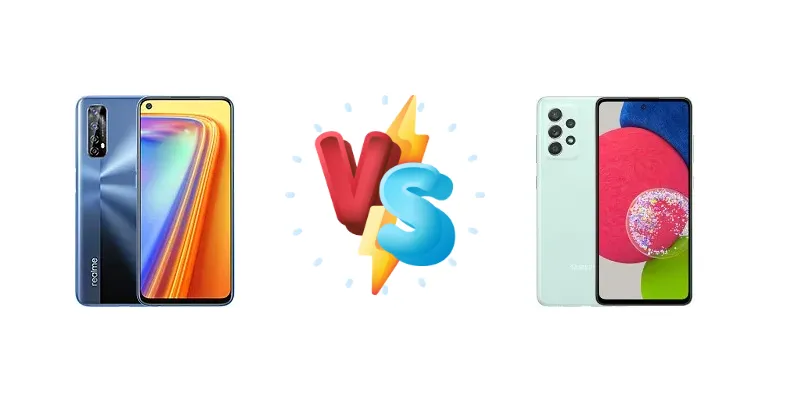
The Realme 7 and Samsung Galaxy A52s 5G represent compelling options in the competitive mid-range smartphone market. The Realme 7, while an older model, continues to offer value, particularly with its rapid 30W charging. The A52s 5G, however, brings 5G connectivity and a more modern chipset to the table, creating a clear battle between established value and newer technology.
🏆 Quick Verdict
For most users, the Samsung Galaxy A52s 5G is the better choice. Its Snapdragon 778G chipset delivers significantly improved performance and 5G capabilities, outweighing the Realme 7’s faster charging. However, users prioritizing charging speed and already invested in the Realme ecosystem might find the Realme 7 sufficient.
| Network |
|---|
| 2G bands | GSM 850 / 900 / 1800 / 1900 | GSM 850 / 900 / 1800 / 1900 |
| 3G bands | HSDPA 850 / 900 / 1700(AWS) / 1900 / 2100 | HSDPA 850 / 900 / 1700(AWS) / 1900 / 2100 |
| 4G bands | 1, 2, 3, 4, 5, 7, 8, 20, 28, 38, 40, 41 | 1, 2, 3, 4, 5, 7, 8, 12, 17, 20, 26, 28, 32, 38, 40, 41, 66 |
| 5G bands | - | 1, 3, 5, 7, 8, 20, 28, 38, 40, 41, 66, 78 SA/NSA/Sub6 |
| Speed | HSPA, LTE | HSPA 42.2/5.76 Mbps, LTE Cat18 1200/150 Mbps, 5G |
| Technology | GSM / HSPA / LTE | GSM / HSPA / LTE / 5G |
| Launch |
|---|
| Announced | 2020, October 07. Released 2020, October 21 | 2021, August 17 |
| Status | Discontinued | Available. Released 2021, September 01 |
| Body |
|---|
| Build | Glass front (Gorilla Glass 3), plastic back, plastic frame | Glass front (Gorilla Glass 5), plastic back |
| Dimensions | 162.3 x 75.4 x 9.4 mm (6.39 x 2.97 x 0.37 in) | 159.9 x 75.1 x 8.4 mm (6.30 x 2.96 x 0.33 in) |
| SIM | Nano-SIM + Nano-SIM | · Nano-SIM· Nano-SIM + Nano-SIM |
| Weight | 196.5 g (6.95 oz) | 189 g (6.67 oz) |
| | - | IP67 dust/water resistant (up to 1m for 30 min) |
| Display |
|---|
| Protection | Corning Gorilla Glass 3 | Corning Gorilla Glass 5 |
| Resolution | 1080 x 2400 pixels, 20:9 ratio (~405 ppi density) | 1080 x 2400 pixels, 20:9 ratio (~405 ppi density) |
| Size | 6.5 inches, 102.0 cm2 (~83.4% screen-to-body ratio) | 6.5 inches, 102.0 cm2 (~84.9% screen-to-body ratio) |
| Type | IPS LCD, 90Hz, 480 nits (typ) | Super AMOLED, 120Hz, 800 nits (HBM) |
| Platform |
|---|
| CPU | Octa-core (2x2.05 GHz Cortex-A76 & 6x2.0 GHz Cortex-A55) | Octa-core (1x2.4 GHz Cortex-A78 & 3x2.2 GHz Cortex-A78 & 4x1.9 GHz Cortex-A55) |
| Chipset | Mediatek MT6785V/CD Helio G95 (12 nm) | Qualcomm SM7325 Snapdragon 778G 5G (6 nm) |
| GPU | Mali-G76 MC4 | Adreno 642L |
| OS | Android 10, Realme UI | Android 11, upgradable to Android 14, One UI 6 |
| Memory |
|---|
| Card slot | microSDXC (dedicated slot) | microSDXC (uses shared SIM slot) |
| Internal | 64GB 4GB RAM, 64GB 6GB RAM, 128GB 8GB RAM | 128GB 4GB RAM, 128GB 6GB RAM, 128GB 8GB RAM, 256GB 6GB RAM, 256GB 8GB RAM |
| Main Camera |
|---|
| Features | LED flash, HDR, panorama | LED flash, panorama, HDR |
| Quad | 48 MP, f/1.8, 26mm (wide), 1/2.0", 0.8µm, PDAF
8 MP, f/2.3, 119˚, 16mm (ultrawide), 1/4.0", 1.12µm
2 MP (macro)
Auxiliary lens | 64 MP, f/1.8, 26mm (wide), 1/1.7", 0.8µm, PDAF, OIS
12 MP, f/2.2, 123˚ (ultrawide), 1.12µm
5 MP (macro)
Auxiliary lens |
| Single | - | 32 MP, f/2.2, 26mm (wide), 1/2.8", 0.8µm |
| Video | 4K@30fps, 1080p@30/60/120fps, gyro-EIS | 4K@30fps, 1080p@30/60fps; gyro-EIS |
| Selfie camera |
|---|
| Features | Panorama | HDR |
| Single | 16 MP, f/2.1, 26mm (wide), 1/3.1", 1.0µm | 32 MP, f/2.2, 26mm (wide), 1/2.8", 0.8µm |
| Video | 1080p@30/120fps | 4K@30fps, 1080p@30/60fps |
| Sound |
|---|
| 3.5mm jack | - | Yes |
| 35mm jack | Yes | Yes |
| Loudspeaker | Yes | Yes, with stereo speakers |
| Comms |
|---|
| Bluetooth | 5.0, A2DP, LE | 5.0, A2DP, LE |
| NFC | Yes | Yes (market/region dependent) |
| Positioning | GPS, GLONASS, BDS | GPS, GLONASS, GALILEO, BDS, QZSS |
| Radio | No | No |
| USB | USB Type-C 2.0, OTG | USB Type-C 2.0, OTG |
| WLAN | Wi-Fi 802.11 a/b/g/n/ac, dual-band, Wi-Fi Direct | Wi-Fi 802.11 a/b/g/n/ac/6, dual-band, Wi-Fi Direct |
| Features |
|---|
| Sensors | Fingerprint (side-mounted), accelerometer, gyro, proximity, compass | Fingerprint (under display, optical), accelerometer, gyro, compass |
| | - | Virtual Proximity Sensing |
| Battery |
|---|
| Charging | 30W wired, 50% in 26 min, 100% in 65 min | 25W wired |
| Type | 5000 mAh | Li-Ion 4500 mAh |
| Misc |
|---|
| Colors | Mist Blue, Mist White | Awesome Black, Awesome White, Awesome Purple, Awesome Mint |
| Models | RMX2155 | SM-A528B, SM-A528B/DS, SM-A528N |
| Price | About 250 EUR | £ 112.98 / € 249.47 |
| SAR | - | 0.72 W/kg (head) |
| SAR EU | - | 0.88 W/kg (head) 0.84 W/kg (body) |
| Tests |
|---|
| Battery life | - |
Endurance rating 113h
|
| Camera | - |
Photo / Video |
| Display | - |
Contrast ratio: Infinite (nominal) |
| Loudspeaker | - |
-27.5 LUFS (Good)
|
| Performance | - |
AnTuTu: 429675 (v8), 506432(v9)
GeekBench: 11060 (v4.4), 2801 (v5.1)
GFXBench: 28fps (ES 3.1 onscreen) |
Realme 7
- Faster 30W charging
- Slightly longer battery endurance rating
- Potentially lower price point (depending on retailer)
- Older chipset (Helio G95)
- No 5G connectivity
- Less powerful CPU and GPU
Samsung Galaxy A52s 5G
- 5G connectivity
- More powerful Snapdragon 778G chipset
- Brighter and potentially higher-quality display
- Slower 25W charging
- Slightly lower battery endurance rating
- Potentially higher price point
Display Comparison
The Samsung Galaxy A52s 5G boasts a significant advantage in display quality, achieving a measured peak brightness of 800 nits. While the Realme 7 offers a respectable contrast ratio of 1474:1, it lacks the brightness needed for comfortable outdoor viewing. Samsung’s ‘Infinite’ contrast ratio (nominal) suggests a superior OLED panel, likely offering deeper blacks and more vibrant colors compared to the Realme 7’s LCD. The absence of refresh rate data for the Realme 7 suggests it’s likely capped at 60Hz, while the A52s 5G is commonly found with a 120Hz panel, providing smoother scrolling and animations.
Camera Comparison
Both phones feature photo and video capabilities, but detailed sensor information is lacking. However, the chipset advantage of the A52s 5G likely translates to superior image processing. The Snapdragon 778G’s ISP (Image Signal Processor) is more advanced, enabling better noise reduction, dynamic range, and overall image quality. While both phones likely include standard features like HDR and portrait modes, the A52s 5G is expected to deliver more consistent and detailed results, especially in challenging lighting conditions. The absence of specific sensor details makes a direct comparison difficult, but the A52s 5G’s processing power gives it an edge.
Performance
The core difference between these two phones lies in their chipsets. The Samsung Galaxy A52s 5G’s Qualcomm Snapdragon 778G (6nm) is a substantial upgrade over the Realme 7’s MediaTek Helio G95 (12nm). The 6nm process node of the Snapdragon 778G translates to better power efficiency and reduced thermal throttling during sustained workloads. The A52s 5G’s CPU configuration – 1x2.4 GHz Cortex-A78, 3x2.2 GHz Cortex-A78, and 4x1.9 GHz Cortex-A55 – is architecturally superior to the Realme 7’s 2x2.05 GHz Cortex-A76 & 6x2.0 GHz Cortex-A55, offering faster single-core and multi-core performance. This difference is particularly noticeable in gaming and demanding applications.
Battery Life
The Realme 7 boasts an endurance rating of 126 hours, while the Samsung Galaxy A52s 5G achieves 113 hours. Despite a slightly lower endurance rating, the A52s 5G’s 25W charging is slower than the Realme 7’s 30W charging. The Realme 7 can reach 50% charge in just 26 minutes and 100% in 65 minutes, offering a significant convenience factor. However, the Snapdragon 778G’s improved power efficiency partially offsets the smaller battery capacity, resulting in comparable real-world battery life for moderate usage. The Realme 7 is the clear winner for users who prioritize minimizing charging time.
Buying Guide
Buy the Realme 7 if you prioritize extremely fast charging and are less concerned with 5G connectivity or demanding gaming. It’s ideal for users who primarily use their phone for communication, social media, and light tasks. Buy the Samsung Galaxy A52s 5G if you want a future-proofed device with 5G, a more powerful processor for gaming and multitasking, and a brighter, more vibrant display. It’s the better choice for power users and those who want a phone that will last for years.
Frequently Asked Questions
❓ Does the Snapdragon 778G in the A52s 5G get hot during extended gaming sessions?
The Snapdragon 778G is known for its efficiency. While it will get warm during prolonged gaming, its 6nm process node and thermal management features in the A52s 5G generally prevent significant throttling, providing a consistently smooth gaming experience. It's a marked improvement over the Helio G95 in the Realme 7, which is more prone to throttling.
❓ Is the 30W charging on the Realme 7 significantly faster in real-world use compared to the A52s 5G’s 25W?
Yes, the Realme 7’s 30W charging is noticeably faster. Reaching 50% in 26 minutes and 100% in 65 minutes provides a substantial time saving compared to the A52s 5G. This is a key advantage for users who frequently need to quickly top up their battery.
❓ How does the 5G connectivity of the A52s 5G impact battery life?
Using 5G will generally consume more battery than 4G LTE. However, the Snapdragon 778G’s power efficiency helps mitigate this impact. The A52s 5G’s battery life remains competitive, and the benefits of faster data speeds often outweigh the slight reduction in battery endurance.