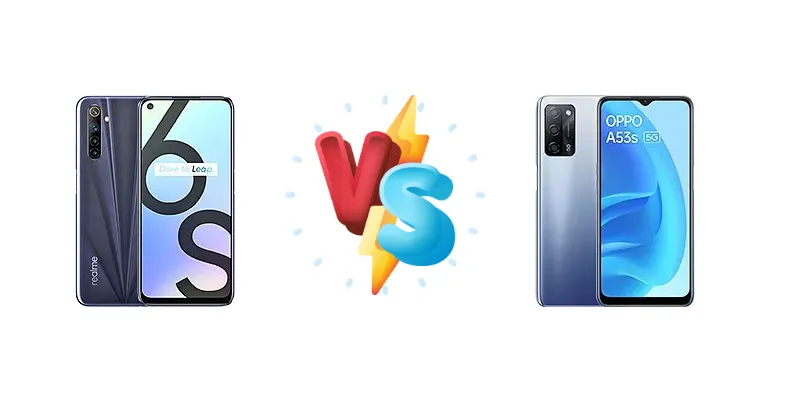
The Realme 6S and Oppo A53s 5G represent distinct approaches to the budget smartphone market. The Realme 6S, released with a focus on gaming performance, boasts a powerful Helio G90T chipset and rapid 30W charging. The Oppo A53s 5G, a later entrant, prioritizes future-proofing with its Dimensity 700 5G modem, albeit with a slower charging solution. This comparison dissects the trade-offs between raw processing power and next-generation connectivity.
🏆 Quick Verdict
For users prioritizing gaming and fast charging, the Realme 6S is the clear winner. Its Helio G90T delivers superior performance in demanding titles. However, if 5G connectivity is a must-have and you're willing to sacrifice some processing speed and charging convenience, the Oppo A53s 5G is a viable option.
| Network |
|---|
| 2G bands | GSM 850 / 900 / 1800 / 1900 | GSM 850 / 900 / 1800 / 1900 |
| 3G bands | HSDPA 850 / 900 / 1700(AWS) / 1900 / 2100 - International | HSDPA 800 / 850 / 900 / 2100 |
| 4G bands | 1, 2, 3, 4, 5, 7, 8, 20, 28, 38, 40, 41 - International | 1, 3, 5, 8, 34, 38, 39, 40, 41 |
| 5G bands | - | 1, 28, 41, 77, 78 SA/NSA |
| Speed | HSPA 42.2/11.5 Mbps, LTE (2CA) Cat6 300/75 Mbps | HSPA, LTE, 5G |
| Technology | GSM / HSPA / LTE | GSM / HSPA / LTE / 5G |
| Launch |
|---|
| Announced | 2020, May 26. Released 2020, June 02 | 2021, April 27 |
| Status | Discontinued | Available. Released 2021, May 07 |
| Body |
|---|
| Build | Glass front (Gorilla Glass 3), plastic back, plastic frame | - |
| Dimensions | 162.1 x 74.8 x 8.9 mm (6.38 x 2.94 x 0.35 in) | 164 x 75.7 x 8.4 mm (6.46 x 2.98 x 0.33 in) |
| SIM | Nano-SIM + Nano-SIM | Nano-SIM + Nano-SIM |
| Weight | 191 g (6.74 oz) | 189.6 g (6.70 oz) |
| | Weather-sealed ports & loudspeaker | - |
| Display |
|---|
| Protection | Corning Gorilla Glass 3 | - |
| Resolution | 1080 x 2400 pixels, 20:9 ratio (~405 ppi density) | 720 x 1600 pixels, 20:9 ratio (~269 ppi density) |
| Size | 6.5 inches, 102.0 cm2 (~84.1% screen-to-body ratio) | 6.52 inches, 102.6 cm2 (~82.7% screen-to-body ratio) |
| Type | IPS LCD, 90Hz, 480 nits (typ) | IPS LCD, 480 nits (typ) |
| Platform |
|---|
| CPU | Octa-core (2x2.05 GHz Cortex-A76 & 6x2.0 GHz Cortex-A55) | Octa-core (2x2.2 GHz Cortex-A76 & 6x2.0 GHz Cortex-A55) |
| Chipset | Mediatek MT6785 Helio G90T (12 nm) | Mediatek Dimensity 700 (7 nm) |
| GPU | Mali-G76 MC4 | Mali-G57 MC2 |
| OS | Android 11, Realme UI 2.0 | Android 11, ColorOS 11.1 |
| Memory |
|---|
| Card slot | microSDXC (dedicated slot) | microSDXC (dedicated slot) |
| Internal | 64GB 4GB RAM, 128GB 6GB RAM | 128GB 6GB RAM, 128GB 8GB RAM |
| | UFS 2.1 | UFS 2.2 |
| Main Camera |
|---|
| Features | LED flash, HDR, panorama | LED flash, HDR, panorama |
| Quad | 48 MP, f/1.8, 26mm (wide), 1/2.0", 0.8µm, PDAF
8 MP, f/2.3, 119˚ (ultrawide), 1/4.0", 1.12µm
2 MP (macro)
Auxiliary lens | - |
| Single | - | 8 MP, f/2.0, 26mm (wide) |
| Triple | - | 13 MP, f/2.2, 25mm (wide), 1/3.06", 1.12µm, PDAF
2 MP (macro)
Auxiliary lens |
| Video | 4K@30fps, 1080p@30/60/120fps, gyro-EIS | 1080p@30fps |
| Selfie camera |
|---|
| Features | HDR, panorama | HDR |
| Single | 16 MP, f/2.0, 26mm (wide), 1/3.06", 1.0µm | 8 MP, f/2.0, 26mm (wide) |
| Video | 1080p@30fps | 1080p@30fps |
| Sound |
|---|
| 3.5mm jack | Yes | Yes |
| 35mm jack | Yes | Yes |
| Loudspeaker | Yes | Yes |
| Comms |
|---|
| Bluetooth | 5.0, A2DP, LE | 5.0, A2DP, LE, aptX HD |
| NFC | No | No |
| Positioning | GPS, GLONASS, BDS | GPS, GLONASS, GALILEO, BDS, QZSS |
| Radio | FM radio | No |
| USB | USB Type-C 2.0, OTG | USB Type-C 2.0, OTG |
| WLAN | Wi-Fi 802.11 a/b/g/n/ac, dual-band, Wi-Fi Direct | Wi-Fi 802.11 a/b/g/n/ac, dual-band, Wi-Fi Direct |
| Features |
|---|
| Sensors | Fingerprint (side-mounted), accelerometer, gyro, proximity, compass | Fingerprint (side-mounted), accelerometer, gyro, proximity, compass |
| Battery |
|---|
| Charging | 30W wired, 100% in 55 min | 10W wired |
| Type | 4300 mAh | Li-Po 5000 mAh |
| Misc |
|---|
| Colors | Eclipse Black, Lunar White | Crystal Blue, Ink Black |
| Models | RMX2002 | CPH2321 |
| Price | About 200 EUR | About 170 EUR |
Realme 6S
- Faster 30W charging for quick top-ups
- Potentially higher peak gaming performance with Helio G90T
- More established gaming-focused software optimizations
- Less power-efficient 12nm process
- Lacks 5G connectivity
- Older chipset architecture
Oppo A53s 5G
- Integrated 5G modem for future-proof connectivity
- More power-efficient 7nm Dimensity 700 chipset
- Potentially better sustained performance due to thermal efficiency
- Significantly slower 10W charging
- Lower peak gaming performance compared to the G90T
- May have less refined software optimizations for gaming
Display Comparison
Neither device's display specifications are provided, so a direct comparison is limited. However, given their market segments, both likely feature LCD panels. The Realme 6S, being slightly older, may have a lower peak brightness. The Oppo A53s 5G, benefiting from later display technology, *could* offer improved color accuracy, but this is speculative. Bezels are likely comparable, typical of phones in this price range.
Camera Comparison
Without detailed camera specs, a precise comparison is difficult. Both phones likely feature multi-camera setups, but the quality will depend heavily on sensor size and image processing. It's reasonable to assume the Realme 6S might prioritize image processing for gaming-related content creation, while the Oppo A53s 5G may focus on general-purpose photography. The presence of a 2MP macro lens on either device is unlikely to significantly impact image quality; these are often included for marketing purposes rather than practical benefit.
Performance
The core difference lies in the chipsets. The Oppo A53s 5G’s Mediatek Dimensity 700, fabricated on a 7nm process, offers improved power efficiency compared to the Realme 6S’s 12nm Helio G90T. While both CPUs share the same Cortex-A76 (2x2.05/2.2 GHz) and Cortex-A55 (6x2.0 GHz) core configuration, the Dimensity 700’s more advanced process node and integrated 5G modem contribute to better sustained performance and lower heat generation. The G90T, however, historically delivers higher peak CPU and GPU performance, making it more suitable for demanding games. The A53s 5G's 5G modem is a significant advantage for users in areas with 5G coverage.
Battery Life
The Realme 6S’s 30W wired charging is a substantial advantage, achieving a full charge in approximately 55 minutes. The Oppo A53s 5G’s 10W charging is significantly slower, requiring considerably longer to reach 100%. While battery capacity isn't specified, the more efficient Dimensity 700 in the A53s 5G *may* offset the charging disadvantage to some extent, offering comparable real-world battery life despite potentially having a smaller battery cell. However, the convenience of the Realme 6S’s rapid charging is a major benefit for power users.
Buying Guide
Buy the Realme 6S if you need a phone primarily for mobile gaming, value fast charging, and don't require 5G connectivity immediately. You'll benefit from a smoother experience in graphically intensive games and quicker top-ups. Buy the Oppo A53s 5G if you prioritize access to 5G networks, anticipate future network upgrades, and are comfortable with a slower charging speed and slightly less powerful processor.
Frequently Asked Questions
❓ Will the Oppo A53s 5G's Dimensity 700 handle demanding games like PUBG or Call of Duty Mobile?
The Dimensity 700 is capable of running these games, but you'll likely need to lower graphics settings to achieve a consistently smooth frame rate. The Helio G90T in the Realme 6S will provide a noticeably better experience at higher settings.
❓ How much slower is the 10W charging on the Oppo A53s 5G compared to the Realme 6S's 30W charging?
The 10W charging on the A53s 5G will take significantly longer – potentially over 3 hours – to fully charge the battery, whereas the Realme 6S can reach 100% in around 55 minutes. This difference is substantial for users who frequently need to quickly replenish their battery.
❓ Is the 5G connectivity on the Oppo A53s 5G worth the trade-off in gaming performance?
That depends on your priorities and location. If you live in an area with robust 5G coverage and anticipate using 5G frequently, the A53s 5G's connectivity is a significant benefit. However, if 5G isn't readily available or you prioritize gaming, the Realme 6S is the better choice.