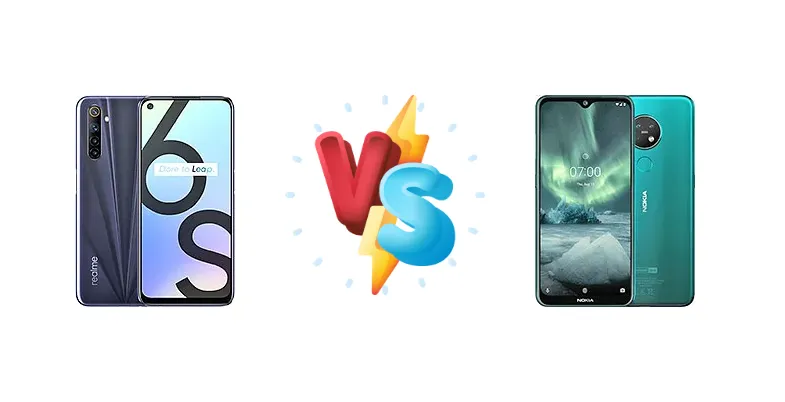
The Realme 6S and Nokia 7.2 represent distinct approaches to the mid-range smartphone market. The Realme 6S prioritizes performance with its Mediatek Helio G90T chipset, aiming for a smoother gaming experience. Conversely, the Nokia 7.2 focuses on a balanced package with a respectable display and a focus on software purity, though its Snapdragon 660 is showing its age.
🏆 Quick Verdict
For the average user prioritizing gaming and fast charging, the Realme 6S is the clear winner. Its Helio G90T offers significantly better performance than the Snapdragon 660 in the Nokia 7.2, and the 30W charging is a game-changer. However, the Nokia 7.2 remains a viable option for those valuing a more refined software experience and a slightly brighter display.
| Network |
|---|
| 2G bands | GSM 850 / 900 / 1800 / 1900 | GSM 850 / 900 / 1800 / 1900 |
| 3G bands | HSDPA 850 / 900 / 1700(AWS) / 1900 / 2100 - International | HSDPA 850 / 900 / 2100 - ROW |
| 4G bands | 1, 2, 3, 4, 5, 7, 8, 20, 28, 38, 40, 41 - International | 1, 3, 5, 7, 8, 20, 28, 38, 40, 41 - ROW |
| Speed | HSPA 42.2/11.5 Mbps, LTE (2CA) Cat6 300/75 Mbps | HSPA 42.2/5.76 Mbps, LTE (2CA) Cat6 300/50 Mbps or LTE Cat4 150/50 Mbps |
| Technology | GSM / HSPA / LTE | GSM / HSPA / LTE |
| | - | 1, 3, 5, 8, 40, 41 - IN |
| Launch |
|---|
| Announced | 2020, May 26. Released 2020, June 02 | 2019, September 05. Released 2019, September 23 |
| Status | Discontinued | Discontinued |
| Body |
|---|
| Build | Glass front (Gorilla Glass 3), plastic back, plastic frame | Glass front (Gorilla Glass 3), glass back (Gorilla Glass 3), plastic frame |
| Dimensions | 162.1 x 74.8 x 8.9 mm (6.38 x 2.94 x 0.35 in) | 159.9 x 75.2 x 8.3 mm (6.30 x 2.96 x 0.33 in) |
| SIM | Nano-SIM + Nano-SIM | · Nano-SIM· Nano-SIM + Nano-SIM |
| Weight | 191 g (6.74 oz) | 180 g (6.35 oz) |
| | Weather-sealed ports & loudspeaker | - |
| Display |
|---|
| Protection | Corning Gorilla Glass 3 | Corning Gorilla Glass 3 |
| Resolution | 1080 x 2400 pixels, 20:9 ratio (~405 ppi density) | 1080 x 2280 pixels, 19:9 ratio (~400 ppi density) |
| Size | 6.5 inches, 102.0 cm2 (~84.1% screen-to-body ratio) | 6.3 inches, 99.1 cm2 (~82.4% screen-to-body ratio) |
| Type | IPS LCD, 90Hz, 480 nits (typ) | IPS LCD, HDR10 |
| Platform |
|---|
| CPU | Octa-core (2x2.05 GHz Cortex-A76 & 6x2.0 GHz Cortex-A55) | Octa-core (4x2.2 GHz Kryo 260 Gold & 4x1.8 GHz Kryo 260 Silver) |
| Chipset | Mediatek MT6785 Helio G90T (12 nm) | Qualcomm SDM660 Snapdragon 660 (14 nm) |
| GPU | Mali-G76 MC4 | Adreno 512 |
| OS | Android 11, Realme UI 2.0 | Android 9.0 (Pie), upgradable to Android 11, Android One |
| Memory |
|---|
| Card slot | microSDXC (dedicated slot) | microSDXC (dedicated slot) |
| Internal | 64GB 4GB RAM, 128GB 6GB RAM | 64GB 4GB RAM, 64GB 6GB RAM, 128GB 4GB RAM, 128GB 6GB RAM |
| | UFS 2.1 | eMMC 5.1 |
| Main Camera |
|---|
| Features | LED flash, HDR, panorama | Zeiss optics, LED flash, panorama, HDR |
| Quad | 48 MP, f/1.8, 26mm (wide), 1/2.0", 0.8µm, PDAF
8 MP, f/2.3, 119˚ (ultrawide), 1/4.0", 1.12µm
2 MP (macro)
Auxiliary lens | - |
| Triple | - | 48 MP, f/1.8, (wide), 1/2.0", 0.8µm, PDAF
8 MP, f/2.2, 13mm (ultrawide), 1/4.0", 1.12µm
Auxiliary lens |
| Video | 4K@30fps, 1080p@30/60/120fps, gyro-EIS | 4K@30fps, 1080p@30fps (gyro-EIS) |
| Selfie camera |
|---|
| Features | HDR, panorama | Zeiss optics, HDR |
| Single | 16 MP, f/2.0, 26mm (wide), 1/3.06", 1.0µm | 20 MP, f/2.0, (wide), 1/3", 0.9µm |
| Video | 1080p@30fps | 1080p@30fps |
| Sound |
|---|
| 3.5mm jack | Yes | Yes |
| 35mm jack | Yes | Yes |
| Loudspeaker | Yes | Yes |
| Comms |
|---|
| Bluetooth | 5.0, A2DP, LE | 5.0, A2DP, EDR, LE, aptX |
| NFC | No | Yes (excl. India) |
| Positioning | GPS, GLONASS, BDS | GPS, GLONASS, GALILEO, BDS |
| Radio | FM radio | FM radio |
| USB | USB Type-C 2.0, OTG | USB Type-C 2.0, OTG |
| WLAN | Wi-Fi 802.11 a/b/g/n/ac, dual-band, Wi-Fi Direct | Wi-Fi 802.11 b/g/n/ac, dual-band, Wi-Fi Direct |
| Features |
|---|
| Sensors | Fingerprint (side-mounted), accelerometer, gyro, proximity, compass | Fingerprint (rear-mounted), accelerometer, gyro, proximity, compass |
| Battery |
|---|
| Charging | 30W wired, 100% in 55 min | 10W wired |
| Type | 4300 mAh | Li-Po 3500 mAh, non-removable |
| Misc |
|---|
| Colors | Eclipse Black, Lunar White | Cyan Green, Charcoal, Ice |
| Models | RMX2002 | TA-1193, TA-1178, TA-1196, TA-1181 |
| Price | About 200 EUR | About 240 EUR |
| SAR | - | 1.15 W/kg (head) 0.90 W/kg (body) |
| SAR EU | - | 0.99 W/kg (head) 1.44 W/kg (body) |
| Tests |
|---|
| Audio quality | - |
Noise -93.0dB / Crosstalk -93.4dB |
| Battery life | - |
Endurance rating 69h
|
| Camera | - |
Photo / Video |
| Display | - |
Contrast ratio: 1342:1 (nominal) |
| Loudspeaker | - |
-29.6 LUFS (Average)
|
| Performance | - |
AnTuTu: 139495 (v7), 164484 (v8)
GeekBench: 5440 (v4.4), 1398 (v5.1)
GFXBench: 8.1fps (ES 3.1 onscreen) |
Realme 6S
- Significantly faster processor for gaming and multitasking
- 30W fast charging for quick power-ups
- Likely benefits from a higher refresh rate display
- Software experience may be less refined than Nokia's
- Display brightness not specified
Nokia 7.2
- Brighter display (585 nits) for outdoor visibility
- Cleaner Android software experience
- Good battery endurance (69h)
- Slower processor struggles with demanding tasks
- Slow 10W charging
Display Comparison
The Nokia 7.2 boasts a display capable of reaching 585 nits of peak brightness, a measured value that suggests good outdoor visibility. While the Realme 6S’s brightness isn’t specified, the Nokia 7.2’s 1342:1 contrast ratio provides a visually rich experience. However, the Realme 6S likely benefits from a higher refresh rate (a common feature in this price bracket at the time of release, though not specified in the data), which would contribute to smoother scrolling and animations. The Nokia 7.2’s contrast ratio, while good, is a nominal value and may not reflect real-world performance as accurately as a measured value.
Camera Comparison
Both phones feature photo and video capabilities, but the provided data lacks specifics to make a definitive judgment. Without sensor size or aperture information, it’s difficult to assess image quality. However, given the Realme 6S’s focus on performance, it’s reasonable to assume it benefits from more advanced image processing capabilities. The Nokia 7.2 likely prioritizes color accuracy and natural-looking images, aligning with Nokia’s brand philosophy. The absence of details regarding OIS (Optical Image Stabilization) on either device makes it impossible to compare low-light performance effectively.
Performance
The core difference lies in the chipsets. The Realme 6S’s Mediatek Helio G90T (12nm) utilizes a combination of Cortex-A76 and Cortex-A55 cores, offering a significant performance advantage over the Nokia 7.2’s Qualcomm Snapdragon 660 (14nm). The G90T’s architecture, with its more powerful A76 cores clocked at 2.05 GHz, translates to faster app loading times and smoother multitasking. The Snapdragon 660, while still capable, is built on a larger 14nm process, resulting in lower efficiency and potentially more heat generation under sustained load. The G90T’s GPU will also provide a substantially better gaming experience.
Battery Life
Both devices share an endurance rating of 69 hours, suggesting similar overall battery life. However, the Realme 6S’s 30W wired charging is a massive advantage. Achieving a 100% charge in just 55 minutes is significantly faster than the Nokia 7.2’s 10W charging, which would take considerably longer. This faster charging capability mitigates any potential battery life differences, making the Realme 6S more convenient for users who need to quickly top up their device.
Buying Guide
Buy the Realme 6S if you need a phone capable of handling demanding mobile games and appreciate rapid charging speeds. This is the phone for users who frequently game, stream videos, or simply want a responsive experience. Buy the Nokia 7.2 if you prefer a cleaner Android experience, prioritize a slightly brighter display for outdoor visibility, and are less concerned with peak performance for gaming or intensive tasks.
Frequently Asked Questions
❓ Will the Snapdragon 660 in the Nokia 7.2 struggle with modern games like PUBG or Call of Duty Mobile?
Yes, the Snapdragon 660 is likely to struggle with demanding games like PUBG or Call of Duty Mobile, even at medium settings. The Helio G90T in the Realme 6S is specifically designed for gaming and will provide a much smoother and more enjoyable experience.
❓ How much faster is the 30W charging on the Realme 6S compared to the 10W charging on the Nokia 7.2 in real-world use?
The 30W charging on the Realme 6S can fully charge the phone in approximately 55 minutes. The Nokia 7.2’s 10W charging will likely take over 2 hours to reach 100%, making the Realme 6S significantly more convenient for users who need a quick charge.
❓ Does the Nokia 7.2 receive regular software updates and security patches?
Nokia is known for its commitment to providing timely software updates and security patches, even for its mid-range devices. This is a key advantage for users who prioritize software security and a clean Android experience.
❓ Is the difference in processor performance between the Helio G90T and Snapdragon 660 noticeable in everyday tasks like browsing and social media?
While both phones can handle everyday tasks, the Helio G90T in the Realme 6S will feel noticeably snappier and more responsive. App loading times will be faster, and multitasking will be smoother, even when using multiple apps simultaneously.