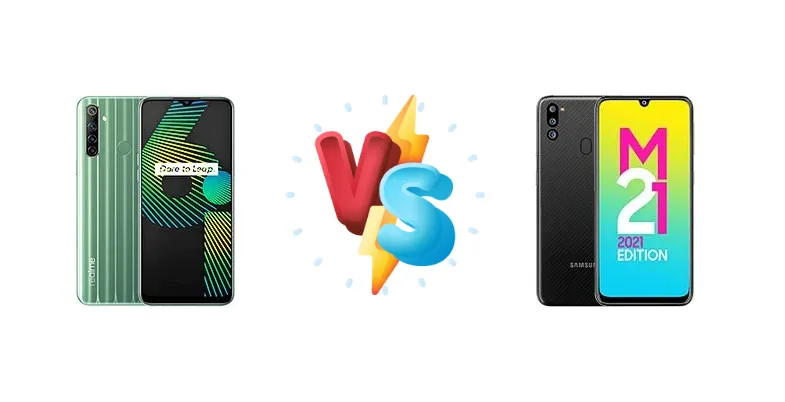
The Realme 6i and Samsung Galaxy M21 2021 represent compelling options in the crowded budget smartphone market. While both aim to deliver essential features at an accessible price, they take different approaches to achieving this. The Realme 6i prioritizes a balance of performance and endurance, while the Samsung M21 2021 leans towards a larger display and Samsung’s software ecosystem. This comparison will dissect their key differences to help you determine which device best suits your needs.
🏆 Quick Verdict
For the average user prioritizing consistent performance and a brighter display, the Realme 6i emerges as the stronger choice. Its Helio G80 chipset, coupled with a measured 528 nits of brightness, offers a smoother experience and better visibility, despite the M21 2021’s larger battery capacity.
| Network |
|---|
| 2G bands | GSM 850 / 900 / 1800 / 1900 | GSM 850 / 900 / 1800 / 1900 |
| 3G bands | HSDPA 850 / 900 / 1700(AWS) / 1900 / 2100 - Global | HSDPA 850 / 900 / 1900 / 2100 |
| 4G bands | 1, 2, 3, 4, 5, 7, 8, 20, 28, 38, 40, 41 - Global | 1, 3, 5, 7, 8, 20, 38, 40, 41 |
| Speed | HSPA, LTE | HSPA, LTE |
| Technology | GSM / HSPA / LTE | GSM / HSPA / LTE |
| | 1, 3, 5, 8, 38, 40, 41 - India | - |
| Launch |
|---|
| Announced | 2020, March 17. Released 2020, March 29 | 2021, July 21 |
| Status | Discontinued | Available. Released 2021, July 26 |
| Body |
|---|
| Build | Glass front, plastic back, plastic frame | Glass front, plastic back, plastic frame |
| Dimensions | 164.4 x 75.4 x 9 mm (6.47 x 2.97 x 0.35 in) | 159 x 75.1 x 9 mm (6.26 x 2.96 x 0.35 in) |
| SIM | Nano-SIM + Nano-SIM | Nano-SIM + Nano-SIM |
| Weight | 199 g (7.02 oz) | 192 g (6.77 oz) |
| Display |
|---|
| Protection | Corning Gorilla Glass 3 | - |
| Resolution | 720 x 1600 pixels, 20:9 ratio (~269 ppi density) | 1080 x 2340 pixels, 19.5:9 ratio (~403 ppi density) |
| Size | 6.5 inches, 102.8 cm2 (~82.9% screen-to-body ratio) | 6.4 inches, 100.5 cm2 (~84.2% screen-to-body ratio) |
| Type | IPS LCD | Super AMOLED, 420 nits (peak) |
| Platform |
|---|
| CPU | Octa-core (2x2.0 GHz Cortex-A75 & 6x1.8 GHz Cortex-A55) | Octa-core (4x2.3 GHz Cortex-A73 & 4x1.7 GHz Cortex-A53) |
| Chipset | Mediatek MT6769V/CU Helio G80 (12 nm) | Exynos 9611 (10 nm) |
| GPU | Mali-G52 MC2 | Mali-G72 MP3 |
| OS | Android 10, Realme UI | Android 11, One UI 3.1 Core |
| Memory |
|---|
| Card slot | microSDXC (dedicated slot) | microSDXC (dedicated slot) |
| Internal | 64GB 3GB RAM, 64GB 4GB RAM, 128GB 4GB RAM | 64GB 4GB RAM, 128GB 6GB RAM |
| | eMMC 5.1 | - |
| Main Camera |
|---|
| Features | LED flash, HDR, panorama | LED flash, panorama, HDR |
| Quad | 48 MP, f/1.8, 26mm (wide), 1/2.0", 0.8µm, PDAF
8 MP, f/2.3, 119˚ (ultrawide), 1/4.0", 1.12µm
2 MP (macro)
2 MP B/W, f/2.4 | - |
| Triple | - | 48 MP, f/2.0, 26mm (wide), 1/2.0", 0.8µm, PDAF
8 MP, f/2.2, 123˚ (ultrawide), 1/4.0", 1.12µm
Auxiliary lens |
| Video | 1080p@30fps, gyro-EIS | 4K@30fps, 1080p@30fps, 720p@240fps, gyro-EIS |
| Selfie camera |
|---|
| Features | HDR, panorama | HDR |
| Single | 16 MP, f/2.0, 26mm (wide), 1/3.06", 1.0µm | 20 MP, f/2.2, 26mm (wide) |
| Video | 1080p@30fps | 1080p@30fps |
| Sound |
|---|
| 3.5mm jack | Yes | Yes |
| 35mm jack | Yes | Yes |
| Loudspeaker | Yes | Yes |
| Comms |
|---|
| Bluetooth | 5.0, A2DP, LE | 5.0, A2DP, LE |
| NFC | Yes (market/region dependent) | Yes (market/region dependent) |
| Positioning | GPS, GLONASS, BDS | GPS, GLONASS, GALILEO, BDS |
| Radio | FM radio | FM radio, RDS, recording |
| USB | USB Type-C 2.0, OTG | USB Type-C 2.0 |
| WLAN | Wi-Fi 802.11 b/g/n, Wi-Fi Direct | Wi-Fi 802.11 a/b/g/n/ac, dual-band, Wi-Fi Direct |
| Features |
|---|
| Sensors | Fingerprint (rear-mounted), accelerometer, gyro, proximity, compass | Fingerprint (rear-mounted), accelerometer, gyro, proximity, compass |
| Battery |
|---|
| Charging | 18W wired
5W reverse wired | 15W wired |
| Type | 5000 mAh | Li-Po 6000 mAh |
| Misc |
|---|
| Colors | White Milk, Green Tea, Blue Soda | Charcoal Black, Arctic Blue |
| Models | RMX2040 | SM-M215G, SM-M215G/DS |
| Price | About 400 EUR | About 130 EUR |
| SAR | - | 0.47 W/kg (head) |
| Tests |
|---|
| Battery life |
Endurance rating 186h
| - |
| Camera |
Photo / Video | - |
| Display |
Contrast ratio: 1610:1 (nominal) | - |
| Loudspeaker |
-30.5 LUFS (Below average)
| - |
| Performance |
AnTuTu: 202275 (v8)
GeekBench: 5890 (v4.4), 1349 (v5.1)
GFXBench: 17fps (ES 3.1 onscreen) | - |
Realme 6i
- Brighter display for better outdoor visibility
- Faster charging (18W vs 15W)
- Gaming-optimized chipset (Helio G80)
- Potentially less battery life than M21 2021
- Lacks Samsung’s software features
Samsung Galaxy M21 2021
- Likely larger battery capacity for extended use
- Samsung’s software ecosystem and security (Knox)
- Potentially more affordable depending on region
- Slower charging speed (15W)
- Less powerful chipset for gaming
Display Comparison
The Realme 6i boasts a measured peak brightness of 528 nits and a 1610:1 contrast ratio, providing a vibrant and easily viewable experience. While the Samsung Galaxy M21 2021’s display specifications aren’t provided, Samsung typically favors color accuracy over peak brightness in this segment. The Realme 6i’s higher brightness is a significant advantage for outdoor use. The contrast ratio suggests deeper blacks and more dynamic visuals on the Realme 6i, enhancing media consumption. The lack of information on the M21 2021’s panel type makes a direct comparison difficult, but Realme’s specification provides a concrete advantage.
Camera Comparison
Both devices feature 'Photo / Video' capabilities, but detailed camera specifications are absent. Given the market positioning, it’s likely both rely on multi-camera setups with a primary sensor and supporting lenses. Without sensor size or aperture information, a direct comparison is impossible. However, the inclusion of a 2MP macro camera on many devices in this price range is often a marketing gimmick, offering limited practical benefit. Image processing will likely differ, with Samsung typically favoring more saturated colors and Realme aiming for a more natural look.
Performance
The Realme 6i’s Mediatek Helio G80 (12nm) chipset, with its octa-core configuration (2x2.0 GHz Cortex-A75 & 6x1.8 GHz Cortex-A55), is designed for gaming and multitasking. The Samsung Galaxy M21 2021 utilizes the Exynos 9611 (10nm). While the Exynos 9611 has a higher clock speed on its prime cores (4x2.3 GHz Cortex-A73), the Helio G80’s architecture is optimized for gaming. The 12nm process of the Helio G80 is less efficient than the 10nm process of the Exynos 9611, but the G80’s focus on gaming performance may offset this in real-world usage. The Cortex-A75 cores in the Helio G80 are generally more efficient than the A53 cores in the Exynos, leading to better sustained performance.
Battery Life
The Realme 6i achieves an impressive endurance rating of 186 hours, indicating excellent battery life. The Samsung Galaxy M21 2021, while lacking a specific endurance rating, likely boasts a larger battery capacity. However, the Realme 6i compensates with 18W wired charging and 5W reverse wired charging, offering faster replenishment and the ability to charge other devices. The M21 2021 is limited to 15W wired charging. The Realme 6i’s faster charging speed is a significant advantage, minimizing downtime and maximizing usability.
Buying Guide
Buy the Realme 6i if you need a phone that feels responsive for everyday tasks and light gaming, and value a brighter, more visible screen. It’s ideal for users who frequently consume media outdoors or in brightly lit environments. Buy the Samsung Galaxy M21 2021 if you prioritize maximizing battery life above all else and are deeply embedded in the Samsung ecosystem, appreciating features like Samsung Knox security.
Frequently Asked Questions
❓ Does the Exynos 9611 in the Samsung Galaxy M21 2021 tend to overheat during prolonged gaming sessions?
The Exynos 9611 is known to exhibit some thermal throttling under sustained load. While it can handle casual gaming, demanding titles may lead to reduced performance over time as the chip heats up. The Realme 6i’s Helio G80, while less powerful on paper, is generally better at maintaining consistent performance due to its gaming-focused design.
❓ Is the 5W reverse wired charging on the Realme 6i actually useful for topping up accessories like earbuds?
Yes, the 5W reverse wired charging is a convenient feature for topping up small accessories like wireless earbuds or a smartwatch. While it won’t rapidly charge a phone, it can provide a significant boost to smaller devices, especially in emergencies.
❓ Can the Realme 6i handle demanding games like PUBG Mobile at high frame rates?
The Realme 6i can run PUBG Mobile, but achieving consistently high frame rates (60fps or higher) may require lowering the graphics settings. The Helio G80 is capable, but it’s not a flagship-level chipset, so compromises are necessary for optimal performance.