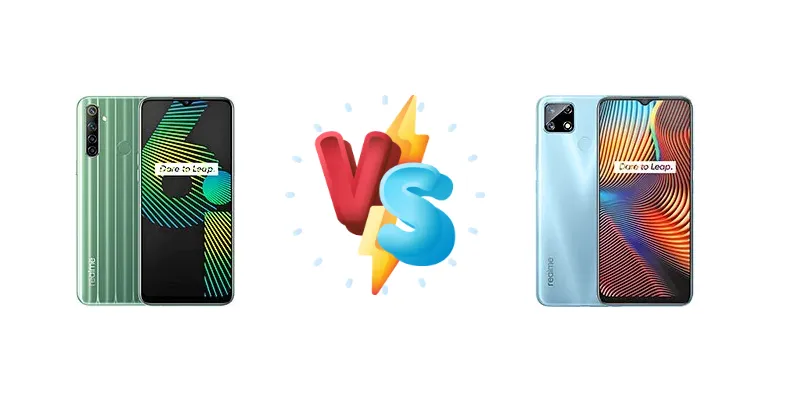
The Realme 6i and 7i represent Realme's continued push into the competitive budget smartphone market. While both aim to deliver a solid experience without breaking the bank, the 7i introduces the Helio G85 chipset as a key upgrade. This comparison dives deep into the nuances between these two devices, helping you determine if the newer model justifies the potential price difference.
🏆 Quick Verdict
For most users, the Realme 7i (Global) offers a worthwhile upgrade over the 6i. The Helio G85 provides a modest performance boost, and while battery life is similar, the 7i's slightly improved efficiency and potential for future software optimizations make it the better long-term choice. However, if budget is the absolute primary concern, the 6i remains a capable device.
| Network |
|---|
| 2G bands | GSM 850 / 900 / 1800 / 1900 | GSM 850 / 900 / 1800 / 1900 |
| 3G bands | HSDPA 850 / 900 / 1700(AWS) / 1900 / 2100 - Global | HSDPA 850 / 900 / 1700(AWS) / 1900 / 2100 |
| 4G bands | 1, 2, 3, 4, 5, 7, 8, 20, 28, 38, 40, 41 - Global | 1, 2, 3, 4, 5, 7, 8, 20, 28, 38, 40, 41 |
| Speed | HSPA, LTE | HSPA, LTE |
| Technology | GSM / HSPA / LTE | GSM / HSPA / LTE |
| | 1, 3, 5, 8, 38, 40, 41 - India | - |
| Launch |
|---|
| Announced | 2020, March 17. Released 2020, March 29 | 2020, December 22. Released 2020, December 23 |
| Status | Discontinued | Discontinued |
| Body |
|---|
| Build | Glass front, plastic back, plastic frame | - |
| Dimensions | 164.4 x 75.4 x 9 mm (6.47 x 2.97 x 0.35 in) | 164.5 x 75.9 x 9.8 mm (6.48 x 2.99 x 0.39 in) |
| SIM | Nano-SIM + Nano-SIM | Nano-SIM + Nano-SIM |
| Weight | 199 g (7.02 oz) | 208 g (7.34 oz) |
| Display |
|---|
| Protection | Corning Gorilla Glass 3 | - |
| Resolution | 720 x 1600 pixels, 20:9 ratio (~269 ppi density) | 720 x 1600 pixels, 20:9 ratio (~270 ppi density) |
| Size | 6.5 inches, 102.8 cm2 (~82.9% screen-to-body ratio) | 6.5 inches, 102.0 cm2 (~81.7% screen-to-body ratio) |
| Type | IPS LCD | IPS LCD, 450 nits (typ), 560 nits (peak) |
| Platform |
|---|
| CPU | Octa-core (2x2.0 GHz Cortex-A75 & 6x1.8 GHz Cortex-A55) | Octa-core (2x2.0 GHz Cortex-A75 & 6x1.8 GHz Cortex-A55) |
| Chipset | Mediatek MT6769V/CU Helio G80 (12 nm) | Mediatek MT6769Z Helio G85 (12 nm) |
| GPU | Mali-G52 MC2 | Mali-G52 MC2 |
| OS | Android 10, Realme UI | Android 10, Realme UI |
| Memory |
|---|
| Card slot | microSDXC (dedicated slot) | microSDXC (dedicated slot) |
| Internal | 64GB 3GB RAM, 64GB 4GB RAM, 128GB 4GB RAM | 64GB 4GB RAM |
| | eMMC 5.1 | eMMC 5.1 |
| Main Camera |
|---|
| Features | LED flash, HDR, panorama | LED flash, HDR, panorama |
| Quad | 48 MP, f/1.8, 26mm (wide), 1/2.0", 0.8µm, PDAF
8 MP, f/2.3, 119˚ (ultrawide), 1/4.0", 1.12µm
2 MP (macro)
2 MP B/W, f/2.4 | - |
| Triple | - | 48 MP, f/1.8, 26mm (wide), 1/2.0", 0.8µm, PDAF
8 MP, f/2.3, 16mm, 119˚ (ultrawide), 1/4.0", 1.12µm
2 MP (macro) |
| Video | 1080p@30fps, gyro-EIS | 1080p@30/60fps |
| Selfie camera |
|---|
| Features | HDR, panorama | HDR, panorama |
| Single | 16 MP, f/2.0, 26mm (wide), 1/3.06", 1.0µm | 8 MP, f/2.0, 26mm (wide), 1/4.0", 1.12µm |
| Video | 1080p@30fps | 1080p@30fps |
| Sound |
|---|
| 3.5mm jack | Yes | Yes |
| 35mm jack | Yes | Yes |
| Loudspeaker | Yes | Yes |
| Comms |
|---|
| Bluetooth | 5.0, A2DP, LE | 5.0, A2DP, LE, aptX HD |
| NFC | Yes (market/region dependent) | No |
| Positioning | GPS, GLONASS, BDS | GPS, GLONASS, BDS |
| Radio | FM radio | FM radio |
| USB | USB Type-C 2.0, OTG | USB Type-C 2.0, OTG |
| WLAN | Wi-Fi 802.11 b/g/n, Wi-Fi Direct | Wi-Fi 802.11 a/b/g/n/ac, dual-band, Wi-Fi Direct |
| Features |
|---|
| Sensors | Fingerprint (rear-mounted), accelerometer, gyro, proximity, compass | Fingerprint (rear-mounted), accelerometer, proximity, compass |
| Battery |
|---|
| Charging | 18W wired
5W reverse wired | 18W wired
5W reverse wired |
| Type | 5000 mAh | 6000 mAh |
| Misc |
|---|
| Colors | White Milk, Green Tea, Blue Soda | Glory Silver, Victory Blue |
| Models | RMX2040 | - |
| Price | About 400 EUR | About 190 EUR |
| Tests |
|---|
| Battery life |
Endurance rating 186h
| - |
| Camera |
Photo / Video | - |
| Display |
Contrast ratio: 1610:1 (nominal) | - |
| Loudspeaker |
-30.5 LUFS (Below average)
| - |
| Performance |
AnTuTu: 202275 (v8)
GeekBench: 5890 (v4.4), 1349 (v5.1)
GFXBench: 17fps (ES 3.1 onscreen) | - |
Realme 6i
- Excellent value for money
- Solid battery life (186h endurance)
- Capable of handling everyday tasks
- Helio G80 chipset is showing its age
- Display lacks vibrancy and high refresh rate
Realme 7i (Global)
- Slightly improved performance with Helio G85
- Potential for better software optimization
- Similar battery life to the 6i
- Price premium over the 6i
- Camera performance likely similar to the 6i
Display Comparison
Both the Realme 6i and 7i feature displays that prioritize affordability over cutting-edge technology. The Realme 6i boasts a measured peak brightness of 528 nits and a 1610:1 contrast ratio. While the 7i's display specifications aren't provided, it's reasonable to expect similar performance given their market positioning. Neither device utilizes high refresh rate panels or advanced display technologies like LTPO, focusing instead on delivering a functional viewing experience. The 6i's contrast ratio suggests decent black levels for the price point, but users seeking vibrant colors and wide viewing angles may find both displays somewhat lacking.
Camera Comparison
Both devices are listed as having 'Photo / Video' capabilities, but specific details regarding sensor size, aperture, or image processing are absent. Given the budget nature of these phones, it's likely both rely on similar camera setups with a primary sensor and potentially auxiliary lenses for depth or macro photography. The absence of Optical Image Stabilization (OIS) is almost certain on both models. The 7i may benefit from slightly improved image processing algorithms due to software optimizations, but substantial differences in image quality are unlikely. Users should temper expectations and understand that these cameras are designed for casual photography rather than professional-grade results.
Performance
The core difference between these two phones lies in their chipsets. The Realme 6i utilizes the Mediatek Helio G80 (12nm), while the 7i features the Helio G85 (also 12nm). Both CPUs share the same octa-core configuration – 2x2.0 GHz Cortex-A75 and 6x1.8 GHz Cortex-A55. However, the G85 boasts a slightly higher GPU clock speed, resulting in a modest performance increase in graphics-intensive tasks like gaming. While not a generational leap, this translates to smoother frame rates and better overall responsiveness in games. Both phones share the same CPU architecture, meaning day-to-day tasks will feel similar, but the 7i will exhibit a slight edge in demanding applications.
Battery Life
The Realme 6i achieves an endurance rating of 186 hours, indicating solid battery life for moderate usage. The Realme 7i's battery life isn't explicitly stated, but given the slightly more efficient Helio G85 chipset, it's reasonable to expect comparable or marginally improved endurance. Both phones support 18W wired charging and 5W reverse wired charging. A full charge from 0-100% will likely take around 2 hours with the included charger. The similar battery performance suggests that the G85's efficiency gains are primarily focused on maintaining performance under load rather than drastically extending battery life.
Buying Guide
Buy the Realme 6i if you prioritize maximizing value and are looking for a reliable daily driver for basic tasks like calling, texting, and social media. It's an excellent choice for users who don't heavily game or require the latest processor. Buy the Realme 7i (Global) if you enjoy mobile gaming, even casually, and want a phone that will feel a bit more responsive and future-proof. The G85 chipset offers a tangible, though not massive, performance advantage.
Frequently Asked Questions
❓ Does the Helio G85 in the Realme 7i offer a noticeable gaming improvement over the G80 in the 6i?
The Helio G85 provides a modest, but noticeable, improvement in gaming performance. Expect slightly higher frame rates and smoother gameplay in demanding titles, but don't anticipate a dramatic difference. It's more about future-proofing and maintaining consistent performance during extended gaming sessions.
❓ Is the camera on the Realme 7i significantly better than the 6i, especially in low-light conditions?
Given the lack of detailed camera specifications for both devices, a significant improvement in camera quality is unlikely. Any differences will likely be due to software processing rather than hardware upgrades. Low-light performance will likely be similar on both phones.
❓ How long does it take to fully charge both the Realme 6i and 7i using the included 18W charger?
Expect a full charge from 0-100% to take approximately 2 hours for both the Realme 6i and 7i when using the included 18W charger. While 18W is a decent charging speed, it's not particularly fast compared to some newer devices.