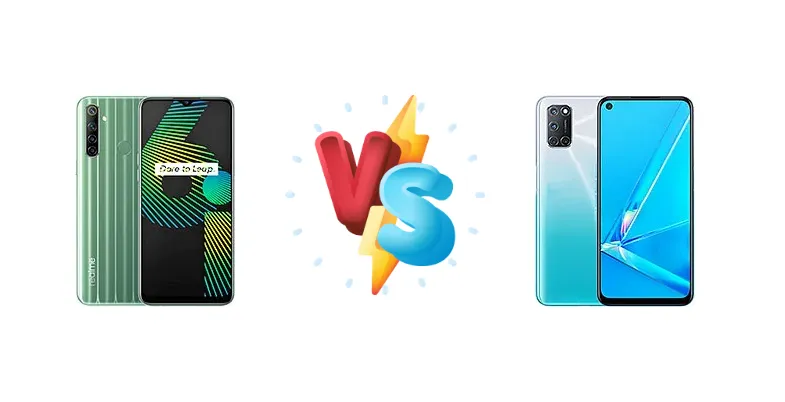
The Realme 6i and Oppo A92 represent compelling options in the crowded budget smartphone market. Both aim to deliver essential features without breaking the bank, but they take different approaches to achieving this. The Realme 6i prioritizes gaming performance with its MediaTek Helio G80 chipset, while the Oppo A92 leans towards a more balanced experience with Qualcomm’s Snapdragon 665. This comparison dives deep into the specifics to determine which device offers the best value.
🏆 Quick Verdict
For users prioritizing gaming and responsiveness, the Realme 6i is the clear winner. Its Helio G80 chipset provides a noticeable performance edge over the Snapdragon 665 in the Oppo A92. However, the Oppo A92 offers a comparable experience for everyday tasks and benefits from a potentially more refined software experience, typical of Oppo’s offerings.
| Network |
|---|
| 2G bands | GSM 850 / 900 / 1800 / 1900 | GSM 850 / 900 / 1800 / 1900 |
| 3G bands | HSDPA 850 / 900 / 1700(AWS) / 1900 / 2100 - Global | HSDPA 850 / 900 / 2100 |
| 4G bands | 1, 2, 3, 4, 5, 7, 8, 20, 28, 38, 40, 41 - Global | 1, 3, 5, 8, 38, 40, 41 - Southeast Asia |
| Speed | HSPA, LTE | HSPA, LTE |
| Technology | GSM / HSPA / LTE | GSM / HSPA / LTE |
| | 1, 3, 5, 8, 38, 40, 41 - India | - |
| Launch |
|---|
| Announced | 2020, March 17. Released 2020, March 29 | 2020, May 04. Released 2020, May 09 |
| Status | Discontinued | Discontinued |
| Body |
|---|
| Build | Glass front, plastic back, plastic frame | - |
| Dimensions | 164.4 x 75.4 x 9 mm (6.47 x 2.97 x 0.35 in) | 162 x 75.5 x 8.9 mm (6.38 x 2.97 x 0.35 in) |
| SIM | Nano-SIM + Nano-SIM | Nano-SIM + Nano-SIM |
| Weight | 199 g (7.02 oz) | 192 g (6.77 oz) |
| Display |
|---|
| Protection | Corning Gorilla Glass 3 | - |
| Resolution | 720 x 1600 pixels, 20:9 ratio (~269 ppi density) | 1080 x 2400 pixels, 20:9 ratio (~405 ppi density) |
| Size | 6.5 inches, 102.8 cm2 (~82.9% screen-to-body ratio) | 6.5 inches, 102.0 cm2 (~83.4% screen-to-body ratio) |
| Type | IPS LCD | IPS LCD, 480 nits (typ) |
| Platform |
|---|
| CPU | Octa-core (2x2.0 GHz Cortex-A75 & 6x1.8 GHz Cortex-A55) | Octa-core (4x2.0 GHz Kryo 260 Gold & 4x1.8 GHz Kryo 260 Silver) |
| Chipset | Mediatek MT6769V/CU Helio G80 (12 nm) | Qualcomm SM6125 Snapdragon 665 (11 nm) |
| GPU | Mali-G52 MC2 | Adreno 610 |
| OS | Android 10, Realme UI | Android 10, ColorOS 7.1 |
| Memory |
|---|
| Card slot | microSDXC (dedicated slot) | microSDXC (dedicated slot) |
| Internal | 64GB 3GB RAM, 64GB 4GB RAM, 128GB 4GB RAM | 128GB 6GB RAM, 128GB 8GB RAM |
| | eMMC 5.1 | UFS 2.1 |
| Main Camera |
|---|
| Features | LED flash, HDR, panorama | LED flash, HDR, panorama |
| Quad | 48 MP, f/1.8, 26mm (wide), 1/2.0", 0.8µm, PDAF
8 MP, f/2.3, 119˚ (ultrawide), 1/4.0", 1.12µm
2 MP (macro)
2 MP B/W, f/2.4 | 48 MP, f/1.7, (wide), 1/2.0", 0.8µm, PDAF
8 MP, f/2.2, 119˚ (ultrawide), 1/4.0", 1.12µm
Auxiliary lens
2 MP B/W, f/2.4 |
| Video | 1080p@30fps, gyro-EIS | 4K@30fps, 1080p@30/120fps, gyro-EIS |
| Selfie camera |
|---|
| Features | HDR, panorama | HDR |
| Single | 16 MP, f/2.0, 26mm (wide), 1/3.06", 1.0µm | 16 MP, f/2.0, (wide), 1/3.06, 1.0µm |
| Video | 1080p@30fps | 1080p@30fps |
| Sound |
|---|
| 3.5mm jack | Yes | Yes |
| 35mm jack | Yes | Yes |
| Loudspeaker | Yes | Yes, with stereo speakers |
| | - | 24-bit/192kHz audio |
| Comms |
|---|
| Bluetooth | 5.0, A2DP, LE | 5.0, A2DP, LE |
| NFC | Yes (market/region dependent) | No |
| Positioning | GPS, GLONASS, BDS | GPS, GLONASS, GALILEO, BDS |
| Radio | FM radio | FM radio |
| USB | USB Type-C 2.0, OTG | USB Type-C 2.0, OTG |
| WLAN | Wi-Fi 802.11 b/g/n, Wi-Fi Direct | Wi-Fi 802.11 a/b/g/n/ac, dual-band, Wi-Fi Direct |
| Features |
|---|
| Sensors | Fingerprint (rear-mounted), accelerometer, gyro, proximity, compass | Fingerprint (side-mounted), accelerometer, proximity, compass |
| Battery |
|---|
| Charging | 18W wired
5W reverse wired | 18W wired |
| Type | 5000 mAh | Li-Po 5000 mAh |
| Misc |
|---|
| Colors | White Milk, Green Tea, Blue Soda | Twilight Black, Stream White, Aurora Purple |
| Models | RMX2040 | CPH2059 |
| Price | About 400 EUR | About 250 EUR |
| Tests |
|---|
| Battery life |
Endurance rating 186h
| - |
| Camera |
Photo / Video | - |
| Display |
Contrast ratio: 1610:1 (nominal) | - |
| Loudspeaker |
-30.5 LUFS (Below average)
| - |
| Performance |
AnTuTu: 202275 (v8)
GeekBench: 5890 (v4.4), 1349 (v5.1)
GFXBench: 17fps (ES 3.1 onscreen) | - |
Realme 6i
- Superior gaming performance thanks to the Helio G80 chipset.
- Reverse wired charging for added convenience.
- Higher measured display brightness for better outdoor visibility.
- Camera specifications are unknown, potentially limiting image quality.
- Software experience may be less refined than Oppo’s ColorOS.
Oppo A92
- Potentially more efficient Snapdragon 665 chipset.
- Oppo’s ColorOS typically offers a polished user experience.
- Reliable performance for everyday tasks.
- Inferior CPU performance compared to the Realme 6i’s Helio G80.
- Lacks reverse wired charging functionality.
Display Comparison
The Realme 6i boasts a measured peak brightness of 528 nits and a 1610:1 contrast ratio. While the Oppo A92’s display specifications aren’t provided, it’s reasonable to assume similar characteristics given its market segment. The Realme 6i’s higher measured brightness will translate to better visibility outdoors under direct sunlight. Both devices likely utilize IPS LCD panels, meaning color accuracy and viewing angles will be comparable, though the Realme 6i’s contrast ratio suggests slightly more vibrant visuals.
Camera Comparison
Both phones feature a 'Photo / Video' camera setup, but detailed sensor information is lacking. Without specifics on megapixel counts, sensor sizes, or aperture values, a direct comparison is difficult. However, given the budget nature of both devices, it’s likely that image quality will be similar in good lighting conditions. The Realme 6i’s gaming-focused chipset *may* offer slightly faster image processing, but this is speculative. It’s safe to assume both phones will struggle in low-light scenarios.
Performance
This is where the most significant difference lies. The Realme 6i’s MediaTek Helio G80 (12nm) features a dual-cluster CPU configuration with two Cortex-A75 cores clocked at 2.0 GHz and six Cortex-A55 cores at 1.8 GHz. This architecture is geared towards sustained performance. The Oppo A92, on the other hand, uses the Qualcomm Snapdragon 665 (11nm) with four Kryo 260 Gold cores at 2.0 GHz and four Kryo 260 Silver cores at 1.8 GHz. While both are octa-core CPUs, the Helio G80’s Cortex-A75 cores offer a performance advantage in CPU-intensive tasks and gaming. The Snapdragon 665’s 11nm process *should* offer slightly better power efficiency, but the G80’s gaming focus suggests optimizations that may mitigate this.
Battery Life
The Realme 6i has an endurance rating of 186 hours, indicating solid battery life. It supports 18W wired charging and 5W reverse wired charging. The Oppo A92’s battery capacity and endurance rating are not provided, but it also supports 18W wired charging. The Realme 6i’s reverse wired charging is a unique feature, allowing it to act as a power bank for other devices. Without knowing the Oppo A92’s battery capacity, it’s difficult to definitively say which phone offers better battery life, but the Realme 6i’s endurance rating provides a strong baseline.
Buying Guide
Buy the Realme 6i if you need a phone primarily for mobile gaming, demanding multitasking, or if you frequently use resource-intensive apps. The Helio G80’s Cortex-A75 cores will provide a smoother experience. Buy the Oppo A92 if you prioritize a balanced experience with reliable performance for everyday tasks like social media, browsing, and communication, and prefer a potentially more polished software experience from Oppo.
Frequently Asked Questions
❓ Will the Realme 6i’s Helio G80 overheat during extended gaming sessions?
The Helio G80 is designed for gaming, and while it can generate heat, Realme typically implements thermal management solutions to prevent excessive throttling. The 12nm process isn't the most efficient, but the chipset is optimized for sustained performance, suggesting it can handle moderate gaming loads without significant issues. However, prolonged, high-intensity gaming will likely lead to some degree of thermal throttling.
❓ Is the Snapdragon 665 in the Oppo A92 sufficient for playing PUBG Mobile?
The Snapdragon 665 can run PUBG Mobile, but you’ll likely need to use lower graphics settings to maintain a stable frame rate. It’s not a chipset designed for demanding games, so expect some stuttering or lag during intense firefights. The Realme 6i’s Helio G80 will provide a significantly smoother PUBG Mobile experience.
❓ Does either phone support fast charging beyond 18W?
Neither the Realme 6i nor the Oppo A92 officially support charging speeds exceeding 18W. While they may be compatible with faster chargers, they will only draw power at the 18W rate. This is typical for phones in this price range.