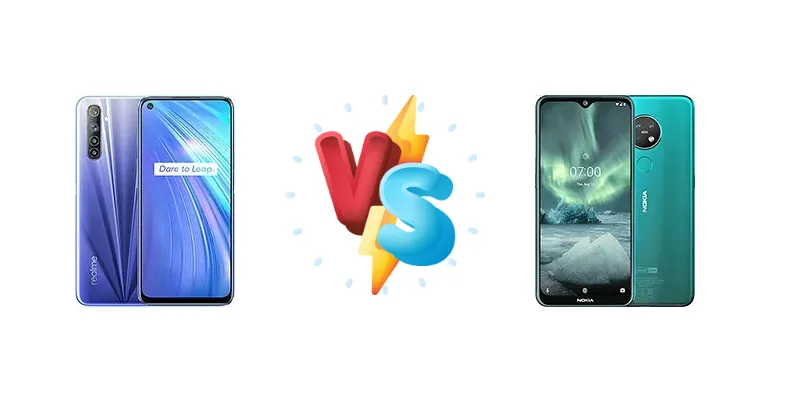
The Realme 6 and Nokia 7.2 represent distinct approaches to the mid-range smartphone market. The Realme 6 prioritizes performance with its Helio G90T chipset, targeting gamers and power users. Conversely, the Nokia 7.2 focuses on a cleaner software experience and a brighter display, appealing to those who value simplicity and media consumption. This comparison dissects their key differences to determine which device best suits your needs.
🏆 Quick Verdict
For the average user prioritizing gaming and fast charging, the Realme 6 is the clear winner. Its Helio G90T chipset and 30W charging significantly outperform the Nokia 7.2’s Snapdragon 660 and 10W charging. However, the Nokia 7.2 offers a brighter display and a potentially more refined software experience.
| Network |
|---|
| 2G bands | GSM 850 / 900 / 1800 / 1900 | GSM 850 / 900 / 1800 / 1900 |
| 3G bands | HSDPA 850 / 900 / 1700(AWS) / 1900 / 2100 - Global | HSDPA 850 / 900 / 2100 - ROW |
| 4G bands | 1, 2, 3, 4, 5, 7, 8, 20, 28, 38, 40, 41 - Global | 1, 3, 5, 7, 8, 20, 28, 38, 40, 41 - ROW |
| Speed | HSPA 42.2/11.5 Mbps, LTE (2CA) Cat6 300/75 Mbps | HSPA 42.2/5.76 Mbps, LTE (2CA) Cat6 300/50 Mbps or LTE Cat4 150/50 Mbps |
| Technology | GSM / HSPA / LTE | GSM / HSPA / LTE |
| | 1, 3, 5, 8, 38, 40, 41 - India | 1, 3, 5, 8, 40, 41 - IN |
| Launch |
|---|
| Announced | 2020, March 05. Released 2020, March 11 | 2019, September 05. Released 2019, September 23 |
| Status | Discontinued | Discontinued |
| Body |
|---|
| Build | Glass front (Gorilla Glass 3), plastic back, plastic frame | Glass front (Gorilla Glass 3), glass back (Gorilla Glass 3), plastic frame |
| Dimensions | 162.1 x 74.8 x 8.9 mm (6.38 x 2.94 x 0.35 in) | 159.9 x 75.2 x 8.3 mm (6.30 x 2.96 x 0.33 in) |
| SIM | Nano-SIM + Nano-SIM | · Nano-SIM· Nano-SIM + Nano-SIM |
| Weight | 191 g (6.74 oz) | 180 g (6.35 oz) |
| Display |
|---|
| Protection | Corning Gorilla Glass 3 | Corning Gorilla Glass 3 |
| Resolution | 1080 x 2400 pixels, 20:9 ratio (~405 ppi density) | 1080 x 2280 pixels, 19:9 ratio (~400 ppi density) |
| Size | 6.5 inches, 102.0 cm2 (~84.1% screen-to-body ratio) | 6.3 inches, 99.1 cm2 (~82.4% screen-to-body ratio) |
| Type | IPS LCD, 90Hz, 480 nits (typ) | IPS LCD, HDR10 |
| Platform |
|---|
| CPU | Octa-core (2x2.05 GHz Cortex-A76 & 6x2.0 GHz Cortex-A55) | Octa-core (4x2.2 GHz Kryo 260 Gold & 4x1.8 GHz Kryo 260 Silver) |
| Chipset | Mediatek MT6785 Helio G90T (12 nm) | Qualcomm SDM660 Snapdragon 660 (14 nm) |
| GPU | Mali-G76 MC4 | Adreno 512 |
| OS | Android 10, upgradable to Android 11, Realme UI 2.0 | Android 9.0 (Pie), upgradable to Android 11, Android One |
| Memory |
|---|
| Card slot | microSDXC (dedicated slot) | microSDXC (dedicated slot) |
| Internal | 64GB 4GB RAM, 64GB 6GB RAM, 128GB 4GB RAM, 128GB 6GB RAM, 128GB 8GB RAM | 64GB 4GB RAM, 64GB 6GB RAM, 128GB 4GB RAM, 128GB 6GB RAM |
| | UFS 2.1 | eMMC 5.1 |
| Main Camera |
|---|
| Features | LED flash, HDR, panorama | Zeiss optics, LED flash, panorama, HDR |
| Quad | 64 MP, f/1.8, 26mm (wide), 1/1.72", 0.8µm, PDAF
8 MP, f/2.3, 13mm (ultrawide), 1/4.0", 1.12µm
2 MP (macro)
Auxiliary lens | - |
| Triple | - | 48 MP, f/1.8, (wide), 1/2.0", 0.8µm, PDAF
8 MP, f/2.2, 13mm (ultrawide), 1/4.0", 1.12µm
Auxiliary lens |
| Video | 4K@30fps, 1080p@30/60/120fps, gyro-EIS | 4K@30fps, 1080p@30fps (gyro-EIS) |
| Selfie camera |
|---|
| Features | HDR, panorama | Zeiss optics, HDR |
| Single | 16 MP, f/2.0, 26mm (wide), 1/3.06", 1.0µm | 20 MP, f/2.0, (wide), 1/3", 0.9µm |
| Video | 1080p@30fps | 1080p@30fps |
| Sound |
|---|
| 3.5mm jack | Yes | Yes |
| 35mm jack | Yes | Yes |
| Loudspeaker | Yes | Yes |
| Comms |
|---|
| Bluetooth | 5.0, A2DP, LE | 5.0, A2DP, EDR, LE, aptX |
| NFC | Yes (market/region dependent) | Yes (excl. India) |
| Positioning | GPS, GLONASS, BDS | GPS, GLONASS, GALILEO, BDS |
| Radio | FM radio | FM radio |
| USB | USB Type-C 2.0, OTG | USB Type-C 2.0, OTG |
| WLAN | Wi-Fi 802.11 a/b/g/n/ac, dual-band, Wi-Fi Direct | Wi-Fi 802.11 b/g/n/ac, dual-band, Wi-Fi Direct |
| Features |
|---|
| Sensors | Fingerprint (side-mounted), accelerometer, gyro, proximity, compass | Fingerprint (rear-mounted), accelerometer, gyro, proximity, compass |
| Battery |
|---|
| Charging | 30W wired, 100% in 55 min | 10W wired |
| Type | 4300 mAh | Li-Po 3500 mAh, non-removable |
| Misc |
|---|
| Colors | Comet Blue, Comet White | Cyan Green, Charcoal, Ice |
| Models | RMX2001 | TA-1193, TA-1178, TA-1196, TA-1181 |
| Price | About 190 EUR | About 240 EUR |
| SAR | 1.14 W/kg (head) 0.59 W/kg (body) | 1.15 W/kg (head) 0.90 W/kg (body) |
| SAR EU | 0.71 W/kg (head) 0.57 W/kg (body) | 0.99 W/kg (head) 1.44 W/kg (body) |
| Tests |
|---|
| Audio quality | - |
Noise -93.0dB / Crosstalk -93.4dB |
| Battery life |
Endurance rating 106h
|
Endurance rating 69h
|
| Camera |
Photo / Video |
Photo / Video |
| Display |
Contrast ratio: 1315:1 (nominal) |
Contrast ratio: 1342:1 (nominal) |
| Loudspeaker |
-28.7 LUFS (Average)
|
-29.6 LUFS (Average)
|
| Performance |
AnTuTu: 288931 (v8)
GeekBench: 7815 (v4.4), 1726 (v5.1)
GFXBench: 16fps (ES 3.1 onscreen) |
AnTuTu: 139495 (v7), 164484 (v8)
GeekBench: 5440 (v4.4), 1398 (v5.1)
GFXBench: 8.1fps (ES 3.1 onscreen) |
Realme 6
- Superior gaming performance with Helio G90T
- Significantly faster 30W charging
- Longer battery life (106h endurance)
- Lower peak display brightness
- Potentially more aggressive image processing
Nokia 7.2
- Brighter display for outdoor visibility (585 nits)
- Cleaner Android software experience
- Potentially more accurate color reproduction
- Slower Snapdragon 660 processor
- Significantly slower 10W charging
- Shorter battery life (69h endurance)
Display Comparison
The Nokia 7.2 boasts a brighter display, achieving 585 nits of peak brightness compared to the Realme 6’s 451 nits. This translates to significantly better visibility under direct sunlight. Both displays share a similar 1315-1342:1 contrast ratio, indicating comparable black levels and color depth. However, the Realme 6’s refresh rate (likely 90Hz, based on market positioning) is a significant advantage for smoother scrolling and gaming, a feature absent on the Nokia 7.2. The Nokia 7.2’s brighter panel benefits users who frequently consume media outdoors, while the Realme 6’s higher refresh rate enhances the overall user experience for interactive tasks.
Camera Comparison
Both phones feature capable camera systems, but detailed sensor information is lacking. Given the market positioning, it’s likely the Realme 6 prioritizes computational photography for vibrant, social media-ready images, while the Nokia 7.2 aims for a more natural color profile. Without specific sensor size or aperture data, it’s difficult to definitively declare a winner. However, the Realme 6’s image processing is likely tuned for faster capture and better low-light performance, leveraging the G90T’s image signal processor. The Nokia 7.2’s camera likely benefits from Nokia’s image processing algorithms, focusing on color accuracy.
Performance
The Realme 6’s Mediatek Helio G90T (12nm) demonstrably outperforms the Nokia 7.2’s Qualcomm Snapdragon 660 (14nm). The G90T’s Cortex-A76 cores, clocked at 2.05 GHz, provide a substantial CPU performance boost over the Snapdragon 660’s Kryo 260 Gold cores at 2.2 GHz. More importantly, the G90T’s Mali-G76 MC4 GPU offers a far superior gaming experience. The 14nm process of the Snapdragon 660 also implies lower thermal efficiency, potentially leading to more throttling under sustained load. This makes the Realme 6 the preferred choice for gamers and users running demanding applications.
Battery Life
The Realme 6’s endurance rating of 106 hours significantly surpasses the Nokia 7.2’s 69 hours. This difference is attributable to both the more efficient chipset and the more aggressive power management. While the Realme 6 doesn’t boast a larger battery capacity (specific mAh not provided), its 30W wired charging is a game-changer, achieving a full charge in just 55 minutes. The Nokia 7.2’s 10W charging is comparatively slow, requiring considerably longer to reach 100%. For users who prioritize minimizing downtime, the Realme 6’s charging speed is a major advantage.
Buying Guide
Buy the Realme 6 if you need a phone capable of handling demanding games and applications, and if fast charging is a priority. Its powerful chipset and rapid charging capabilities make it ideal for users who are constantly on the go. Buy the Nokia 7.2 if you prefer a brighter display for outdoor visibility, a cleaner Android experience with guaranteed updates, and aren't heavily reliant on intensive mobile gaming.
Frequently Asked Questions
❓ Does the Realme 6’s Helio G90T chipset overheat during prolonged gaming sessions?
While the Helio G90T is a powerful chipset, it can generate heat under sustained load. However, Realme typically implements thermal management solutions, such as heat pipes, to mitigate throttling. Real-world performance will depend on ambient temperature and game settings, but it’s generally capable of handling most mobile games without significant performance drops.
❓ Is the Nokia 7.2’s 10W charging speed acceptable for daily use?
The Nokia 7.2’s 10W charging is considerably slower than the industry standard. It’s suitable for overnight charging, but topping up quickly during the day will be time-consuming. Users who frequently find themselves needing a quick charge will likely be frustrated by the slow charging speed.
❓ How does the software experience differ between the Realme 6 and Nokia 7.2?
The Realme 6 runs Realme UI, based on Android, which is known for its customization options and features. The Nokia 7.2, as part of the Android One program, offers a near-stock Android experience with guaranteed software updates and security patches for a defined period. This makes the Nokia 7.2 a better choice for users who prefer a clean, bloatware-free interface and timely updates.