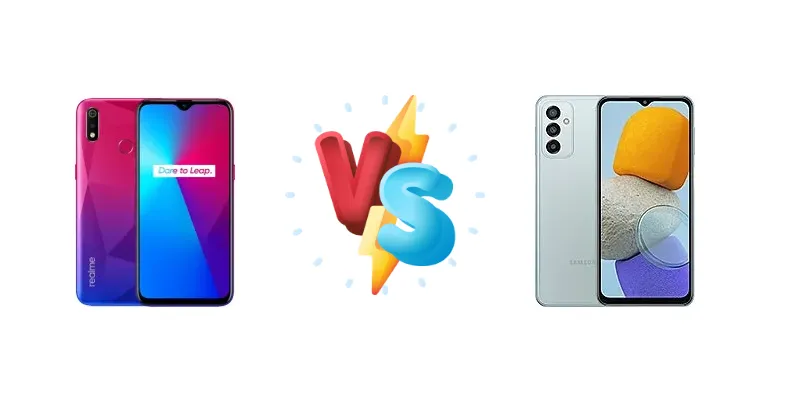
The budget smartphone market is fiercely competitive, offering incredible value for money. Today, we're pitting two contenders against each other: the Realme 3i, a long-standing favorite, and the newer Samsung Galaxy F23. Let's see which phone reigns supreme.
🏆 Quick Verdict
The Samsung Galaxy F23 is the clear winner. Its superior chipset, faster charging, and 5G connectivity offer a significantly better experience despite a slightly higher price. The Realme 3i remains a viable option for those on an extremely tight budget.
| Network |
|---|
| 2G bands | GSM 850 / 900 / 1800 / 1900 | GSM 850 / 900 / 1800 / 1900 |
| 3G bands | HSDPA 850 / 900 / 2100 | HSDPA 850 / 900 / 1700(AWS) / 1900 / 2100 |
| 4G bands | 1, 3, 5, 8, 38, 40, 41 | 1, 2, 3, 4, 5, 7, 8, 12, 17, 20, 26, 28, 38, 40, 41, 66 |
| 5G bands | - | 1, 3, 5, 7, 8, 20, 28, 38, 40, 41, 66, 78 SA/NSA/Sub6 |
| Speed | HSPA 42.2/5.76 Mbps, LTE (2CA) Cat12 600/50 Mbps | HSPA, LTE, 5G |
| Technology | GSM / HSPA / LTE | GSM / HSPA / LTE / 5G |
| Launch |
|---|
| Announced | 2019, July. Released 2019, July | 2022, March 08 |
| Status | Discontinued | Available. Released 2022, March 16 |
| Body |
|---|
| Build | Glass front (Gorilla Glass 3), plastic back, plastic frame | Glass front (Gorilla Glass 5), plastic frame, plastic back |
| Dimensions | 156.1 x 75.6 x 8.3 mm (6.15 x 2.98 x 0.33 in) | 165.5 x 77 x 8.4 mm (6.52 x 3.03 x 0.33 in) |
| SIM | Nano-SIM + Nano-SIM | Nano-SIM + Nano-SIM |
| Weight | 175 g (6.17 oz) | 198 g (6.98 oz) |
| Display |
|---|
| Protection | Corning Gorilla Glass 3 | Corning Gorilla Glass 5 |
| Resolution | 720 x 1520 pixels, 19:9 ratio (~271 ppi density) | 1080 x 2408 pixels, 20:9 ratio (~400 ppi density) |
| Size | 6.2 inches, 95.9 cm2 (~81.3% screen-to-body ratio) | 6.6 inches, 104.9 cm2 (~82.3% screen-to-body ratio) |
| Type | IPS LCD | TFT LCD, 120Hz |
| Platform |
|---|
| CPU | Octa-core (4x2.0 GHz Cortex-A73 & 4x2.0 GHz Cortex-A53) | Octa-core (2x2.2 GHz Kryo 570 & 6x1.8 GHz Kryo 570) |
| Chipset | Mediatek MT6771 Helio P60 (12 nm) | Qualcomm SM7225 Snapdragon 750G 5G (8 nm) |
| GPU | Mali-G72 MP3 | Adreno 619 |
| OS | Android 9.0 (Pie), upgradable to Android 10, Realme UI | Android 12, upgradable to Android 14, One UI 6 |
| Memory |
|---|
| Card slot | microSDXC (dedicated slot) | microSDXC (dedicated slot) |
| Internal | 32GB 3GB RAM, 64GB 4GB RAM | 128GB 4GB RAM, 128GB 6GB RAM |
| | eMMC 5.1 | - |
| Main Camera |
|---|
| Dual | 13 MP, f/1.8, 1/3.1", 1.12µm, PDAF
Auxiliary lens | - |
| Features | LED flash, HDR | LED flash, panorama, HDR |
| Single | - | 8 MP, f/2.2, (wide) |
| Triple | - | 50 MP, f/1.8, (wide), PDAF
8 MP, f/2.2, 123˚ (ultrawide), 1/4.0", 1.12µm
2 MP (macro) |
| Video | 1080p@30fps | 4K@30fps, 1080p@30fps, 720p@480fps |
| Selfie camera |
|---|
| Features | HDR | - |
| Single | 13 MP, f/2.0, (wide), 1/3.1", 1.12µm | 8 MP, f/2.2, (wide) |
| Video | 1080p@30fps | 1080p@30fps |
| Sound |
|---|
| 3.5mm jack | Yes | Yes |
| 35mm jack | Yes | Yes |
| Loudspeaker | Yes | Yes |
| Comms |
|---|
| Bluetooth | 4.2, A2DP, LE | 5.0, A2DP, LE |
| NFC | No | Yes |
| Positioning | GPS, GLONASS | GPS, GLONASS, GALILEO, BDS, QZSS |
| Radio | FM radio | FM radio, recording |
| USB | microUSB 2.0, OTG | USB Type-C 2.0, OTG |
| WLAN | Wi-Fi 802.11 b/g/n | Wi-Fi 802.11 a/b/g/n/ac, dual-band, Wi-Fi Direct |
| Features |
|---|
| Sensors | Fingerprint (rear-mounted), accelerometer, proximity | Fingerprint (side-mounted), accelerometer, gyro, compass |
| | - | Virtual Proximity Sensing |
| Battery |
|---|
| Charging | 10W wired | 25W wired |
| Type | 4230 mAh, non-removable | Li-Po 5000 mAh |
| Misc |
|---|
| Colors | Diamond Blue, Diamond Red, Diamond Black | Aqua Blue, Forest Green |
| Models | RMX1827 | SM-E236B, SM-E236B/DS |
| Price | About 8000 INR | About 190 EUR |
| SAR | - | 1.24 W/kg (head) |
Realme 3i
- Very affordable
- Decent battery life
- Good value for basic use
- Outdated chipset
- Low resolution display
- Slow charging
- No 5G
Samsung Galaxy F23
- 5G connectivity
- Faster performance
- Better camera
- Fast charging
- Smooth display (120Hz)
- Slightly more expensive
- Design may not appeal to everyone
Display Comparison
The Samsung Galaxy F23 boasts a larger 6.6-inch FHD+ display with a 120Hz refresh rate, offering a smoother visual experience compared to the Realme 3i's smaller 6.22-inch HD+ display. Color accuracy and brightness are also noticeably improved on the F23.
Camera Comparison
While both phones offer decent camera setups, the Samsung Galaxy F23 generally produces better images with more detail and dynamic range. The F23's image processing algorithms are also more refined. The Realme 3i's camera is adequate for basic photography.
Performance
The Snapdragon 750G in the Galaxy F23 is a significant upgrade over the Helio P60 in the Realme 3i. Expect faster app loading times, smoother multitasking, and better gaming performance on the F23. The 8nm process also contributes to better power efficiency.
Battery Life
Both phones offer large batteries, but the Samsung Galaxy F23's more efficient chipset and 25W fast charging give it an edge. While the Realme 3i's battery life is respectable, the F23 charges significantly faster.
Buying Guide
The Realme 3i is best for users on a very limited budget who prioritize basic functionality and don't need 5G. The Samsung Galaxy F23 is ideal for those seeking a smoother performance, better camera, faster charging, and future-proof 5G connectivity, even within a budget.
Frequently Asked Questions
❓ Is the Realme 3i still worth buying in 2024?
Only if you're on an extremely tight budget and primarily need a phone for basic calling and messaging. Otherwise, the Samsung Galaxy F23 offers significantly better value.
❓ Which phone has better gaming performance?
The Samsung Galaxy F23, thanks to its Snapdragon 750G chipset, provides a much smoother and more enjoyable gaming experience.