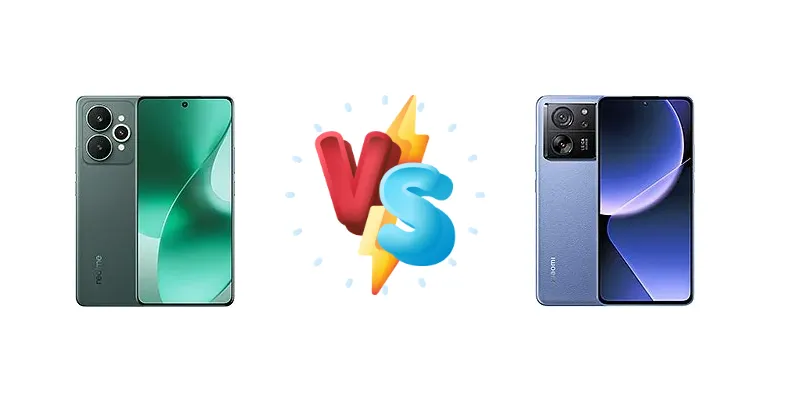
The Realme 15 and Xiaomi 13T Pro represent compelling options in the increasingly competitive mid-range smartphone market. While both leverage Mediatek's Dimensity series, they target slightly different priorities – the Realme 15 focusing on efficient performance, and the 13T Pro aiming for near-flagship speed. This comparison dissects their key differences to help you choose the right device.
🏆 Quick Verdict
For the average user prioritizing a balance of performance and value, the Xiaomi 13T Pro emerges as the stronger contender. Its significantly more powerful Dimensity 9200+ chipset and blazing-fast 120W charging outweigh the Realme 15’s efficiency, offering a more future-proof and convenient experience.
| Network |
|---|
| 2G bands | GSM 850 / 900 / 1800 / 1900 | GSM 850 / 900 / 1800 / 1900 |
| 3G bands | HSDPA 900 / 2100 | HSDPA 800 / 850 / 900 / 1700(AWS) / 1900 / 2100 |
| 4G bands | 1, 3, 5, 8, 40 | 1, 2, 3, 4, 5, 7, 8, 12, 13, 17, 18, 19, 20, 25, 26, 28, 32, 38, 39, 40, 41, 42, 48, 66 |
| 5G bands | 1, 3, 5, 8, 40 SA/NSA | 1, 3, 5, 7, 8, 20, 28, 38, 40, 41, 66, 75, 77, 78 SA/NSA |
| Speed | HSPA, LTE, 5G | HSPA, LTE, 5G |
| Technology | GSM / HSPA / LTE / 5G | GSM / HSPA / LTE / 5G |
| Launch |
|---|
| Announced | 2025, September 18 | 2023, September 26 |
| Status | Available. Released 2025, September | Available. Released 2023, September 26 |
| Body |
|---|
| Build | Glass front, aluminum frame, fiber-reinforced plastic back or silicone polymer (eco leather) back | Glass front (Gorilla Glass 5), glass back or silicone polymer back, plastic frame |
| Dimensions | 163.3 x 75.9 x 7.7 mm (6.43 x 2.99 x 0.30 in) | 162.2 x 75.7 x 8.5 mm (6.39 x 2.98 x 0.33 in) |
| SIM | Nano-SIM + Nano-SIM | · Nano-SIM + eSIM· Nano-SIM + Nano-SIM |
| Weight | 185 g (6.53 oz) | 200 g or 206 g (7.05 oz) |
| Display |
|---|
| Protection | Corning Gorilla Glass (unspecified version) | Corning Gorilla Glass 5 |
| Resolution | 1080 x 2392 pixels (~388 ppi density) | 1220 x 2712 pixels, 20:9 ratio (~446 ppi density) |
| Size | 6.77 inches, 110.9 cm2 (~89.5% screen-to-body ratio) | 6.67 inches, 107.4 cm2 (~87.5% screen-to-body ratio) |
| Type | AMOLED, 1B colors, 144Hz, 3840Hz PWM, HDR, 1600 nits (HBM), 4500 nits (peak) | AMOLED, 68B colors, 144Hz, Dolby Vision, HDR10+, 1200 nits (HBM), 2600 nits (peak) |
| Platform |
|---|
| CPU | Octa-core (4x2.6 GHz Cortex-A78 & 4x2.0 GHz Cortex-A55) | Octa-core (1x3.35 GHz Cortex-X3 & 3x3.0 GHz Cortex-A715 & 4x2.0 GHz Cortex-A510) |
| Chipset | Mediatek Dimensity 7300+ (4 nm) | Mediatek Dimensity 9200+ (4 nm) |
| GPU | Mali-G615 MC2 | Immortalis-G715 MC11 |
| OS | Android 15, Realme UI 6.0 | Android 13, up to 4 major Android upgrades, HyperOS |
| Memory |
|---|
| Card slot | No | No |
| Internal | 256GB 12GB RAM | 256GB 12GB RAM, 512GB 12GB RAM, 1TB 16GB RAM |
| Main Camera |
|---|
| Dual | 50 MP, f/1.8, 26mm (wide), 1/1.95", PDAF, OIS
8 MP, f/2.2, 112˚, 16mm (ultrawide) | - |
| Features | LED flash, HDR, panorama | Leica lens, color spectrum sensor, LED flash, HDR, panorama |
| Triple | - | 50 MP, f/1.9, 24mm (wide), 1/1.28", 1.22µm, PDAF, OIS
50 MP, f/1.9, 50mm (telephoto), 1/2.88", 0.61µm, PDAF, 2x optical zoom
12 MP, f/2.2, 15mm (ultrawide), 1/3.06", 1.12µm |
| Video | 4K@30fps, 1080p@30/60/120fps, gyro-EIS, OIS | 8K@24fps, 4K@24/30/60fps, 4K/1080p@30fps HDR10+, 1080p@30/60/120/240fps; 10-bit LOG, gyro-EIS |
| Selfie camera |
|---|
| Features | Panorama | HDR |
| Single | 50 MP, f/2.4, 23mm (wide) | 20 MP, f/2.2, (wide), 0.8µm |
| Video | 4K@30fps, 1080p@30fps, gyro-EIS | 1080p@30fps, HDR10+ |
| Sound |
|---|
| 35mm jack | No | No |
| Loudspeaker | Yes, with stereo speakers | Yes, with stereo speakers |
| Comms |
|---|
| Bluetooth | 5.4, A2DP, LE | 5.4, A2DP, LE |
| Infrared port | Yes | Yes |
| NFC | No | Yes |
| Positioning | GPS, GALILEO, GLONASS, BDS, QZSS | GPS (L1+L5), GLONASS (G1), GALILEO (E1+E5a), NavIC (L5), BDS |
| Radio | No | No |
| USB | USB Type-C 2.0 | USB Type-C 2.0, OTG |
| WLAN | Wi-Fi 802.11 a/b/g/n/ac/6, dual-band | Wi-Fi 802.11 a/b/g/n/ac/6e/7, dual/tri-band (market/region dependent), Wi-Fi Direct |
| Features |
|---|
| Sensors | Fingerprint (under display, optical), accelerometer, gyro, proximity, compass | Fingerprint (under display, optical), accelerometer, gyro, proximity, compass |
| Battery |
|---|
| Charging | 80W wired, 50% in 25 min, 100% in 61 min | 120W wired, PD3.0, QC4, 100% in 19 min |
| Type | Si/C Li-Ion 7000 mAh | Li-Po 5000 mAh |
| Misc |
|---|
| Colors | Silk Pink, Suit Titanium | Alpine Blue, Meadow Green, Black |
| Models | RMX5106 | 23078PND5G |
| Price | About 300 EUR | $ 370.00 / £ 482.55 / € 301.99 |
| SAR EU | - | 1.00 W/kg (head) 0.99 W/kg (body) |
Realme 15
- Potentially better power efficiency with Dimensity 7300+
- More affordable price point (likely)
- 80W charging is still relatively fast
- Significantly less powerful chipset than the 13T Pro
- Slower charging speed compared to the 13T Pro
- Camera system likely less advanced
Xiaomi 13T Pro
- Blazing-fast 120W charging
- Powerful Dimensity 9200+ chipset for gaming and demanding tasks
- Brighter display for better outdoor visibility
- Potentially lower battery longevity due to faster charging
- Likely higher price point
- May run warmer under sustained load
Display Comparison
The Xiaomi 13T Pro boasts a notably brighter display, reaching a measured peak of 1094 nits. While the Realme 15’s display specifications are currently unavailable, the 13T Pro’s high brightness ensures excellent visibility outdoors. The 13T Pro’s panel likely benefits from a higher contrast ratio, enhancing visual clarity. Without knowing the Realme 15’s panel technology (OLED vs LCD, refresh rate), it’s difficult to assess color accuracy, but the 13T Pro’s brightness gives it a clear advantage for media consumption.
Camera Comparison
Detailed camera analysis is hampered by limited information on the Realme 15. However, the Xiaomi 13T Pro’s camera system is expected to be more versatile, likely featuring a larger main sensor and more advanced image processing capabilities. The 13T Pro’s focus on photo and video suggests a more refined camera experience. Without knowing the Realme 15’s sensor sizes and apertures, it’s difficult to make a direct comparison, but the 13T Pro’s likely superior hardware and software processing give it an edge. We can assume the 13T Pro will offer better low-light performance and dynamic range.
Performance
The core difference lies in the chipsets. The Xiaomi 13T Pro’s Mediatek Dimensity 9200+ (4nm) is a substantial upgrade over the Realme 15’s Dimensity 7300+ (4nm). The 9200+ features a Cortex-X3 prime core clocked at 3.35 GHz, compared to the 7300+'s Cortex-A78 cores at 2.6 GHz. This translates to significantly faster CPU performance in benchmarks and real-world applications. The 13T Pro’s GPU is also more powerful, offering a superior gaming experience. While both use a 4nm process, the architectural improvements in the 9200+ provide a performance edge. The 13T Pro’s likely use of faster LPDDR5X RAM further enhances responsiveness.
Battery Life
The Xiaomi 13T Pro’s 120W charging is a game-changer, achieving a full charge in just 19 minutes. This is significantly faster than the Realme 15’s 80W charging, which takes 61 minutes for a full charge. While the 13T Pro’s battery capacity is unknown, its active use score of 11:50h and endurance rating of 102h suggest excellent battery life. The Realme 15’s battery capacity is also unknown, but the 13T Pro’s faster charging mitigates any potential capacity disadvantage, offering greater convenience for users who frequently need to top up their battery.
Buying Guide
Buy the Realme 15 if you prioritize long-term efficiency and a smooth, responsive experience for everyday tasks, and are comfortable with slightly slower charging. Buy the Xiaomi 13T Pro if you demand maximum performance for gaming and demanding applications, and value the convenience of incredibly fast 120W charging, even if it impacts battery longevity slightly.
Frequently Asked Questions
❓ Does the Dimensity 9200+ in the Xiaomi 13T Pro get noticeably hot during extended gaming sessions?
While the Dimensity 9200+ is a powerful chip, Xiaomi typically employs effective thermal management solutions. Expect some warmth during prolonged gaming, but the 13T Pro is unlikely to suffer from severe throttling due to its advanced cooling system. The 4nm process also contributes to improved thermal efficiency compared to older chipsets.
❓ Is the 80W charging on the Realme 15 still fast enough for daily use, or is the 120W on the 13T Pro a must-have?
80W charging is still considered fast and will adequately charge the Realme 15 overnight. However, the 120W charging on the 13T Pro offers a significant convenience factor, allowing for a full charge in under 20 minutes. If you frequently find yourself needing to quickly top up your battery, the 120W charging is a worthwhile upgrade.
❓ How does the Dimensity 7300+ in the Realme 15 perform with graphically intensive games like Genshin Impact?
The Dimensity 7300+ is capable of running Genshin Impact, but you'll likely need to lower the graphics settings to achieve a consistently smooth frame rate. It's a solid performer for mid-range gaming, but won't match the experience offered by the Dimensity 9200+ in the Xiaomi 13T Pro.