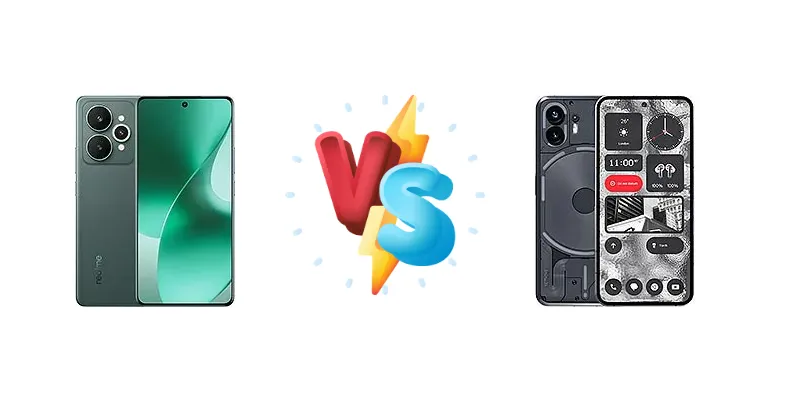
The Realme 15 and Nothing Phone (2) represent distinct approaches to the mid-range and upper-mid-range smartphone market. The Realme 15 focuses on delivering rapid charging and a modern chipset at a competitive price, while the Nothing Phone (2) prioritizes a unique design, software experience, and sustained performance from its flagship-tier Snapdragon processor. This comparison dissects their key differences to determine which device best suits your needs.
🏆 Quick Verdict
For the average user prioritizing raw performance and long-term software support, the Nothing Phone (2) is the superior choice. Its Snapdragon 8+ Gen 1 chipset offers a significant performance advantage, and its 14:21h active use battery score demonstrates excellent endurance. However, the Realme 15’s 80W charging is a compelling feature for those who value speed above all else.
| Network |
|---|
| 2G bands | GSM 850 / 900 / 1800 / 1900 | GSM 850 / 900 / 1800 / 1900 |
| 3G bands | HSDPA 900 / 2100 | HSDPA 800 / 850 / 900 / 1700(AWS) / 1900 / 2100 |
| 4G bands | 1, 3, 5, 8, 40 | 1, 2, 3, 4, 5, 7, 8, 12, 17, 18, 19, 20, 25, 26, 28, 30, 32, 34, 38, 39, 40, 41, 42, 48, 66, 71 |
| 5G bands | 1, 3, 5, 8, 40 SA/NSA | 1, 2, 3, 5, 7, 8, 12, 20, 25, 28, 30, 38, 40, 41, 66, 71, 75, 77, 78 SA/NSA |
| Speed | HSPA, LTE, 5G | HSPA, LTE, 5G |
| Technology | GSM / HSPA / LTE / 5G | GSM / HSPA / LTE / 5G |
| Launch |
|---|
| Announced | 2025, September 18 | 2023, July 11 |
| Status | Available. Released 2025, September | Available. Released 2023, July 17 |
| Body |
|---|
| Build | Glass front, aluminum frame, fiber-reinforced plastic back or silicone polymer (eco leather) back | Glass front (Gorilla Glass 5), glass back (Gorilla Glass 5), aluminum frame |
| Dimensions | 163.3 x 75.9 x 7.7 mm (6.43 x 2.99 x 0.30 in) | 162.1 x 76.4 x 8.6 mm (6.38 x 3.01 x 0.34 in) |
| SIM | Nano-SIM + Nano-SIM | Nano-SIM + Nano-SIM |
| Weight | 185 g (6.53 oz) | 201.2 g (7.09 oz) |
| Display |
|---|
| Protection | Corning Gorilla Glass (unspecified version) | Corning Gorilla Glass 5 |
| Resolution | 1080 x 2392 pixels (~388 ppi density) | 1080 x 2412 pixels, 20:9 ratio (~394 ppi density) |
| Size | 6.77 inches, 110.9 cm2 (~89.5% screen-to-body ratio) | 6.7 inches, 108.0 cm2 (~87.2% screen-to-body ratio) |
| Type | AMOLED, 1B colors, 144Hz, 3840Hz PWM, HDR, 1600 nits (HBM), 4500 nits (peak) | LTPO OLED, 1B colors, 120Hz, 1920Hz PWM, HDR10+, 1600 nits (HBM), 1600 nits (peak) |
| Platform |
|---|
| CPU | Octa-core (4x2.6 GHz Cortex-A78 & 4x2.0 GHz Cortex-A55) | Octa-core (1x3.0 GHz Cortex-X2 & 3x2.5 GHz Cortex-A710 & 4x1.80 GHz Cortex-A510) |
| Chipset | Mediatek Dimensity 7300+ (4 nm) | Qualcomm SM8475 Snapdragon 8+ Gen 1 (4 nm) |
| GPU | Mali-G615 MC2 | Adreno 730 |
| OS | Android 15, Realme UI 6.0 | Android 13, upgradable to Android 15, up to 3 major Android upgrades, Nothing OS 3.0 |
| Memory |
|---|
| Card slot | No | No |
| Internal | 256GB 12GB RAM | 128GB 8GB RAM, 256GB 12GB RAM, 512GB 12GB RAM |
| Main Camera |
|---|
| Dual | 50 MP, f/1.8, 26mm (wide), 1/1.95", PDAF, OIS
8 MP, f/2.2, 112˚, 16mm (ultrawide) | 50 MP, f/1.9, 24mm (wide), 1/1.56", 1.0µm, PDAF, OIS
50 MP, f/2.2, 114˚ (ultrawide), 1/2.76", 0.64µm, AF |
| Features | LED flash, HDR, panorama | LED flash, panorama, HDR |
| Video | 4K@30fps, 1080p@30/60/120fps, gyro-EIS, OIS | 4K@30/60fps, 1080p@30/60fps, gyro-EIS, live HDR, OIS |
| Selfie camera |
|---|
| Features | Panorama | HDR |
| Single | 50 MP, f/2.4, 23mm (wide) | 32 MP, f/2.5, (wide), 1/2.74", 0.8µm |
| Video | 4K@30fps, 1080p@30fps, gyro-EIS | 1080p@30fps |
| Sound |
|---|
| 35mm jack | No | No |
| Loudspeaker | Yes, with stereo speakers | Yes, with stereo speakers |
| Comms |
|---|
| Bluetooth | 5.4, A2DP, LE | 5.3, A2DP, LE, aptX HD, aptX Adaptive |
| Infrared port | Yes | - |
| NFC | No | Yes |
| Positioning | GPS, GALILEO, GLONASS, BDS, QZSS | GPS (L1+L5), GLONASS (L1), BDS (B1I+B1c), GALILEO (E1), QZSS (L1), NavIC |
| Radio | No | No |
| USB | USB Type-C 2.0 | USB Type-C 2.0, OTG |
| WLAN | Wi-Fi 802.11 a/b/g/n/ac/6, dual-band | Wi-Fi 802.11 a/b/g/n/ac/6, dual-band, Wi-Fi Direct |
| Features |
|---|
| Sensors | Fingerprint (under display, optical), accelerometer, gyro, proximity, compass | Fingerprint (under display, optical), accelerometer, proximity, gyro, compass |
| Battery |
|---|
| Charging | 80W wired, 50% in 25 min, 100% in 61 min | 45W wired, PD3.0, PPS, QC4, 100% in 55 min
15W wireless, 100% in 130 min
5W reverse wireless |
| Type | Si/C Li-Ion 7000 mAh | Li-Ion 4700 mAh |
| Misc |
|---|
| Colors | Silk Pink, Suit Titanium | White, Dark Gray |
| Models | RMX5106 | A065 |
| Price | About 300 EUR | $ 379.99 / £ 370.00 |
Realme 15
- Significantly faster 80W wired charging
- Potentially more affordable price point
- Modern Mediatek Dimensity 7300+ chipset
- Likely less powerful CPU and GPU than the Snapdragon 8+ Gen 1
- Battery life likely shorter than the Nothing Phone (2)
Nothing Phone (2)
- Flagship-level Snapdragon 8+ Gen 1 performance
- Excellent battery life (14:21h active use)
- Brighter display (998 nits)
- Slower 45W wired charging
- Higher price point
- Wireless charging adds complexity and potential heat
Display Comparison
The Nothing Phone (2) boasts a brighter display, reaching a measured peak brightness of 998 nits, which translates to better visibility outdoors. While the Realme 15’s display specifications are currently unavailable, Nothing Phone (2)'s brightness advantage is significant. The Nothing Phone (2) likely utilizes a more advanced panel technology, potentially LTPO, for adaptive refresh rates and improved power efficiency, though this is unconfirmed. The Nothing Phone (2)'s Glyph Interface also adds a unique visual element, though its practical utility is subjective.
Camera Comparison
Detailed camera analysis is limited by the provided data. Both phones are described as having 'Photo / Video' capabilities, but specifics are missing. Without sensor size, aperture, or OIS details, it’s difficult to make a definitive judgment. However, given the Nothing Phone (2)'s positioning, it’s reasonable to expect a more sophisticated camera system with better image processing and potentially larger sensors. The Realme 15 will likely focus on providing a versatile camera experience at a lower price point, but may lack the advanced features of the Nothing Phone (2).
Performance
The core difference lies in the chipsets. The Nothing Phone (2) is powered by the Qualcomm Snapdragon 8+ Gen 1 (4nm), featuring an octa-core configuration with a high-clocked Cortex-X2 prime core. This architecture is designed for peak performance. Conversely, the Realme 15 utilizes the Mediatek Dimensity 7300+ (4nm), with a different core arrangement (4x2.6 GHz Cortex-A78 & 4x2.0 GHz Cortex-A55). While both are 4nm chips, the Snapdragon 8+ Gen 1’s Cortex-X2 core provides a substantial performance uplift in CPU-intensive tasks. The Nothing Phone (2)'s superior GPU will also deliver a smoother gaming experience. The Realme 15 will be capable, but the Nothing Phone (2) offers a more future-proofed experience.
Battery Life
The Nothing Phone (2) excels in battery endurance, achieving an impressive 14:21h of active use and an endurance rating of 103 hours. While the Realme 15’s battery capacity is unknown, its 80W wired charging is a standout feature. It can reach 50% charge in just 25 minutes and 100% in 61 minutes. The Nothing Phone (2) charges at 45W (PD3.0, PPS, QC4) taking 55 minutes for a full charge. The Realme 15’s faster charging is ideal for quick top-ups, but the Nothing Phone (2)'s longer battery life reduces the need for frequent charging.
Buying Guide
Buy the Realme 15 if you need blazing-fast charging and prioritize getting a phone quickly topped up, even if it means slightly less sustained performance. It’s ideal for users who frequently find themselves with low battery and limited time to charge. Buy the Nothing Phone (2) if you prefer a more refined software experience, a more powerful processor for demanding tasks like gaming and video editing, and longer battery life between charges. It’s the better option for power users and those who value a unique aesthetic.
Frequently Asked Questions
❓ How much faster is the Realme 15's 80W charging compared to the Nothing Phone (2)'s 45W charging in a real-world scenario?
While the Realme 15 charges at a higher wattage, the difference in full charge times is only about 10 minutes (61 minutes vs 55 minutes). The Realme 15 excels in quickly adding a significant charge – reaching 50% in 25 minutes – making it ideal for those needing a fast boost when short on time. The Nothing Phone (2)'s charging is still respectable and benefits from wider compatibility with PD3.0, PPS, and QC4 standards.
❓ Will the Dimensity 7300+ in the Realme 15 struggle with graphically demanding games compared to the Snapdragon 8+ Gen 1 in the Nothing Phone (2)?
Yes, the Snapdragon 8+ Gen 1 offers a significant advantage in GPU performance. While the Dimensity 7300+ is a capable chipset, the Snapdragon 8+ Gen 1’s Adreno GPU will deliver higher frame rates and smoother gameplay in demanding titles like Genshin Impact or Call of Duty: Mobile, especially at higher graphics settings. The Nothing Phone (2) is the better choice for serious mobile gamers.
❓ Does the Nothing Phone (2)'s wireless charging significantly impact its battery health over the long term?
Wireless charging inherently generates more heat than wired charging, which can contribute to battery degradation over time. However, the Nothing Phone (2) incorporates intelligent charging algorithms and thermal management to mitigate this effect. While some battery degradation is inevitable with any smartphone, the Nothing Phone (2)'s charging system is designed to minimize it. The Realme 15, lacking wireless charging, avoids this potential concern altogether.