
Realme 15 vs Google Pixel 7a: A Deep Dive into Mid-Range Champions
| Phones Images | |||||
|---|---|---|---|---|---|
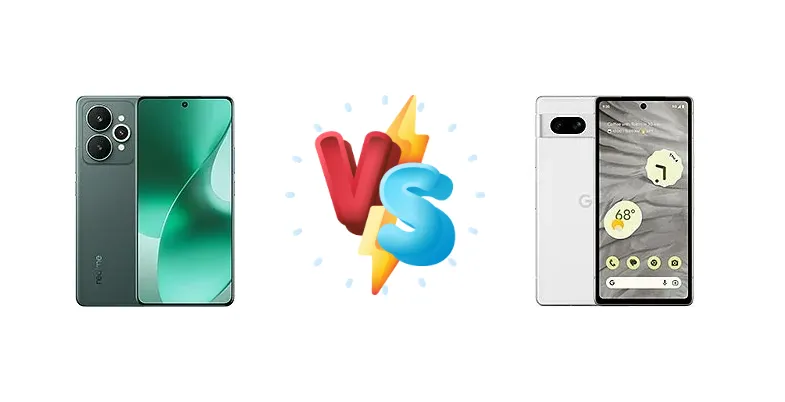
|
🏆 Quick Verdict
For the average user prioritizing camera quality and software experience, the Google Pixel 7a remains the superior choice. However, the Realme 15 delivers significantly faster charging and potentially better sustained performance for gaming thanks to its more efficient chipset and cooling, making it a strong contender for power users.
| PHONES | ||
|---|---|---|
| Phone Names | Realme 15 | Google Pixel 7a |
| Network | ||
|---|---|---|
| 2G bands | GSM 850 / 900 / 1800 / 1900 | GSM 850 / 900 / 1800 / 1900 |
| 3G bands | HSDPA 900 / 2100 | HSDPA 800 / 850 / 900 / 1700(AWS) / 1900 / 2100 |
| 4G bands | 1, 3, 5, 8, 40 | 1, 2, 3, 4, 5, 7, 8, 12, 13, 14, 17, 20, 25, 26, 28, 29, 30, 38, 40, 41, 48, 66, 71 - GWKK3, G0DZQ |
| 5G bands | 1, 3, 5, 8, 40 SA/NSA | 1, 2, 3, 5, 7, 8, 12, 14, 20, 25, 28, 30, 38, 41, 48, 66, 71, 77, 78 SA/NSA/Sub6 - GWKK3 |
| Speed | HSPA, LTE, 5G | HSPA, LTE, 5G |
| Technology | GSM / HSPA / LTE / 5G | GSM / HSPA / LTE / 5G |
| - | 1, 2, 3, 5, 7, 8, 12, 20, 25, 28, 38, 40, 41, 66, 75, 76, 77, 78, 79 SA/NSA/Sub6 - GHL1X, G82U8 | |
| Launch | ||
|---|---|---|
| Announced | 2025, September 18 | 2023, May 10 |
| Status | Available. Released 2025, September | Available. Released 2023, May 10 |
| Body | ||
|---|---|---|
| Build | Glass front, aluminum frame, fiber-reinforced plastic back or silicone polymer (eco leather) back | Glass front (Gorilla Glass 3), aluminum frame, plastic back |
| Dimensions | 163.3 x 75.9 x 7.7 mm (6.43 x 2.99 x 0.30 in) | 152 x 72.9 x 9 mm (5.98 x 2.87 x 0.35 in) |
| SIM | Nano-SIM + Nano-SIM | Nano-SIM + eSIM |
| Weight | 185 g (6.53 oz) | 193.5 g (6.84 oz) |
| - | IP67 dust/water resistant (up to 1m for 30 min) | |
| Display | ||
|---|---|---|
| Protection | Corning Gorilla Glass (unspecified version) | Corning Gorilla Glass 3 |
| Resolution | 1080 x 2392 pixels (~388 ppi density) | 1080 x 2400 pixels, 20:9 ratio (~429 ppi density) |
| Size | 6.77 inches, 110.9 cm2 (~89.5% screen-to-body ratio) | 6.1 inches, 90.7 cm2 (~81.8% screen-to-body ratio) |
| Type | AMOLED, 1B colors, 144Hz, 3840Hz PWM, HDR, 1600 nits (HBM), 4500 nits (peak) | OLED, HDR, 90Hz |
| - | Always-on display | |
| Platform | ||
|---|---|---|
| CPU | Octa-core (4x2.6 GHz Cortex-A78 & 4x2.0 GHz Cortex-A55) | Octa-core (2x2.85 GHz Cortex-X1 & 2x2.35 GHz Cortex-A78 & 4x1.80 GHz Cortex-A55) |
| Chipset | Mediatek Dimensity 7300+ (4 nm) | Google Tensor G2 (5 nm) |
| GPU | Mali-G615 MC2 | Mali-G710 MP7 |
| OS | Android 15, Realme UI 6.0 | Android 13, upgradable to Android 15, up to 5 major Android upgrades |
| Memory | ||
|---|---|---|
| Card slot | No | No |
| Internal | 256GB 12GB RAM | 128GB 8GB RAM |
| - | UFS 3.1 | |
| Main Camera | ||
|---|---|---|
| Dual | 50 MP, f/1.8, 26mm (wide), 1/1.95", PDAF, OIS 8 MP, f/2.2, 112˚, 16mm (ultrawide) | 64 MP, f/1.9, 26mm (wide), 1/1.73", 0.8µm, dual pixel PDAF, OIS 13 MP, f/2.2, 120˚ (ultrawide), 1.12µm |
| Features | LED flash, HDR, panorama | Dual-LED flash, Pixel Shift, Auto-HDR, panorama |
| Video | 4K@30fps, 1080p@30/60/120fps, gyro-EIS, OIS | 4K@30/60fps, 1080p@30/60/120/240fps, OIS |
| Selfie camera | ||
|---|---|---|
| Features | Panorama | HDR, panorama |
| Single | 50 MP, f/2.4, 23mm (wide) | 13 MP, f/2.2, 20mm (ultrawide), 1.12µm |
| Video | 4K@30fps, 1080p@30fps, gyro-EIS | 4K@30fps, 1080p@30fps |
| Sound | ||
|---|---|---|
| 3.5mm jack | - | No |
| 35mm jack | No | No |
| Loudspeaker | Yes, with stereo speakers | Yes, with stereo speakers |
| Comms | ||
|---|---|---|
| Bluetooth | 5.4, A2DP, LE | 5.3, A2DP, LE |
| Infrared port | Yes | - |
| NFC | No | Yes |
| Positioning | GPS, GALILEO, GLONASS, BDS, QZSS | GPS, GLONASS, GALILEO, BDS, QZSS, NavIC |
| Radio | No | No |
| USB | USB Type-C 2.0 | USB Type-C 3.2 |
| WLAN | Wi-Fi 802.11 a/b/g/n/ac/6, dual-band | Wi-Fi 802.11 a/b/g/n/ac/6e, tri-band |
| Features | ||
|---|---|---|
| Sensors | Fingerprint (under display, optical), accelerometer, gyro, proximity, compass | Fingerprint (under display, optical), accelerometer, gyro, proximity, compass, barometer |
| Battery | ||
|---|---|---|
| Charging | 80W wired, 50% in 25 min, 100% in 61 min | 18W wired, PD3.0 7.5W wireless |
| Type | Si/C Li-Ion 7000 mAh | Li-Po 4385 mAh |
| Misc | ||
|---|---|---|
| Colors | Silk Pink, Suit Titanium | Charcoal, Snow, Sea, Coral |
| Models | RMX5106 | GWKK3, GHL1X, G0DZQ, G82U8 |
| Price | About 300 EUR | € 179.90 / $ 150.00 / £ 170.00 / ₹ 25,980 |
Realme 15
- Exceptional camera quality and image processing
- Clean and consistently updated Android experience
- Strong AI and machine learning capabilities
- Good battery endurance (76h rating)
- Slow 18W charging
- Tensor G2 may throttle under sustained load
Google Pixel 7a
- Blazing-fast 80W wired charging
- Potentially better sustained performance with Dimensity 7300+
- More efficient 4nm chipset
- Competitive price point
- Camera likely won't match Pixel 7a's quality
- Software updates may be less frequent
Display Comparison
The Google Pixel 7a boasts a display capable of reaching 1070 nits of peak brightness, ensuring excellent visibility even in direct sunlight. While the Realme 15’s display specifications are currently unavailable, Realme typically focuses on color accuracy and high refresh rates in this segment. The Pixel 7a’s brightness advantage is significant, particularly for outdoor use. The absence of LTPO technology on either device suggests both will rely on adaptive refresh rate switching to conserve battery, but the Pixel’s higher peak brightness is a clear win for visual clarity.
Camera Comparison
Google’s Pixel phones are renowned for their computational photography prowess, and the 7a is no exception. While specific sensor details are missing for the Realme 15, the Pixel 7a’s image processing pipeline, powered by the Tensor G2, delivers exceptional dynamic range and detail. The Pixel 7a’s camera excels in low-light conditions and offers features like Magic Eraser and Photo Unblur. Without knowing the Realme 15’s sensor size and aperture, it’s difficult to make a direct comparison, but the Pixel 7a’s established reputation and AI-driven enhancements give it a significant advantage. We can assume the Realme 15 will focus on delivering a versatile camera system, but likely won't match the Pixel's software sophistication.
Performance
The core difference lies in the chipsets. The Google Pixel 7a’s Tensor G2 (5nm) prioritizes AI and machine learning tasks, excelling in areas like voice recognition and image processing. However, the Realme 15’s Mediatek Dimensity 7300+ (4nm) utilizes a more traditional CPU core configuration – Cortex-A78 and A55 – and is built on a smaller 4nm process. This suggests potentially better thermal efficiency and sustained performance under heavy load, like prolonged gaming. The Pixel 7a’s CPU, with its Cortex-X1 cores clocked at 2.85 GHz, offers a burst of speed, but the Dimensity 7300+’s architecture may provide more consistent performance over time. The Pixel 7a benefits from Google’s software optimization, but the Dimensity 7300+ is a strong contender in raw processing power.
Battery Life
The Google Pixel 7a has an endurance rating of 76 hours, indicating solid battery life. However, the Realme 15 compensates with its incredibly fast 80W wired charging, capable of reaching 50% charge in just 25 minutes and 100% in 61 minutes. The Pixel 7a’s 18W charging is comparatively slow. While the Pixel 7a’s battery endurance suggests it can last a full day for most users, the Realme 15’s rapid charging mitigates any potential battery life concerns, allowing for quick top-ups throughout the day. The inclusion of 7.5W wireless charging on the Pixel 7a is a convenience feature, but doesn’t offset the charging speed disparity.
Buying Guide
Buy the Realme 15 if you need a phone that can rapidly recharge, handles demanding games without significant throttling, and offers strong value for money. Buy the Google Pixel 7a if you prioritize computational photography, a clean and consistently updated Android experience, and a more refined overall user interface.