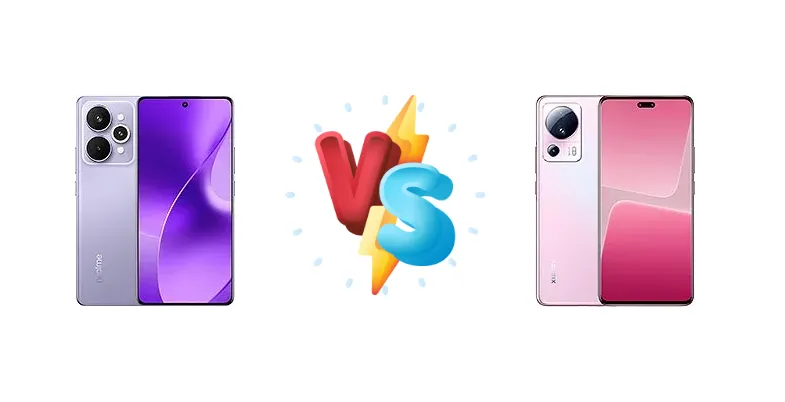
The mid-range smartphone market is fiercely competitive, and the Realme 15 Pro and Xiaomi 13 Lite represent compelling options for users seeking premium features without the flagship price tag. This comparison dives deep into their specifications, focusing on performance, display quality, battery endurance, and charging capabilities to determine which device offers the best overall value.
🏆 Quick Verdict
For the average user prioritizing sustained performance and display brightness, the Realme 15 Pro emerges as the winner. Its newer Snapdragon 7 Gen 4 chipset and significantly brighter 1862 nit display offer a noticeable advantage over the Xiaomi 13 Lite, despite the latter's slightly faster full charge time.
| Network |
|---|
| 2G bands | GSM 850 / 900 / 1800 / 1900 | GSM 850 / 900 / 1800 / 1900 |
| 3G bands | HSDPA 850 / 900 / 2100 | HSDPA 800 / 850 / 900 / 1700(AWS) / 1900 / 2100 |
| 4G bands | 1, 3, 5, 8, 28, 40, 41 | 1, 2, 3, 4, 5, 7, 8, 12, 13, 17, 18, 19, 20, 26, 28, 32, 38, 40, 41, 42, 66 |
| 5G bands | 1, 3, 5, 8, 28, 40, 41, 77, 78 SA/NSA | 1, 3, 5, 7, 8, 20, 28, 38, 40, 41, 66, 77, 78 SA/NSA |
| Speed | HSPA, LTE, 5G | HSPA, LTE, 5G |
| Technology | GSM / HSPA / LTE / 5G | GSM / HSPA / LTE / 5G |
| Launch |
|---|
| Announced | 2025, July 24 | 2023, February 26 |
| Status | Available. Released 2025, July 30 | Available. Released 2023, March 08 |
| Body |
|---|
| Build | Glass front (Gorilla Glass 7i), aluminum frame, fiber-reinforced plastic back or silicone polymer (eco leather) back | Glass front (Gorilla Glass 5), glass back, plastic frame |
| Dimensions | 162.3 x 76.2 x 7.7 mm (6.39 x 3.00 x 0.30 in) | 159.2 x 72.7 x 7.2 mm (6.27 x 2.86 x 0.28 in) |
| SIM | Nano-SIM + Nano-SIM | · Nano-SIM + eSIM· Nano-SIM + Nano-SIM |
| Weight | 187 g (6.60 oz) | 171 g (6.03 oz) |
| | - | IP53, dust and splash resistant |
| Display |
|---|
| Protection | Corning Gorilla Glass 7i | Corning Gorilla Glass 5 |
| Resolution | 1280 x 2800 pixels, 19.5:9 ratio (~453 ppi density) | 1080 x 2400 pixels, 20:9 ratio (~402 ppi density) |
| Size | 6.8 inches, 112.8 cm2 (~91.2% screen-to-body ratio) | 6.55 inches, 103.6 cm2 (~89.5% screen-to-body ratio) |
| Type | OLED, 1B colors, 144Hz, 4608Hz PWM, HDR10+, 1800 nits (HBM), 6500 nits (peak) | AMOLED, 68B colors, Dolby Vision, HDR10+, 120Hz, 500 nits (typ), 1000 nits (peak) |
| Platform |
|---|
| CPU | Octa-core (1x2.8 GHz Cortex-720 & 4x2.4 GHz Cortex-720 & 3x1.8 GHz Cortex-520) | Octa-core (1x2.4 GHz Cortex-A710 & 3x2.36 GHz Cortex-A710 & 4x1.8 GHz Cortex-A510) |
| Chipset | Qualcomm SM7750-AB Snapdragon 7 Gen 4 (4 nm) | Qualcomm SM7450-AB Snapdragon 7 Gen 1 (4 nm) |
| GPU | Adreno 722 | Adreno 644 |
| OS | Android 15, up to 3 major Android upgrades, Realme UI 6.0 | Android 12, MIUI 14 |
| Memory |
|---|
| Card slot | No | No |
| Internal | 128GB 8GB RAM, 256GB 8GB RAM, 256GB 12GB RAM, 512GB 12GB RAM | 64GB 8GB RAM, 128GB 8GB RAM, 256GB 8GB RAM |
| | - | UFS 2.2 |
| Main Camera |
|---|
| Dual | 50 MP, f/1.8, 24mm (wide), 1/1.56", 1.0µm, multi-directional PDAF, OIS
50 MP, f/2.0, 16mm, 116˚ (ultrawide), 1/2.88", 0.61µm | - |
| Features | LED flash, HDR, panorama | Dual-LED dual-tone flash, HDR, panorama |
| Triple | - | 50 MP, f/1.8, 23mm (wide), 1/1.56", 1.0µm, PDAF
8 MP, f/2.2, 119˚ (ultrawide), 1/4.0", 1.12µm
2 MP (macro) |
| Video | 4K@30/60fps, 1080p@30/60/120fps, gyro-EIS, OIS | 4K@30fps, 1080p@30/60/120fps, 720p@960fps |
| Selfie camera |
|---|
| Dual | - | 32 MP, f/2.4, 100˚ (ultrawide), 1/2.74", 0.8µm
8 MP, f/2.3, (depth) |
| Features | Panorama | Dual-LED flash, HDR |
| Single | 50 MP, f/2.4, 23mm (wide), 1/2.88", 0.61µm | - |
| Video | 4K@30/60fps, 1080p@30/60fps | 1080p@30/60fps |
| Sound |
|---|
| 3.5mm jack | - | No |
| 35mm jack | No | No |
| Loudspeaker | Yes, with stereo speakers | Yes |
| | - | 24-bit/192kHz audio |
| Comms |
|---|
| Bluetooth | 5.4, A2DP, LE | 5.2, A2DP, LE |
| Infrared port | Yes | Yes |
| NFC | Yes (market/region dependent) | Yes (market/region dependent) |
| Positioning | GPS, GLONASS, GALILEO, BDS | GPS (L1), GLONASS (G1), BDS (B1I+B1c), GALILEO (E1), QZSS (L1) |
| Radio | No | No |
| USB | USB Type-C 2.0 | USB Type-C 2.0, OTG |
| WLAN | Wi-Fi 802.11 a/b/g/n/ac/6, dual-band | Wi-Fi 802.11 a/b/g/n/ac/6, dual-band |
| Features |
|---|
| Sensors | Fingerprint (under display, optical), accelerometer, gyro, proximity, compass | Fingerprint (under display, optical), accelerometer, gyro, proximity, compass |
| Battery |
|---|
| Charging | 80W wired, 50% in 25 min | 67W wired, 100% in 40 min |
| Type | Market-dependent versions:· Li-Ion 7000 mAh - India, China· Si/C Li-Ion 7000 mAh - ROW | Li-Po 4500 mAh |
| Misc |
|---|
| Colors | Flowing Silver, Silk Purple, Velvet Green, Game of Thrones Limited Edition | Black, Lite Blue, Lite Pink |
| Models | RMX5101 | - |
| Price | ₹ 30,399 | About 180 EUR |
| Tests |
|---|
| Battery life | - |
Endurance rating 93h
|
| Camera | - |
Photo / Video |
| Display | - |
Contrast ratio: Infinite (nominal) |
| Loudspeaker | - |
-28.5 LUFS (Average)
|
| Performance | - |
AnTuTu: 534143 (v9)
GeekBench: 2936 (v5.1), 2434 (v6)
GFXBench: 33fps (ES 3.1 onscreen) |
Realme 15 Pro
- Significantly brighter display for outdoor use
- More powerful and efficient Snapdragon 7 Gen 4 chipset
- Faster 80W charging
- Longer measured battery life in active use
- Camera specifications are unknown
- Design aesthetics are subjective and not detailed
Xiaomi 13 Lite
- Sleek and lightweight design (assumed)
- Faster full charge time (40 minutes)
- Established brand reputation
- Potentially lower price point
- Dimmer display, less visible outdoors
- Older Snapdragon 7 Gen 1 chipset
- Slower charging speed (to 50%)
- Endurance rating is less informative than active use testing
Display Comparison
The Realme 15 Pro boasts a substantial advantage in display brightness, reaching a measured 1862 nits compared to the Xiaomi 13 Lite’s 938 nits. This difference translates to significantly better outdoor visibility, especially in direct sunlight. While both devices feature infinite (nominal) contrast ratios, the Realme’s higher peak brightness is a more tangible benefit for everyday use. We lack panel technology details (LTPO, AMOLED) for both, but the brightness difference is a clear win for the Realme. Bezels are assumed to be similar given the market segment, but the brighter display will visually 'pop' more.
Camera Comparison
Both phones are listed as having Photo/Video capabilities, but detailed camera specifications are absent. Given the market positioning, we can assume both will feature multi-camera setups. However, without sensor size, aperture, or OIS details, a direct comparison is impossible. It's likely both will rely heavily on software processing to enhance image quality. The absence of any mention of a telephoto lens on either device suggests a focus on wide-angle and ultrawide photography. We can safely assume any 'macro' lenses included are of limited utility.
Performance
The Realme 15 Pro’s Qualcomm SM7750-AB Snapdragon 7 Gen 4 (4nm) represents a generational leap over the Xiaomi 13 Lite’s Snapdragon 7 Gen 1 (4nm). The 7 Gen 4 utilizes a tri-cluster CPU configuration (1x2.8 GHz Cortex-720, 4x2.4 GHz Cortex-720, 3x1.8 GHz Cortex-520) compared to the 7 Gen 1’s (1x2.4 GHz Cortex-A710, 3x2.36 GHz Cortex-A710, 4x1.8 GHz Cortex-A510). The newer architecture in the 7 Gen 4, particularly the Cortex-720 cores, should deliver improved single-core and multi-core performance. While both are built on a 4nm process, the architectural improvements in the 7 Gen 4 will likely result in better efficiency and sustained performance under load. The Xiaomi 13 Lite's CPU core configuration, with more A710 cores, might show a slight edge in certain heavily threaded tasks, but the Realme 15 Pro will likely excel in gaming and general responsiveness.
Battery Life
The Realme 15 Pro delivers an impressive 17:04h of active use, a concrete measure of real-world endurance. The Xiaomi 13 Lite, with an endurance rating of 93h, provides a less direct comparison. While 93h sounds good, it's an older testing methodology. The Realme 15 Pro’s 80W wired charging is significantly faster, achieving 50% charge in 25 minutes, compared to the Xiaomi 13 Lite’s 67W charging which takes 40 minutes for a full charge. The faster charging of the Realme 15 Pro is a significant convenience factor, even if the Xiaomi 13 Lite’s overall battery life is comparable.
Buying Guide
Buy the Realme 15 Pro if you need a phone that can handle demanding applications and offers excellent visibility in bright sunlight. Its more modern chipset and brighter screen make it ideal for gamers and media consumers. Buy the Xiaomi 13 Lite if you prioritize a sleek design and a slightly faster complete charge, and are less concerned with pushing the absolute limits of processing power or outdoor screen visibility.
Frequently Asked Questions
❓ Will the Snapdragon 7 Gen 4 in the Realme 15 Pro handle demanding games like Genshin Impact at high settings?
The Snapdragon 7 Gen 4 is a significant step up from the 7 Gen 1 and should be capable of running Genshin Impact at medium to high settings with playable frame rates. However, sustained performance will depend on the phone's thermal management, which is currently unknown. Expect some frame drops during extended gaming sessions.
❓ How much of a difference will the display brightness make in everyday use for the Realme 15 Pro?
The 1862 nit peak brightness of the Realme 15 Pro is a substantial improvement over the Xiaomi 13 Lite. This translates to a much more comfortable viewing experience in direct sunlight, making it easier to see the screen when outdoors. Even indoors, the brighter display will offer more vibrant colors and better contrast.
❓ Is the 67W charging on the Xiaomi 13 Lite still considered fast charging in 2024?
While 67W is still considered fast charging, it's becoming increasingly common to see 80W and even 120W charging speeds in this price range. The Realme 15 Pro's 80W charging offers a noticeable advantage, reaching 50% charge in just 25 minutes, compared to the Xiaomi 13 Lite's 40 minutes for a full charge.
❓ Does either phone support expandable storage via microSD card?
Neither the provided specifications nor typical market trends for these brands suggest microSD card support. Users should carefully consider their storage needs and choose a model with sufficient internal storage.