
Realme 15 Pro vs Nothing Phone (2): A Detailed Comparison of Mid-Range Powerhouses
| Phones Images | |||||
|---|---|---|---|---|---|
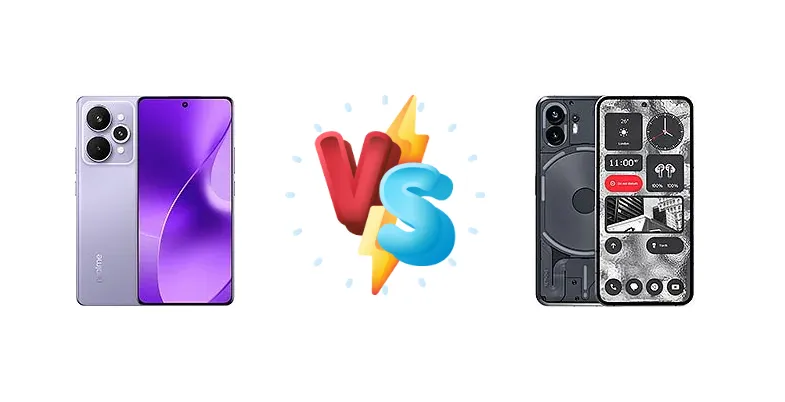
|
🏆 Quick Verdict
For the average user prioritizing battery life and value, the Realme 15 Pro emerges as the winner. Its impressive 17:04-hour active use score and 80W charging significantly outperform the Nothing Phone (2)'s 14:21 hours and slower 45W charging, making it ideal for power users and those on the go.
| PHONES | ||
|---|---|---|
| Phone Names | Realme 15 Pro | Nothing Phone (2) |
| Network | ||
|---|---|---|
| 2G bands | GSM 850 / 900 / 1800 / 1900 | GSM 850 / 900 / 1800 / 1900 |
| 3G bands | HSDPA 850 / 900 / 2100 | HSDPA 800 / 850 / 900 / 1700(AWS) / 1900 / 2100 |
| 4G bands | 1, 3, 5, 8, 28, 40, 41 | 1, 2, 3, 4, 5, 7, 8, 12, 17, 18, 19, 20, 25, 26, 28, 30, 32, 34, 38, 39, 40, 41, 42, 48, 66, 71 |
| 5G bands | 1, 3, 5, 8, 28, 40, 41, 77, 78 SA/NSA | 1, 2, 3, 5, 7, 8, 12, 20, 25, 28, 30, 38, 40, 41, 66, 71, 75, 77, 78 SA/NSA |
| Speed | HSPA, LTE, 5G | HSPA, LTE, 5G |
| Technology | GSM / HSPA / LTE / 5G | GSM / HSPA / LTE / 5G |
| Launch | ||
|---|---|---|
| Announced | 2025, July 24 | 2023, July 11 |
| Status | Available. Released 2025, July 30 | Available. Released 2023, July 17 |
| Body | ||
|---|---|---|
| Build | Glass front (Gorilla Glass 7i), aluminum frame, fiber-reinforced plastic back or silicone polymer (eco leather) back | Glass front (Gorilla Glass 5), glass back (Gorilla Glass 5), aluminum frame |
| Dimensions | 162.3 x 76.2 x 7.7 mm (6.39 x 3.00 x 0.30 in) | 162.1 x 76.4 x 8.6 mm (6.38 x 3.01 x 0.34 in) |
| SIM | Nano-SIM + Nano-SIM | Nano-SIM + Nano-SIM |
| Weight | 187 g (6.60 oz) | 201.2 g (7.09 oz) |
| Display | ||
|---|---|---|
| Protection | Corning Gorilla Glass 7i | Corning Gorilla Glass 5 |
| Resolution | 1280 x 2800 pixels, 19.5:9 ratio (~453 ppi density) | 1080 x 2412 pixels, 20:9 ratio (~394 ppi density) |
| Size | 6.8 inches, 112.8 cm2 (~91.2% screen-to-body ratio) | 6.7 inches, 108.0 cm2 (~87.2% screen-to-body ratio) |
| Type | OLED, 1B colors, 144Hz, 4608Hz PWM, HDR10+, 1800 nits (HBM), 6500 nits (peak) | LTPO OLED, 1B colors, 120Hz, 1920Hz PWM, HDR10+, 1600 nits (HBM), 1600 nits (peak) |
| Platform | ||
|---|---|---|
| CPU | Octa-core (1x2.8 GHz Cortex-720 & 4x2.4 GHz Cortex-720 & 3x1.8 GHz Cortex-520) | Octa-core (1x3.0 GHz Cortex-X2 & 3x2.5 GHz Cortex-A710 & 4x1.80 GHz Cortex-A510) |
| Chipset | Qualcomm SM7750-AB Snapdragon 7 Gen 4 (4 nm) | Qualcomm SM8475 Snapdragon 8+ Gen 1 (4 nm) |
| GPU | Adreno 722 | Adreno 730 |
| OS | Android 15, up to 3 major Android upgrades, Realme UI 6.0 | Android 13, upgradable to Android 15, up to 3 major Android upgrades, Nothing OS 3.0 |
| Memory | ||
|---|---|---|
| Card slot | No | No |
| Internal | 128GB 8GB RAM, 256GB 8GB RAM, 256GB 12GB RAM, 512GB 12GB RAM | 128GB 8GB RAM, 256GB 12GB RAM, 512GB 12GB RAM |
| Main Camera | ||
|---|---|---|
| Dual | 50 MP, f/1.8, 24mm (wide), 1/1.56", 1.0µm, multi-directional PDAF, OIS 50 MP, f/2.0, 16mm, 116˚ (ultrawide), 1/2.88", 0.61µm | 50 MP, f/1.9, 24mm (wide), 1/1.56", 1.0µm, PDAF, OIS 50 MP, f/2.2, 114˚ (ultrawide), 1/2.76", 0.64µm, AF |
| Features | LED flash, HDR, panorama | LED flash, panorama, HDR |
| Video | 4K@30/60fps, 1080p@30/60/120fps, gyro-EIS, OIS | 4K@30/60fps, 1080p@30/60fps, gyro-EIS, live HDR, OIS |
| Selfie camera | ||
|---|---|---|
| Features | Panorama | HDR |
| Single | 50 MP, f/2.4, 23mm (wide), 1/2.88", 0.61µm | 32 MP, f/2.5, (wide), 1/2.74", 0.8µm |
| Video | 4K@30/60fps, 1080p@30/60fps | 1080p@30fps |
| Sound | ||
|---|---|---|
| 35mm jack | No | No |
| Loudspeaker | Yes, with stereo speakers | Yes, with stereo speakers |
| Comms | ||
|---|---|---|
| Bluetooth | 5.4, A2DP, LE | 5.3, A2DP, LE, aptX HD, aptX Adaptive |
| Infrared port | Yes | - |
| NFC | Yes (market/region dependent) | Yes |
| Positioning | GPS, GLONASS, GALILEO, BDS | GPS (L1+L5), GLONASS (L1), BDS (B1I+B1c), GALILEO (E1), QZSS (L1), NavIC |
| Radio | No | No |
| USB | USB Type-C 2.0 | USB Type-C 2.0, OTG |
| WLAN | Wi-Fi 802.11 a/b/g/n/ac/6, dual-band | Wi-Fi 802.11 a/b/g/n/ac/6, dual-band, Wi-Fi Direct |
| Features | ||
|---|---|---|
| Sensors | Fingerprint (under display, optical), accelerometer, gyro, proximity, compass | Fingerprint (under display, optical), accelerometer, proximity, gyro, compass |
| Battery | ||
|---|---|---|
| Charging | 80W wired, 50% in 25 min | 45W wired, PD3.0, PPS, QC4, 100% in 55 min 15W wireless, 100% in 130 min 5W reverse wireless |
| Type | Market-dependent versions:· Li-Ion 7000 mAh - India, China· Si/C Li-Ion 7000 mAh - ROW | Li-Ion 4700 mAh |
| Misc | ||
|---|---|---|
| Colors | Flowing Silver, Silk Purple, Velvet Green, Game of Thrones Limited Edition | White, Dark Gray |
| Models | RMX5101 | A065 |
| Price | ₹ 30,399 | $ 379.99 / £ 370.00 |
Realme 15 Pro
- Exceptional battery life (17:04h active use)
- Ultra-fast 80W wired charging
- Brighter display (1862 nits)
- Less powerful processor than the Nothing Phone (2)
- Limited camera information available
Nothing Phone (2)
- Flagship-level Snapdragon 8+ Gen 1 processor
- Wireless and reverse wireless charging
- Potentially superior camera system
- Shorter battery life (14:21h active use)
- Slower 45W wired charging
- Lower peak display brightness
Display Comparison
The Realme 15 Pro boasts a significantly brighter display, reaching a measured 1862 nits, compared to the Nothing Phone (2)'s 998 nits. This translates to superior visibility in direct sunlight. While both utilize 4nm chipsets, the display brightness difference is a key advantage for the Realme, particularly for outdoor users. We lack information on panel technology (LTPO, AMOLED) for the Realme, but the Nothing Phone (2) is known for its excellent color accuracy and smooth scrolling. The Realme's higher peak brightness is the standout feature here.
Camera Comparison
The provided data lacks detailed camera specifications for both devices. However, the Nothing Phone (2) is marketed with a strong emphasis on its camera capabilities, including photo and video features. Without sensor size or aperture information for either phone, it’s difficult to make a definitive judgment. We can assume the Nothing Phone (2) will offer a more versatile and feature-rich camera experience, given its positioning as a more premium device. The Realme 15 Pro likely focuses on delivering solid, reliable image quality without the advanced features.
Performance
The Nothing Phone (2) holds a clear advantage in raw processing power, equipped with the Qualcomm Snapdragon 8+ Gen 1. Its CPU configuration – 1x3.0 GHz Cortex-X2, 3x2.5 GHz Cortex-A710, and 4x1.80 GHz Cortex-A510 – is significantly more powerful than the Realme 15 Pro’s Snapdragon 7 Gen 4 (1x2.8 GHz Cortex-720, 4x2.4 GHz Cortex-720, 3x1.8 GHz Cortex-520). However, the Snapdragon 7 Gen 4’s 4nm process node offers improved efficiency, potentially mitigating the performance gap in everyday tasks. The Nothing Phone (2) will excel in demanding applications and gaming, while the Realme 15 Pro provides a smooth experience for typical usage.
Battery Life
Battery life is where the Realme 15 Pro truly shines. Its active use score of 17:04 hours significantly surpasses the Nothing Phone (2)'s 14:21 hours. While the Nothing Phone (2) offers wireless charging (15W) and reverse wireless charging (5W), the Realme 15 Pro compensates with incredibly fast 80W wired charging, reaching 50% charge in just 25 minutes. The Nothing Phone (2) takes 55 minutes for a full charge. This difference in charging speed is substantial and favors the Realme for users who frequently need to top up their battery.
Buying Guide
Buy the Realme 15 Pro if you need exceptional battery life, fast charging, and a strong price-to-performance ratio. It’s the perfect choice for users who prioritize longevity and don’t want to compromise on daily usability. Buy the Nothing Phone (2) if you prefer a more refined design, a faster processor for demanding tasks like video editing or high-end gaming, and the convenience of wireless charging, even if it comes at the cost of battery endurance and charging speed.