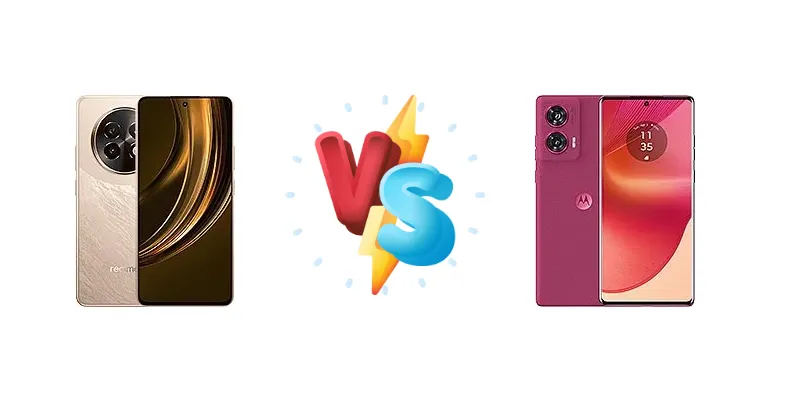
The mid-range smartphone market is fiercely competitive, and the Realme 15 Lite and Motorola Edge 50 Fusion represent compelling options for users seeking a balance of performance and affordability. This comparison dissects their key specifications, focusing on the chipset differences, display capabilities, and charging technologies to determine which device delivers the most value.
🏆 Quick Verdict
For the average user prioritizing sustained performance and faster charging, the Realme 15 Lite emerges as the stronger contender. Its Mediatek Dimensity 7300 Energy chipset, coupled with 80W charging, provides a noticeable edge over the Motorola Edge 50 Fusion's Snapdragon 7s Gen 2 (or 6 Gen 1 in LATAM) and 68W charging.
| Network |
|---|
| 2G bands | GSM 850 / 900 / 1800 / 1900 | GSM 850 / 900 / 1800 / 1900 |
| 3G bands | HSDPA 850 / 900 / 2100 | HSDPA 850 / 900 / 1900 / 2100 |
| 4G bands | LTE | 1, 2, 3, 5, 7, 8, 18, 19, 20, 26, 28, 32, 38, 40, 41, 42, 71 - International |
| 5G bands | SA/NSA | 1, 3, 5, 7, 8, 20, 26, 28, 38, 40, 41, 77, 78 SA/NSA |
| Speed | HSPA, LTE, 5G | HSPA, LTE, 5G |
| Technology | GSM / HSPA / LTE / 5G | GSM / HSPA / LTE / 5G |
| Launch |
|---|
| Announced | 2025, October | 2024, April 16 |
| Status | Available. Released 2025, October | Available. Released 2024, May 15 |
| Body |
|---|
| Build | - | Glass front, silicone polymer back (eco leather), plastic frame |
| Dimensions | 161.7 x 74.7 x 7.6 mm (6.37 x 2.94 x 0.30 in) | 161.9 x 73.1 x 7.9 mm (6.37 x 2.88 x 0.31 in) |
| SIM | Nano-SIM + Nano-SIM | · Nano-SIM + eSIM· Nano-SIM + Nano-SIM |
| Weight | 185 g (6.53 oz) | 174.9 g (6.17 oz) |
| Display |
|---|
| Protection | - | Corning Gorilla Glass 5 |
| Resolution | 1080 x 2400 pixels, 20:9 ratio (~395 ppi density) | 1080 x 2400 pixels, 20:9 ratio (~393 ppi density) |
| Size | 6.67 inches, 107.4 cm2 (~88.9% screen-to-body ratio) | 6.7 inches, 108.4 cm2 (~91.6% screen-to-body ratio) |
| Type | OLED, 1B colors, 120Hz, 2000 nits (peak) | P-OLED, 1B colors, 120Hz (LATAM), 144Hz (INT), 1600 nits (peak) |
| Platform |
|---|
| CPU | Octa-core (4x2.5 GHz Cortex-A78 & 4x2.0 GHz Cortex-A55) | Octa-core (4x2.40 GHz Cortex-A78 & 4x1.95 GHz Cortex-A55) - InternationalOcta-core (4x2.2 GHz Cortex-A78 & 4x1.8 GHz Cortex-A55) - LATAM |
| Chipset | Mediatek Dimensity 7300 Energy (4 nm) | Qualcomm SM7435-AB Snapdragon 7s Gen 2 (4 nm) - InternationalQualcomm SM6450 Snapdragon 6 Gen 1 (4 nm) - LATAM |
| GPU | Mali-G615 MC2 | Adreno 710 |
| OS | Android 15, Realme UI 6.0 | Android 14, upgradable to Android 15, up to 3 major Android upgrades |
| Memory |
|---|
| Card slot | microSDXC (uses shared SIM slot) | No |
| Internal | 128GB 8GB RAM, 256GB 8GB RAM, 256GB 12GB RAM | 128GB 8GB RAM, 256GB 8GB RAM, 256GB 12GB RAM, 512GB 8GB RAM, 512GB 12GB RAM |
| Main Camera |
|---|
| Dual | 50 MP, f/1.8, (wide), 1/1.95", PDAF, OIS
Auxiliary lens | 50 MP, f/1.9, (wide), 1/1.56", 1.0µm, multi-directional PDAF, OIS
13 MP, f/2.2, 120˚ (ultrawide), 1/3.0", 1.12µm, AF |
| Features | LED flash, HDR, panorama | LED flash, HDR, panorama |
| Video | 4K@30fps, 1080p@30fps, gyro-EIS, OIS | 4K@30fps, 1080p@30/60/120fps, gyro-EIS |
| Selfie camera |
|---|
| Features | - | HDR |
| Single | 16 MP, (wide) | 32 MP, f/2.5, (wide), 1/3.14", 0.7µm |
| Video | Yes | 4K@30fps, 1080p@30fps |
| Sound |
|---|
| 35mm jack | Yes | No |
| Loudspeaker | Yes | Yes, with stereo speakers |
| Comms |
|---|
| Bluetooth | 5.4, A2DP, LE | 5.2, A2DP, LE |
| Infrared port | Yes | - |
| NFC | Unspecified | Yes |
| Positioning | GPS, GLONASS, GALILEO, BDS | GPS, GLONASS, GALILEO |
| Radio | No | No |
| USB | USB Type-C 2.0 | USB Type-C 2.0, OTG |
| WLAN | Wi-Fi 802.11 a/b/g/n/ac, dual-band | Wi-Fi 802.11 a/b/g/n/ac, dual-band |
| Features |
|---|
| Sensors | Fingerprint (under display, optical); unspecified sensors | Fingerprint (under display, optical), accelerometer, gyro, proximity, compass |
| Battery |
|---|
| Charging | 80W wired | 68W wired, 50% in 15 min |
| Type | 5000 mAh | 5000 mAh |
| Misc |
|---|
| Colors | Satin Green, Glitter Gold, Electric Purple | Forest Blue, Marshmallow Blue, Hot Pink |
| Models | RMX5000 | XT2429-1 |
| Price | About 170 EUR | € 208.99 / $ 245.00 / ₹ 18,667 |
Realme 15 Lite
- Faster 80W charging for quicker top-ups
- Potentially better sustained performance with Dimensity 7300 Energy
- More efficient 4nm chipset
- Display brightness likely lower than Motorola Edge 50 Fusion
- Battery capacity not specified
Motorola Edge 50 Fusion
- Brighter 1322 nits display for excellent outdoor visibility
- Longer battery life in active use (12:40h)
- Strong ISP capabilities with Snapdragon 7s Gen 2
- Slower 68W charging
- LATAM version uses less powerful Snapdragon 6 Gen 1
Display Comparison
The Motorola Edge 50 Fusion boasts a significantly brighter display, reaching a measured 1322 nits, making it ideal for outdoor visibility. While the Realme 15 Lite’s display specifications are not provided, the Edge 50 Fusion’s high peak brightness is a clear advantage for users frequently exposed to sunlight. The panel technology and refresh rate are unknown for the Realme 15 Lite, but the Edge 50 Fusion’s brightness alone positions it as superior for visual clarity in bright environments. The absence of LTPO on either device suggests neither will offer the extreme power savings of adaptive refresh rate technology.
Camera Comparison
Camera details are limited for both devices. Without sensor size or aperture information, a direct comparison is difficult. However, focusing on the core processing capabilities, the Snapdragon 7s Gen 2 in the Edge 50 Fusion generally offers strong image signal processing (ISP) capabilities. The Realme 15 Lite’s Dimensity 7300 Energy also includes a capable ISP, but its performance relative to the Snapdragon is unknown without further testing. The presence of Optical Image Stabilization (OIS) on either device is unconfirmed, but would be a crucial factor for low-light photography.
Performance
The core of the performance difference lies in the chipsets. The Realme 15 Lite utilizes the Mediatek Dimensity 7300 Energy (4nm), featuring an octa-core configuration with 4x2.5 GHz Cortex-A78 and 4x2.0 GHz Cortex-A55 cores. The Motorola Edge 50 Fusion, internationally, features the Qualcomm SM7435-AB Snapdragon 7s Gen 2 (4nm) with a similar octa-core layout (4x2.40 GHz Cortex-A78 & 4x1.95 GHz Cortex-A55). However, the LATAM version downgrades to the Snapdragon 6 Gen 1. The Dimensity 7300 Energy’s slightly higher Cortex-A78 clock speed suggests a marginal advantage in single-core performance. Both chips are built on a 4nm process, ensuring good efficiency, but the Dimensity 7300 Energy is generally considered to offer better sustained performance due to its thermal design. The RAM configuration is not specified for either device, but LPDDR5x would be a significant benefit.
Battery Life
The Motorola Edge 50 Fusion demonstrates a strong real-world battery performance, achieving 12 hours and 40 minutes of active use. The Realme 15 Lite’s battery capacity is not specified, but its 80W wired charging significantly outpaces the Edge 50 Fusion’s 68W charging, which claims 50% charge in 15 minutes. This faster charging speed is a major advantage for users who prioritize quick top-ups. While the Edge 50 Fusion’s battery life is commendable, the Realme 15 Lite’s charging speed could offset a potentially smaller battery capacity.
Buying Guide
Buy the Realme 15 Lite if you need a phone that can handle demanding applications and games with consistent performance, and if rapid charging is a priority. You'll benefit from the Dimensity 7300 Energy's efficient architecture. Buy the Motorola Edge 50 Fusion if you prioritize display brightness and a potentially longer battery life during typical use, and are willing to trade some raw processing power for it. The Edge 50 Fusion is a solid choice for media consumption and everyday tasks.
Frequently Asked Questions
❓ Does the Mediatek Dimensity 7300 Energy in the Realme 15 Lite experience thermal throttling during extended gaming sessions?
The Dimensity 7300 Energy is designed with thermal efficiency in mind, utilizing a 4nm process. While throttling can occur in any smartphone under sustained load, the Dimensity 7300 Energy generally performs well in maintaining consistent performance during gaming, especially compared to older or less efficient chipsets. However, the specific thermal management implementation by Realme will ultimately determine the extent of any throttling.
❓ Is the Snapdragon 6 Gen 1 in the LATAM version of the Motorola Edge 50 Fusion a significant downgrade compared to the Snapdragon 7s Gen 2?
Yes, the Snapdragon 6 Gen 1 represents a noticeable step down in performance compared to the Snapdragon 7s Gen 2. The 7s Gen 2 offers a more powerful CPU and GPU, resulting in smoother multitasking, faster app loading times, and improved gaming performance. Users in the LATAM region should be aware of this difference when considering the Edge 50 Fusion.
❓ How does the 68W charging on the Motorola Edge 50 Fusion compare to the 80W charging on the Realme 15 Lite in real-world usage?
While both offer fast charging, the Realme 15 Lite’s 80W charging will likely result in a faster overall charge time. The Edge 50 Fusion claims 50% charge in 15 minutes, but the 80W system on the Realme 15 Lite should achieve a similar percentage in less time, and a full charge will be noticeably quicker.