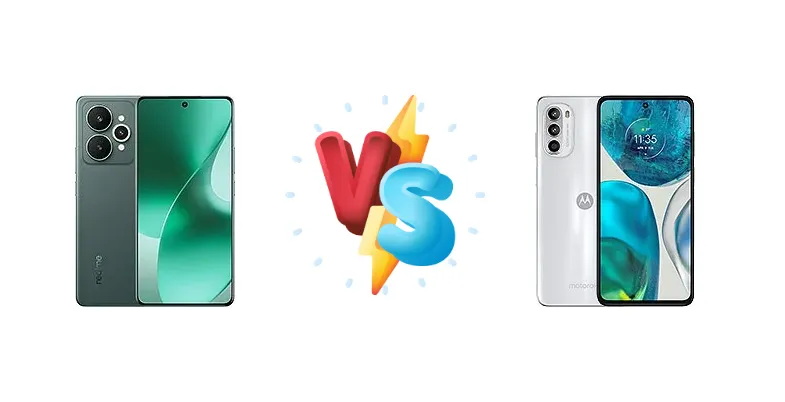
The Realme 15 (India) and Motorola Moto G52 represent distinct approaches to the competitive mid-range smartphone market. The Realme 15 prioritizes raw processing power with its Dimensity 7300+ chipset, while the Moto G52 aims for a balance of efficiency and affordability with the Snapdragon 680. This comparison dissects their key differences to help you determine which device best suits your needs.
🏆 Quick Verdict
For users prioritizing performance and fast charging, the Realme 15 (India) is the clear winner. Its Dimensity 7300+ offers a significant leap in processing capability over the Moto G52’s Snapdragon 680, and the 80W charging dramatically reduces downtime. However, the Moto G52 remains a viable option for those seeking a more budget-friendly and power-efficient device.
| Network |
|---|
| 2G bands | GSM 850 / 900 / 1800 / 1900 | GSM 850 / 900 / 1800 / 1900 |
| 3G bands | HSDPA 850 / 900 / 2100 | HSDPA 850 / 900 / 1700(AWS) / 1900 / 2100 |
| 4G bands | 1, 3, 5, 8, 28, 40, 41 | LTE |
| 5G bands | 1, 3, 5, 8, 28, 40, 41, 77, 78 SA/NSA | - |
| Speed | HSPA, LTE, 5G | HSPA, LTE |
| Technology | GSM / HSPA / LTE / 5G | GSM / HSPA / LTE |
| Launch |
|---|
| Announced | 2025, July 24 | 2022, April 12 |
| Status | Available. Released 2025, July 30 | Available. Released 2022, April 20 |
| Body |
|---|
| Build | Glass front, aluminum frame, fiber-reinforced plastic back or silicone polymer (eco leather) back | - |
| Dimensions | 162.3 x 76.2 x 7.7 / 7.8 / 8.0 mm | 160.1 x 74.5 x 8 mm (6.30 x 2.93 x 0.31 in) |
| SIM | Nano-SIM + Nano-SIM | Nano-SIM + Nano-SIM |
| Weight | 187 g or 189 g (6.60 oz) | 169 g (5.96 oz) |
| | - | Water-repellent design |
| Display |
|---|
| Protection | Corning Gorilla Glass (unspecified version) | - |
| Resolution | 1280 x 2800 pixels, 19.5:9 ratio (~453 ppi density) | 1080 x 2400 pixels, 20:9 ratio (~402 ppi density) |
| Size | 6.8 inches, 112.8 cm2 (~91.2% screen-to-body ratio) | 6.6 inches, 103.6 cm2 (~86.9% screen-to-body ratio) |
| Type | OLED, 1B colors, 144Hz, 4608Hz PWM, HDR10+, 1800 nits (HBM), 6500 nits (peak) | AMOLED, 90Hz |
| Platform |
|---|
| CPU | Octa-core (4x2.6 GHz Cortex-A78 & 4x2.0 GHz Cortex-A55) | Octa-core (4x2.4 GHz Kryo 265 Gold & 4x1.9 GHz Kryo 265 Silver) |
| Chipset | Mediatek Dimensity 7300+ (4 nm) | Qualcomm SM6225 Snapdragon 680 4G (6 nm) |
| GPU | Mali-G615 MC2 | Adreno 610 |
| OS | Android 15, up to 3 major Android upgrades, Realme UI 6.0 | Android 12, planned upgrade to Android 13 |
| Memory |
|---|
| Card slot | No | microSDXC (uses shared SIM slot) |
| Internal | 128GB 8GB RAM, 256GB 8GB RAM, 256GB 12GB RAM, 512GB 12GB RAM | 64GB 4GB RAM, 128GB 4GB RAM, 128GB 6GB RAM, 256GB 6GB RAM |
| Main Camera |
|---|
| Dual | 50 MP, f/1.8, 24mm (wide), 1/1.56", PDAF, OIS
8 MP, f/2.2, 112˚, 16mm (ultrawide) | - |
| Features | LED flash, HDR, panorama | LED flash, HDR, panorama |
| Triple | - | 50 MP, f/1.8 (wide), 1/2.76", 0.64µm, PDAF
8 MP, f/2.2, 118˚ (ultrawide), 1/4.0", 1.12µm
2 MP (macro) |
| Video | 4K@30fps, 1080p@30fps, gyro-EIS, OIS | 1080p@30fps |
| Selfie camera |
|---|
| Features | Panorama | - |
| Single | 50 MP, f/2.4, 23mm (wide) | 16 MP, f/2.5, (wide), 1.0µm |
| Video | 4K@30fps, 1080p@30fps | 1080p@30fps |
| Sound |
|---|
| 3.5mm jack | - | Yes |
| 35mm jack | No | Yes |
| Loudspeaker | Yes, with stereo speakers | Yes, with stereo speakers |
| Comms |
|---|
| Bluetooth | 5.4, A2DP, LE | 5.0, A2DP, LE |
| Infrared port | Yes | - |
| NFC | No | Yes (market/region dependent) |
| Positioning | GPS, GLONASS, GALILEO, BDS | GPS, GLONASS, GALILEO |
| Radio | No | Unspecified |
| USB | USB Type-C 2.0 | USB Type-C 2.0 |
| WLAN | Wi-Fi 802.11 a/b/g/n/ac/6, dual-band | Wi-Fi 802.11 a/b/g/n/ac, dual-band, Wi-Fi Direct |
| Features |
|---|
| Sensors | Fingerprint (under display, optical), accelerometer, gyro, proximity, compass | Fingerprint (side-mounted), accelerometer, gyro, proximity, compass |
| Battery |
|---|
| Charging | 80W wired, 50% in 25 min | 30W wired |
| Type | Li-Ion 7000 mAh | Li-Po 5000 mAh |
| Misc |
|---|
| Colors | Flowing Silver, Silk Pink, Velvet Green | Charcoal Gray, Porcelain White |
| Models | RMX5106 | XT2221-1, XT2221-2 |
| Price | ₹ 24,699 | About 470 EUR |
Realme 15 (India)
- Significantly faster processor (Dimensity 7300+)
- Ultra-fast 80W charging
- Potentially superior camera performance
- May be more expensive
- Potentially higher thermal output under heavy load
Motorola Moto G52
- More affordable price point
- Good power efficiency (Snapdragon 680)
- Reliable performance for everyday tasks
- Slower processor
- Slower 30W charging
Display Comparison
While display specifications are missing for both devices, the Realme brand typically focuses on higher refresh rates and brighter panels in this segment. The Moto G52, given its positioning, likely features a standard 60Hz panel. The Realme 15’s potential for a higher refresh rate would translate to smoother scrolling and animations, benefiting gamers and frequent social media users. Color accuracy is also likely to be superior on the Realme 15, given Realme’s recent emphasis on display quality.
Camera Comparison
Without detailed camera specs, it’s difficult to make a definitive judgment. However, Realme often equips its phones with larger sensors and more advanced image processing algorithms. The Realme 15 is likely to offer superior image quality, particularly in low-light conditions, due to its more powerful ISP (Image Signal Processor) integrated within the Dimensity 7300+. The Moto G52 will likely rely on software optimization to compensate for a potentially less capable sensor. The absence of OIS (Optical Image Stabilization) information suggests neither phone prioritizes advanced stabilization features.
Performance
The core difference lies in the chipsets. The Realme 15’s Mediatek Dimensity 7300+ (4nm) is a substantial upgrade over the Motorola Moto G52’s Qualcomm Snapdragon 680 (6nm). The Dimensity 7300+ utilizes more modern CPU cores – Cortex-A78 – offering significantly higher peak performance compared to the Kryo 265 Gold cores in the Snapdragon 680. The 4nm process node further enhances efficiency, potentially leading to better thermal management under sustained load. This means the Realme 15 will handle graphically intensive games and demanding applications with greater ease and less throttling. The Snapdragon 680, while capable for everyday tasks, will struggle with more resource-intensive operations.
Battery Life
The Realme 15’s 80W wired charging is a game-changer. Claiming a 50% charge in 25 minutes drastically reduces downtime compared to the Moto G52’s 30W charging. While battery capacity isn’t specified, the faster charging speed of the Realme 15 effectively mitigates any potential disadvantage from a slightly smaller battery. The Snapdragon 680’s 6nm process contributes to better power efficiency, potentially giving the Moto G52 a slight edge in overall battery life during light usage, but the Realme 15’s charging speed will be more impactful for most users.
Buying Guide
Buy the Realme 15 (India) if you need a phone capable of handling demanding games, multitasking, and benefit from incredibly fast charging speeds. This is the choice for power users and those who value future-proofing. Buy the Motorola Moto G52 if you prefer a more conservative approach, prioritizing battery life, a potentially lower price point, and a reliable, if less flashy, user experience. It’s ideal for everyday tasks and users who don’t push their phones to the limit.
Frequently Asked Questions
❓ Will the Dimensity 7300+ in the Realme 15 overheat during prolonged gaming sessions?
While the Dimensity 7300+ is a powerful chip, the 4nm process node helps mitigate thermal throttling. However, sustained gaming at maximum settings will inevitably generate heat. Realme typically incorporates cooling solutions in their devices, but performance may still decrease slightly after extended play. The Moto G52’s Snapdragon 680 will likely run cooler, but at the cost of overall performance.
❓ Is the 30W charging on the Moto G52 slow compared to the Realme 15’s 80W?
Yes, the difference is substantial. 30W charging will take considerably longer to fully charge the Moto G52 compared to the Realme 15’s 80W, which can add 50% charge in just 25 minutes. For users who frequently need to top up their battery quickly, the Realme 15 is the superior choice.
❓ Can the Motorola Moto G52 handle demanding apps like video editing software?
The Snapdragon 680 is adequate for basic tasks, but it will struggle with demanding applications like video editing. Rendering times will be slow, and the phone may experience lag or stuttering. The Realme 15’s Dimensity 7300+ is much better suited for such tasks, offering a smoother and more efficient experience.