
Realme 14x vs Xiaomi Redmi Note 13 Pro 4G: A Deep Dive into Battery, Performance, and Value
| Phones Images | |||||
|---|---|---|---|---|---|
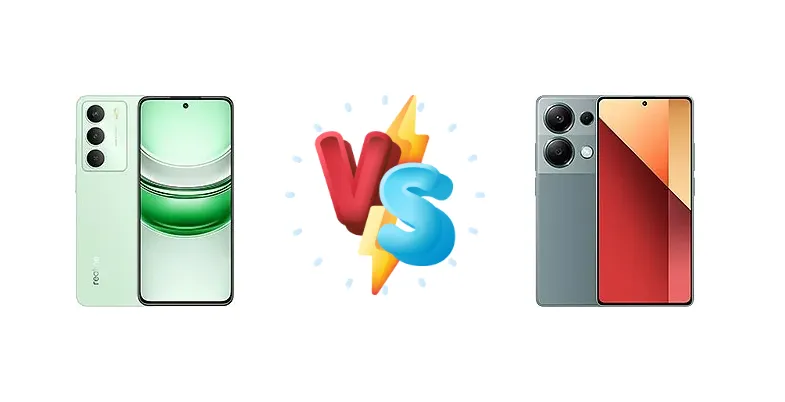
|
🏆 Quick Verdict
For the average user prioritizing long-lasting battery life, the Realme 14x emerges as the winner. Its impressive 65:33h endurance significantly outpaces the Redmi Note 13 Pro 4G’s 11:36h active use score. However, those who value rapid charging and a brighter screen will find the Redmi Note 13 Pro 4G more appealing.
| PHONES | ||
|---|---|---|
| Phone Names | Realme 14x | Xiaomi Redmi Note 13 Pro 4G |
| Network | ||
|---|---|---|
| 2G bands | GSM 850 / 900 / 1800 / 1900 | GSM 850 / 900 / 1800 / 1900 |
| 3G bands | HSDPA 800 / 850 / 900 / 1700(AWS) / 1900 / 2100 | HSDPA 850 / 900 / 1700(AWS) / 1900 / 2100 |
| 4G bands | 1, 2, 3, 4, 5, 7, 8, 12, 13, 17, 18, 19, 20, 26, 28, 38, 40, 41, 66 | 1, 2, 3, 4, 5, 7, 8, 12, 13, 17, 18, 19, 20, 26, 28, 38, 40, 41, 66 |
| 5G bands | 1, 2, 3, 5, 7, 8, 20, 26, 28, 38, 40, 41, 66, 77, 78 SA/NSA | - |
| Speed | HSPA, LTE, 5G | HSPA, LTE |
| Technology | GSM / HSPA / LTE / 5G | GSM / HSPA / LTE |
| Launch | ||
|---|---|---|
| Announced | 2025, January 24 | 2024, January 15 |
| Status | Available. Released 2025, January 24 | Available. Released 2024, January 15 |
| Body | ||
|---|---|---|
| Build | - | Glass front (Gorilla Glass 5), plastic frame, plastic back |
| Dimensions | 165.7 x 76.2 x 7.9 mm (6.52 x 3.00 x 0.31 in) | 161.1 x 75 x 8 mm (6.34 x 2.95 x 0.31 in) |
| SIM | Nano-SIM + Nano-SIM | Nano-SIM + Nano-SIM |
| Weight | 190 g (6.70 oz) | 188 g (6.63 oz) |
| Display | ||
|---|---|---|
| Protection | Mohs level 5 | Corning Gorilla Glass 5 |
| Resolution | 720 x 1604 pixels, 20:9 ratio (~264 ppi density) | 1080 x 2400 pixels, 20:9 ratio (~395 ppi density) |
| Size | 6.67 inches, 107.2 cm2 (~84.9% screen-to-body ratio) | 6.67 inches, 107.4 cm2 (~88.9% screen-to-body ratio) |
| Type | IPS LCD, 120Hz, 625 nits | AMOLED, 1B colors, 120Hz, 500 nits (typ), 1000 nits (HBM), 1300 nits (peak) |
| Platform | ||
|---|---|---|
| CPU | Octa-core (2x2.4 GHz Cortex-A76 & 6x2.0 GHz Cortex-A55) | Octa-core (2x2.2 GHz Cortex-A76 & 6x2.0 GHz Cortex-A55) |
| Chipset | Mediatek Dimensity 6300 (6 nm) | Mediatek Helio G99 Ultra |
| GPU | Mali-G57 MC2 | Mali-G57 MC2 |
| OS | Android 15, Realme UI 6.0 | Android 13, up to 3 major Android upgrades, HyperOS |
| Memory | ||
|---|---|---|
| Card slot | microSDXC (uses shared SIM slot) | microSDXC (uses shared SIM slot) |
| Internal | 128GB 6GB RAM, 256GB 6GB RAM, 256GB 8GB RAM | 128GB 8GB RAM, 256GB 8GB RAM, 256GB 12GB RAM, 512GB 8GB RAM, 512GB 12GB RAM |
| Main Camera | ||
|---|---|---|
| Features | LED flash, HDR, panorama | LED flash, HDR, panorama |
| Single | 50 MP, f/1.8, 27mm (wide), 1/2.88", 0.61µm, PDAF | - |
| Triple | - | 200 MP, f/1.7, 23mm (wide), 1/1.4", 0.56µm, multi-directional PDAF, OIS 8 MP, f/2.2, 15mm, 120˚ (ultrawide), 1/4.4", 1.0µm 2 MP (macro) |
| Video | 1080p@30fps | 1080p@30/60fps |
| Selfie camera | ||
|---|---|---|
| Single | 8 MP, (wide) | 16 MP, f/2.4, (wide), 1/3.0", 1.0µm |
| Video | 1080p@30fps | 1080p@30/60fps |
| Sound | ||
|---|---|---|
| 35mm jack | Yes | Yes |
| Loudspeaker | Yes | Yes, with dual speakers |
| Comms | ||
|---|---|---|
| Bluetooth | 5.3, A2DP, LE | 5.2, A2DP, LE |
| Infrared port | - | Yes |
| NFC | Yes | Yes (market/region dependent) |
| Positioning | GPS, GALILEO, GLONASS, QZSS, BDS | GPS, GLONASS, GALILEO, BDS |
| Radio | No | FM radio |
| USB | USB Type-C 2.0 | USB Type-C 2.0, OTG |
| WLAN | Wi-Fi 802.11 a/b/g/n/ac, dual-band | Wi-Fi 802.11 a/b/g/n/ac, dual-band |
| Features | ||
|---|---|---|
| Sensors | Fingerprint (side-mounted), accelerometer, proximity, compass | Fingerprint (under display, optical), accelerometer, gyro, compass |
| Battery | ||
|---|---|---|
| Charging | 15W wired | 67W wired, 50% in 16 min, 100% in 46 min |
| Type | 5000 mAh | 5000 mAh |
| Misc | ||
|---|---|---|
| Colors | Peridot Green, Carbon Black | Midnight Black, Lavender Purple, Forest Green |
| Models | RMX5020, RMX3943 | 23117RA68G, 2312FPCA6G |
| Price | € 109.00 / $ 142.11 / £ 139.00 | € 92.00 / $ 269.99 / £ 299.99 |
| SAR | - | 1.09 W/kg (head) 1.09 W/kg (body) |
| SAR EU | - | 0.99 W/kg (head) 0.99 W/kg (body) |
| EU LABEL | ||
|---|---|---|
| Battery | 65:33h endurance, 1000 cycles | - |
| Energy | Class A | - |
| Free fall | Class B (180 falls) | - |
| Repairability | Class B | - |
Realme 14x
- Exceptional battery life (65:33h endurance)
- More power-efficient chipset (6nm Dimensity 6300)
- Potentially better sustained performance due to 6nm process
- Slow charging speed (15W)
- Display brightness likely lower than Redmi
Xiaomi Redmi Note 13 Pro 4G
- Very fast charging (67W, 0-100% in 46 min)
- Bright display (1047 nits)
- Stronger camera marketing suggests better imaging capabilities
- Significantly shorter battery life (11:36h active use)
- Less power-efficient chipset (Helio G99 Ultra)
Display Comparison
The Xiaomi Redmi Note 13 Pro 4G boasts a significantly brighter display, reaching a measured peak of 1047 nits. This is a substantial advantage for outdoor visibility, especially in direct sunlight. While the Realme 14x’s display specifications are not provided, the Redmi’s brightness level suggests a clear win for Xiaomi in this category. The Redmi’s panel likely offers a more vivid and engaging viewing experience, though the absence of LTPO technology means it won’t dynamically adjust refresh rates for power saving like some higher-end phones.
Camera Comparison
The context data for both devices is limited regarding camera specifics. However, the Redmi Note 13 Pro 4G is marketed with a focus on its camera capabilities, suggesting a more robust imaging system. While the Realme 14x likely offers a competent camera experience, the Redmi’s emphasis on photo and video implies features like potentially larger sensors or more advanced image processing algorithms. Without detailed sensor size or aperture information, it’s difficult to make a definitive judgment, but the Redmi’s marketing suggests a stronger focus on photography.
Performance
Both devices utilize Mediatek chipsets, but differ in their approach. The Realme 14x features the Mediatek Dimensity 6300 (6nm), while the Redmi Note 13 Pro 4G employs the Helio G99 Ultra. The Dimensity 6300, built on a more efficient 6nm process, should offer slightly better power efficiency. However, the CPU configurations are similar – both utilize an octa-core setup with 2x Cortex-A76 cores at slightly different clock speeds (2.4GHz vs 2.2GHz). The real-world performance difference will likely be subtle, with the Realme potentially holding a slight edge in sustained workloads due to its more advanced node. Neither chipset is geared towards extreme gaming, but should handle everyday tasks and moderate gaming without issue.
Battery Life
Battery life is where the Realme 14x truly shines. Its impressive 65:33h endurance rating dwarfs the Redmi Note 13 Pro 4G’s 11:36h active use score. This translates to significantly longer periods between charges for the Realme. However, the Redmi compensates with its 67W wired charging, capable of reaching 50% charge in just 16 minutes and 100% in 46 minutes. The Realme 14x’s 15W charging is considerably slower, requiring a much longer time to fully replenish the battery. This creates a trade-off: the Realme offers exceptional longevity, while the Redmi prioritizes quick top-ups.
Buying Guide
Buy the Realme 14x if you need a phone that can reliably last through a full day – and then some – of heavy use, and aren't concerned with the latest charging speeds. Buy the Xiaomi Redmi Note 13 Pro 4G if you prioritize a vibrant, bright display for media consumption and need the convenience of significantly faster 67W charging, even if it means more frequent top-ups.