
Realme 14x vs Google Pixel 7a: A Deep Dive into the Budget Smartphone Battle
| Phones Images | |||||
|---|---|---|---|---|---|
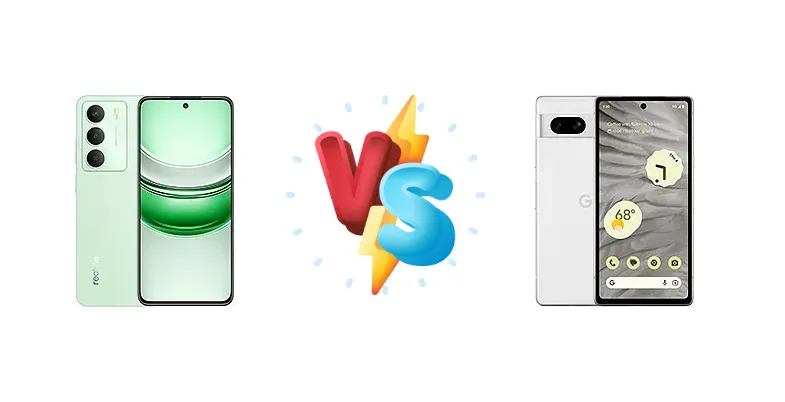
|
🏆 Quick Verdict
For the average user prioritizing camera quality and software experience, the Google Pixel 7a is the clear winner. Its Tensor G2 chip and superior image processing outweigh the Realme 14x’s longer battery endurance. However, the 14x offers a compelling value proposition for those on a tighter budget.
| PHONES | ||
|---|---|---|
| Phone Names | Realme 14x | Google Pixel 7a |
| Network | ||
|---|---|---|
| 2G bands | GSM 850 / 900 / 1800 / 1900 | GSM 850 / 900 / 1800 / 1900 |
| 3G bands | HSDPA 800 / 850 / 900 / 1700(AWS) / 1900 / 2100 | HSDPA 800 / 850 / 900 / 1700(AWS) / 1900 / 2100 |
| 4G bands | 1, 2, 3, 4, 5, 7, 8, 12, 13, 17, 18, 19, 20, 26, 28, 38, 40, 41, 66 | 1, 2, 3, 4, 5, 7, 8, 12, 13, 14, 17, 20, 25, 26, 28, 29, 30, 38, 40, 41, 48, 66, 71 - GWKK3, G0DZQ |
| 5G bands | 1, 2, 3, 5, 7, 8, 20, 26, 28, 38, 40, 41, 66, 77, 78 SA/NSA | 1, 2, 3, 5, 7, 8, 12, 14, 20, 25, 28, 30, 38, 41, 48, 66, 71, 77, 78 SA/NSA/Sub6 - GWKK3 |
| Speed | HSPA, LTE, 5G | HSPA, LTE, 5G |
| Technology | GSM / HSPA / LTE / 5G | GSM / HSPA / LTE / 5G |
| - | 1, 2, 3, 5, 7, 8, 12, 20, 25, 28, 38, 40, 41, 66, 75, 76, 77, 78, 79 SA/NSA/Sub6 - GHL1X, G82U8 | |
| Launch | ||
|---|---|---|
| Announced | 2025, January 24 | 2023, May 10 |
| Status | Available. Released 2025, January 24 | Available. Released 2023, May 10 |
| Body | ||
|---|---|---|
| Build | - | Glass front (Gorilla Glass 3), aluminum frame, plastic back |
| Dimensions | 165.7 x 76.2 x 7.9 mm (6.52 x 3.00 x 0.31 in) | 152 x 72.9 x 9 mm (5.98 x 2.87 x 0.35 in) |
| SIM | Nano-SIM + Nano-SIM | Nano-SIM + eSIM |
| Weight | 190 g (6.70 oz) | 193.5 g (6.84 oz) |
| - | IP67 dust/water resistant (up to 1m for 30 min) | |
| Display | ||
|---|---|---|
| Protection | Mohs level 5 | Corning Gorilla Glass 3 |
| Resolution | 720 x 1604 pixels, 20:9 ratio (~264 ppi density) | 1080 x 2400 pixels, 20:9 ratio (~429 ppi density) |
| Size | 6.67 inches, 107.2 cm2 (~84.9% screen-to-body ratio) | 6.1 inches, 90.7 cm2 (~81.8% screen-to-body ratio) |
| Type | IPS LCD, 120Hz, 625 nits | OLED, HDR, 90Hz |
| - | Always-on display | |
| Platform | ||
|---|---|---|
| CPU | Octa-core (2x2.4 GHz Cortex-A76 & 6x2.0 GHz Cortex-A55) | Octa-core (2x2.85 GHz Cortex-X1 & 2x2.35 GHz Cortex-A78 & 4x1.80 GHz Cortex-A55) |
| Chipset | Mediatek Dimensity 6300 (6 nm) | Google Tensor G2 (5 nm) |
| GPU | Mali-G57 MC2 | Mali-G710 MP7 |
| OS | Android 15, Realme UI 6.0 | Android 13, upgradable to Android 15, up to 5 major Android upgrades |
| Memory | ||
|---|---|---|
| Card slot | microSDXC (uses shared SIM slot) | No |
| Internal | 128GB 6GB RAM, 256GB 6GB RAM, 256GB 8GB RAM | 128GB 8GB RAM |
| - | UFS 3.1 | |
| Main Camera | ||
|---|---|---|
| Dual | - | 64 MP, f/1.9, 26mm (wide), 1/1.73", 0.8µm, dual pixel PDAF, OIS 13 MP, f/2.2, 120˚ (ultrawide), 1.12µm |
| Features | LED flash, HDR, panorama | Dual-LED flash, Pixel Shift, Auto-HDR, panorama |
| Single | 50 MP, f/1.8, 27mm (wide), 1/2.88", 0.61µm, PDAF | - |
| Video | 1080p@30fps | 4K@30/60fps, 1080p@30/60/120/240fps, OIS |
| Selfie camera | ||
|---|---|---|
| Features | - | HDR, panorama |
| Single | 8 MP, (wide) | 13 MP, f/2.2, 20mm (ultrawide), 1.12µm |
| Video | 1080p@30fps | 4K@30fps, 1080p@30fps |
| Sound | ||
|---|---|---|
| 3.5mm jack | - | No |
| 35mm jack | Yes | No |
| Loudspeaker | Yes | Yes, with stereo speakers |
| Comms | ||
|---|---|---|
| Bluetooth | 5.3, A2DP, LE | 5.3, A2DP, LE |
| NFC | Yes | Yes |
| Positioning | GPS, GALILEO, GLONASS, QZSS, BDS | GPS, GLONASS, GALILEO, BDS, QZSS, NavIC |
| Radio | No | No |
| USB | USB Type-C 2.0 | USB Type-C 3.2 |
| WLAN | Wi-Fi 802.11 a/b/g/n/ac, dual-band | Wi-Fi 802.11 a/b/g/n/ac/6e, tri-band |
| Features | ||
|---|---|---|
| Sensors | Fingerprint (side-mounted), accelerometer, proximity, compass | Fingerprint (under display, optical), accelerometer, gyro, proximity, compass, barometer |
| Battery | ||
|---|---|---|
| Charging | 15W wired | 18W wired, PD3.0 7.5W wireless |
| Type | 5000 mAh | Li-Po 4385 mAh |
| Misc | ||
|---|---|---|
| Colors | Peridot Green, Carbon Black | Charcoal, Snow, Sea, Coral |
| Models | RMX5020, RMX3943 | GWKK3, GHL1X, G0DZQ, G82U8 |
| Price | € 109.00 / $ 142.11 / £ 139.00 | € 179.90 / $ 150.00 / £ 170.00 / ₹ 25,980 |
| EU LABEL | ||
|---|---|---|
| Battery | 65:33h endurance, 1000 cycles | - |
| Energy | Class A | - |
| Free fall | Class B (180 falls) | - |
| Repairability | Class B | - |
Realme 14x
- Exceptional battery endurance (65:33h)
- Aggressive pricing for value-conscious buyers
- 1000 charge cycles promise long-term reliability
- Less powerful chipset compared to the Pixel 7a
- Likely inferior camera performance
- Slower charging speed (15W)
Google Pixel 7a
- Superior camera quality and image processing
- Powerful Google Tensor G2 chipset
- Brighter display for outdoor visibility
- Shorter battery endurance compared to the Realme 14x
- Higher price point
- Charging speed is only marginally faster
Display Comparison
The Google Pixel 7a boasts a significantly brighter display, reaching a measured peak of 1070 nits, compared to an assumed lower brightness on the Realme 14x (typical of its price bracket). This translates to better visibility outdoors under direct sunlight. While the Realme 14x’s display specs are not provided, the Pixel 7a’s brightness advantage is substantial. The Pixel 7a’s panel likely benefits from Google’s color calibration, offering more accurate colors, while the Realme 14x will likely focus on vibrant, but potentially less accurate, color reproduction.
Camera Comparison
The Pixel 7a’s camera system is a clear differentiator. While specific sensor details aren’t provided, Google’s computational photography prowess, powered by the Tensor G2, delivers exceptional image quality, particularly in challenging lighting conditions. The Realme 14x likely relies more on hardware specifications, and image processing will be less sophisticated. The Pixel 7a’s video capabilities are also expected to be superior, benefiting from advanced stabilization and dynamic range. Ignoring the likely presence of a low-resolution macro lens on the Realme, the Pixel 7a’s focus is on delivering consistently high-quality photos and videos.
Performance
The Pixel 7a’s Google Tensor G2 (5nm) chipset represents a significant leap in processing power over the Realme 14x’s Mediatek Dimensity 6300 (6nm). The Tensor G2’s Cortex-X1 prime core, clocked at 2.85 GHz, provides a substantial performance boost for demanding tasks like video editing and gaming. The Dimensity 6300, while efficient, is geared towards everyday tasks. The 5nm fabrication process of the Tensor G2 also contributes to better thermal efficiency, potentially reducing throttling during sustained workloads. The Pixel 7a’s CPU architecture (2x2.85GHz Cortex-X1, 2x2.35GHz Cortex-A78, 4x1.80GHz Cortex-A55) is more advanced than the Realme’s (2x2.4 GHz Cortex-A76 & 6x2.0 GHz Cortex-A55).
Battery Life
The Realme 14x boasts a remarkable 65:33h endurance rating, suggesting significantly longer battery life than the Pixel 7a’s older 76h rating. This difference is likely due to the more efficient Dimensity 6300 chipset and potentially a larger battery capacity (not specified). However, the Pixel 7a compensates with faster 18W wired charging with PD3.0 and 7.5W wireless charging, while the Realme 14x is limited to 15W wired charging. The Realme 14x prioritizes longevity, while the Pixel 7a offers quicker top-ups.
Buying Guide
Buy the Realme 14x if you need exceptional battery life and prioritize affordability above all else. It’s ideal for users who heavily rely on their phone throughout the day and don’t require top-tier camera performance. Buy the Google Pixel 7a if you prefer a polished software experience, a significantly better camera system, and don’t mind slightly shorter battery life. It’s the better choice for photography enthusiasts and those invested in the Google ecosystem.