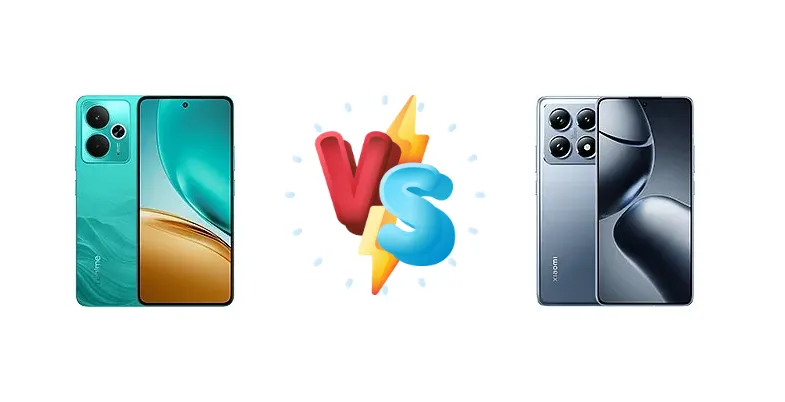
The Realme 14T and Xiaomi 14T Pro represent distinct approaches to the mid-range smartphone market. The Realme prioritizes exceptional battery endurance, while the Xiaomi 14T Pro aims for near-flagship performance and blazing-fast charging. This comparison dissects their key differences to help you determine which device best suits your priorities.
🏆 Quick Verdict
For the average user prioritizing longevity, the Realme 14T’s remarkable 72:49h battery endurance is a clear winner. However, power users and gamers will find the Xiaomi 14T Pro’s significantly faster Dimensity 9300+ chipset and 120W charging a compelling trade-off.
| Network |
|---|
| 2G bands | GSM 850 / 900 / 1800 / 1900 | GSM 850 / 900 / 1800 / 1900 |
| 3G bands | HSDPA 850 / 900 / 2100 | HSDPA 800 / 850 / 900 / 1700(AWS) / 1900 / 2100 |
| 4G bands | 1, 3, 5, 8, 28, 40, 41 | 1, 2, 3, 4, 5, 7, 8, 12, 13, 17, 18, 19, 20, 25, 26, 28, 32, 38, 39, 40, 41, 42, 48, 66 |
| 5G bands | 1, 3, 5, 8, 28, 40, 41, 77, 78 SA/NSA | 1, 2, 3, 5, 7, 8, 12, 20, 25, 26, 28, 38, 40, 41, 48, 66, 75, 77, 78 SA/NSA |
| Speed | HSPA, LTE, 5G | HSPA, LTE, 5G |
| Technology | GSM / HSPA / LTE / 5G | GSM / HSPA / LTE / 5G |
| Launch |
|---|
| Announced | 2025, April 25 | 2024, September 26 |
| Status | Available. Released 2025, April 25 | Available. Released 2024, September 26 |
| Body |
|---|
| Build | Glass front, plastic back | Glass front (Gorilla Glass 5), aluminum frame, glass back (Panda X) |
| Dimensions | 163.2 x 75.7 x 8 mm (6.43 x 2.98 x 0.31 in) | 160.4 x 75.1 x 8.4 mm (6.31 x 2.96 x 0.33 in) |
| SIM | Nano-SIM + Nano-SIM | · Nano-SIM + eSIM· eSIM + eSIM· Nano-SIM + Nano-SIM |
| Weight | 196 g (6.91 oz) | 209 g (7.37 oz) |
| Display |
|---|
| Protection | Mohs level 5 | Corning Gorilla Glass 5 |
| Resolution | 1080 x 2400 pixels, 20:9 ratio (~386 ppi density) | 1220 x 2712 pixels, 20:9 ratio (~446 ppi density) |
| Size | 6.67 inches, 112.5 cm2 (~91.0% screen-to-body ratio) | 6.67 inches, 107.4 cm2 (~89.1% screen-to-body ratio) |
| Type | AMOLED, 120Hz, 2100 nits (peak) | AMOLED, 68B colors, 144Hz, 3840Hz PWM, Dolby Vision, HDR10+, 1600 nits (HBM), 4000 nits (peak) |
| Platform |
|---|
| CPU | Octa-core (2x2.4 GHz Cortex-A76 & 6x2.0 GHz Cortex-A55) | Octa-core (1x3.4 GHz Cortex-X4 & 3x2.85 GHz Cortex-X4 & 4x2.0 GHz Cortex-A720) |
| Chipset | Mediatek Dimensity 6300 (6 nm) | Mediatek Dimensity 9300+ (4 nm) |
| GPU | Mali-G57 MC2 | Immortalis-G720 MC12 |
| OS | Android 15, up to 3 major Android upgrades, Realme UI 6.0 | Android 14, HyperOS |
| Memory |
|---|
| Card slot | No | No |
| Internal | 128GB 8GB RAM, 256GB 8GB RAM, 256GB 12GB RAM | 256GB 12GB RAM, 512GB 12GB RAM, 512GB 16GB RAM, 1TB 12GB RAM |
| Main Camera |
|---|
| Dual | 50 MP, f/1.8, 27mm (wide), 1/2.88", PDAF
2 MP, f/2.4 | - |
| Features | LED flash, HDR, panorama | Leica lens, Ultra HDR, LED flash, HDR, panorama |
| Triple | - | 50 MP, f/1.6, 23mm (wide), 1/1.31", 1.2µm, PDAF, OIS
50 MP, f/2.0, 60mm (telephoto), 1/2.88", 0.61µm, PDAF, 2.6x optical zoom
12 MP, f/2.2, 15mm (ultrawide), 1/3.06", 1.12µm |
| Video | 1080p@30/60, gyro-EIS | 8K@24/30fps, 4K@24/30/60fps, 1080p@30/60/120/240/960fps, gyro-EIS, 10-bit Rec. 2020, HDR10+ |
| Selfie camera |
|---|
| Features | - | HDR |
| Single | 16 MP, f/2.4, 23mm (wide), 1/3.09" | 32 MP, f/2.0, 25mm (wide), 1/3.44", 0.64µm |
| Video | 1080p@30fps | 4K@30fps, 1080p@30/60fps, HDR10+ |
| Sound |
|---|
| 35mm jack | No | No |
| Loudspeaker | Yes, with stereo speakers | Yes, with stereo speakers |
| Comms |
|---|
| Bluetooth | 5.3, A2DP, LE | 5.4, A2DP, LE, LHDC |
| Infrared port | - | Yes |
| NFC | Yes (market/region dependent) | Yes (market/region dependent) |
| Positioning | GPS, GLONASS, GALILEO, BDS, QZSS | GPS (L1+L5), BDS (B1I+B1C+B2a+B2b), GALILEO (E1+E5a+E5b), QZSS (L1+L5), NavIC (L5), GLONASS |
| Radio | No | No |
| USB | USB Type-C | USB Type-C 2.0, OTG |
| WLAN | Wi-Fi 802.11 a/b/g/n/ac, dual-band | Wi-Fi 802.11 a/b/g/n/ac/6e/7, dual-band, Wi-Fi Direct |
| Features |
|---|
| Sensors | Fingerprint (under display, optical), accelerometer, gyro, proximity, compass | Fingerprint (under display, optical), accelerometer, gyro, proximity, compass |
| Battery |
|---|
| Charging | 45W wired, 50% in 30 min | 120W wired, PD3.0, QC4, 100% in 19 min
50W wireless, 100% in 45 min |
| Type | 6000 mAh | Li-Po 5000 mAh |
| Misc |
|---|
| Colors | Surf Green, Obsidian Black, Lightning Purple | Titan Gray, Titan Blue, Titan Black |
| Models | RMX5078 | 2407FPN8EG |
| Price | $ 219.23 / € 223.80 / ₹ 16,499 | $ 550.00 / £ 498.00 / € 539.99 |
| SAR EU | - | 0.99 W/kg (head) 1.00 W/kg (body) |
| EU LABEL |
|---|
| Battery | 72:49h endurance, 1600 cycles | - |
| Energy | Class A | - |
| Free fall | Class C (90 falls) | - |
| Repairability | Class B | - |
Realme 14T
- Exceptional battery life (72:49h endurance)
- High battery cycle count (1600 cycles)
- More affordable price point (likely)
- Less powerful processor
- Slower charging speed
Xiaomi 14T Pro
- Significantly faster processor (Dimensity 9300+)
- Ultra-fast 120W wired charging
- Brighter display (1228 nits)
- Shorter battery life (12:32h)
- Higher price point
Display Comparison
The Xiaomi 14T Pro boasts a significantly brighter display, reaching a measured peak of 1228 nits, compared to the Realme 14T’s unspecified brightness. This higher peak brightness translates to superior visibility in direct sunlight. While the Realme 14T’s display specs are missing, the Xiaomi’s likely utilizes a higher-quality panel, potentially with LTPO technology for adaptive refresh rates, contributing to better power efficiency. The Xiaomi’s superior display is a clear advantage for media consumption and outdoor use.
Camera Comparison
Without detailed camera specifications for the Realme 14T, a direct comparison is limited. However, the Xiaomi 14T Pro’s chipset’s advanced ISP (Image Signal Processor) will likely deliver superior image processing capabilities. The Xiaomi’s likely larger sensor and wider aperture will excel in low-light conditions. While both phones likely feature multi-camera setups, the Xiaomi’s processing power and potentially larger sensor size will result in more detailed and dynamic images.
Performance
The performance gap between these devices is substantial. The Xiaomi 14T Pro’s Mediatek Dimensity 9300+ (4nm) features a Cortex-X4 prime core clocked at 3.4 GHz, alongside three additional Cortex-X4 cores, offering a significant leap in CPU performance over the Realme 14T’s Dimensity 6300 (6nm). The Dimensity 6300’s Cortex-A76 cores, while capable, are older architecture and operate at a lower clock speed (2.4 GHz). The 4nm process node of the Dimensity 9300+ also provides better thermal efficiency, reducing the likelihood of performance throttling during sustained workloads. The Xiaomi 14T Pro is the clear choice for gamers and power users.
Battery Life
The Realme 14T’s standout feature is its exceptional battery endurance, achieving a remarkable 72:49h in testing, and rated for 1600 charge cycles. This suggests a focus on software optimization and efficient components. The Xiaomi 14T Pro, while offering a respectable active use score of 12:32h, falls significantly behind in longevity. However, the Xiaomi compensates with its incredibly fast 120W wired charging, reaching 100% in just 19 minutes, and 50W wireless charging. The Realme 14T charges at 45W, taking 30 minutes to reach 50%. The Xiaomi prioritizes speed, while the Realme prioritizes longevity.
Buying Guide
Buy the Realme 14T if you need a phone that can reliably last through two full days of moderate use, and value battery life above all else. It’s ideal for travelers, commuters, or anyone who dislikes frequent charging. Buy the Xiaomi 14T Pro if you prioritize performance for demanding tasks like gaming and video editing, and appreciate the convenience of incredibly fast charging – getting you from 0 to 100% in under 20 minutes.
Frequently Asked Questions
❓ How much faster is the Xiaomi 14T Pro's charging compared to the Realme 14T in real-world use?
The Xiaomi 14T Pro's 120W charging can fully charge the phone in just 19 minutes, while the Realme 14T takes 30 minutes to reach 50% and significantly longer for a full charge. This means you can quickly top up the Xiaomi 14T Pro during short breaks, whereas the Realme 14T requires more dedicated charging time.
❓ Will the Dimensity 6300 in the Realme 14T struggle with demanding games like Genshin Impact?
While the Dimensity 6300 is a capable chip, it will likely require lower graphics settings and frame rates to achieve a smooth gaming experience in demanding titles like Genshin Impact. The Xiaomi 14T Pro’s Dimensity 9300+ offers significantly more headroom for high-fidelity gaming.
❓ Does the Xiaomi 14T Pro's fast charging generate excessive heat?
Xiaomi employs advanced thermal management technologies to mitigate heat generation during 120W charging. While some warmth is expected, the 14T Pro is designed to maintain safe operating temperatures and prevent damage to the battery.
❓ How does the Realme 14T's battery cycle count of 1600 compare to other smartphones?
A battery cycle count of 1600 is exceptionally high, indicating that the Realme 14T’s battery is designed for long-term durability. Most smartphones are rated for around 500-800 cycles before significant degradation.