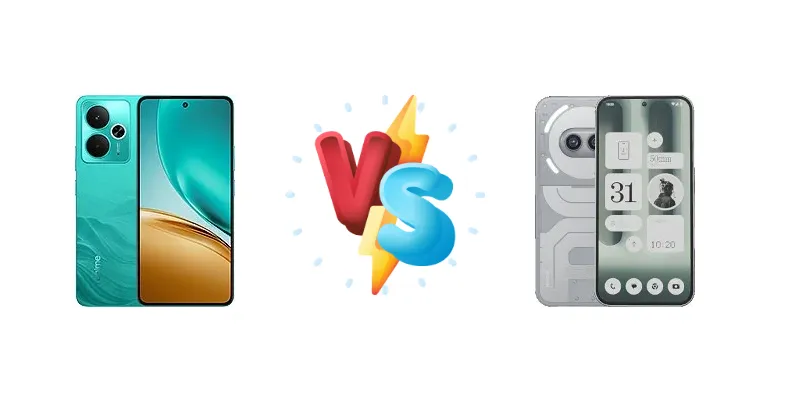
The mid-range smartphone market is fiercely competitive, and the Realme 14T and Nothing Phone (2a) Plus represent compelling options. The Realme 14T aims for exceptional battery life and sustained performance, while the Nothing Phone (2a) Plus prioritizes a brighter display and faster charging, leveraging a more advanced chipset. This comparison dissects their key differences to determine which device best suits your needs.
🏆 Quick Verdict
For the average user prioritizing longevity and consistent performance, the Realme 14T emerges as the winner. Its exceptional 72:49h battery endurance and 1600 charge cycles significantly outperform the Nothing Phone (2a) Plus. However, users who value a brighter screen and quicker charging will find the Nothing Phone (2a) Plus more appealing.
| Network |
|---|
| 2G bands | GSM 850 / 900 / 1800 / 1900 | GSM 850 / 900 / 1800 / 1900 |
| 3G bands | HSDPA 850 / 900 / 2100 | HSDPA 800 / 850 / 900 / 1700(AWS) / 1900 / 2100 |
| 4G bands | 1, 3, 5, 8, 28, 40, 41 | 1, 3, 4, 5, 7, 8, 18, 19, 20, 26, 28, 38, 39, 40, 41, 42, 66 |
| 5G bands | 1, 3, 5, 8, 28, 40, 41, 77, 78 SA/NSA | 1, 3, 5, 7, 8, 20, 28, 38, 40, 41, 66, 77, 78 SA/NSA |
| Speed | HSPA, LTE, 5G | HSPA, LTE, 5G |
| Technology | GSM / HSPA / LTE / 5G | GSM / HSPA / LTE / 5G |
| Launch |
|---|
| Announced | 2025, April 25 | 2024, July 31 |
| Status | Available. Released 2025, April 25 | Available. Released 2024, August 03 |
| Body |
|---|
| Build | Glass front, plastic back | Glass front (Gorilla Glass 5), plastic frame, plastic back |
| Dimensions | 163.2 x 75.7 x 8 mm (6.43 x 2.98 x 0.31 in) | 161.7 x 76.3 x 8.5 mm (6.37 x 3.00 x 0.33 in) |
| SIM | Nano-SIM + Nano-SIM | Nano-SIM + Nano-SIM |
| Weight | 196 g (6.91 oz) | 190 g (6.70 oz) |
| Display |
|---|
| Protection | Mohs level 5 | Corning Gorilla Glass 5 |
| Resolution | 1080 x 2400 pixels, 20:9 ratio (~386 ppi density) | 1080 x 2412 pixels, 20:9 ratio (~395 ppi density) |
| Size | 6.67 inches, 112.5 cm2 (~91.0% screen-to-body ratio) | 6.7 inches, 107.5 cm2 (~87.1% screen-to-body ratio) |
| Type | AMOLED, 120Hz, 2100 nits (peak) | AMOLED, 1B colors, 120Hz, 2160Hz PWM, HDR10+, 700 nits (typ), 1100 nits (HBM), 1300 nits (peak) |
| Platform |
|---|
| CPU | Octa-core (2x2.4 GHz Cortex-A76 & 6x2.0 GHz Cortex-A55) | Octa-core (2x3.0 GHz Cortex-A715 & 6x 2.0 GHz Cortex-A510) |
| Chipset | Mediatek Dimensity 6300 (6 nm) | Mediatek Dimensity 7350 Pro (4 nm) |
| GPU | Mali-G57 MC2 | Mali-G610 MC4 |
| OS | Android 15, up to 3 major Android upgrades, Realme UI 6.0 | Android 14, up to 3 major Android upgrades, Nothing OS 3.0 |
| Memory |
|---|
| Card slot | No | No |
| Internal | 128GB 8GB RAM, 256GB 8GB RAM, 256GB 12GB RAM | 256GB 8GB RAM, 256GB 12GB RAM |
| Main Camera |
|---|
| Dual | 50 MP, f/1.8, 27mm (wide), 1/2.88", PDAF
2 MP, f/2.4 | 50 MP, f/1.9, 24mm (wide), 1/1.57", 1.0µm, PDAF, OIS
50 MP, f/2.2, 114˚ (ultrawide), 1/2.76", 0.64µm |
| Features | LED flash, HDR, panorama | LED flash, panorama, HDR |
| Video | 1080p@30/60, gyro-EIS | 4K@30fps, 1080p@60/120fps, gyro-EIS |
| Selfie camera |
|---|
| Features | - | HDR |
| Single | 16 MP, f/2.4, 23mm (wide), 1/3.09" | 50 MP, f/2.2, (wide), 1/2.76" |
| Video | 1080p@30fps | 4K@30fps |
| Sound |
|---|
| 35mm jack | No | No |
| Loudspeaker | Yes, with stereo speakers | Yes, with stereo speakers |
| Comms |
|---|
| Bluetooth | 5.3, A2DP, LE | 5.3, A2DP, LE |
| NFC | Yes (market/region dependent) | Yes, 360˚ |
| Positioning | GPS, GLONASS, GALILEO, BDS, QZSS | GPS, GALILEO, GLONASS, BDS, QZSS |
| Radio | No | No |
| USB | USB Type-C | USB Type-C 2.0, OTG |
| WLAN | Wi-Fi 802.11 a/b/g/n/ac, dual-band | Wi-Fi 802.11 a/b/g/n/ac/6, dual-band, Wi-Fi Direct |
| Features |
|---|
| Sensors | Fingerprint (under display, optical), accelerometer, gyro, proximity, compass | Fingerprint (under display, optical), accelerometer, gyro, proximity, compass |
| Battery |
|---|
| Charging | 45W wired, 50% in 30 min | 50W wired, 50% in 21 min, 100% in 56 min |
| Type | 6000 mAh | 5000 mAh |
| Misc |
|---|
| Colors | Surf Green, Obsidian Black, Lightning Purple | Black, Grey |
| Models | RMX5078 | A142P |
| Price | $ 219.23 / € 223.80 / ₹ 16,499 | € 269.90 / ₹ 22,599 |
| EU LABEL |
|---|
| Battery | 72:49h endurance, 1600 cycles | - |
| Energy | Class A | - |
| Free fall | Class C (90 falls) | - |
| Repairability | Class B | - |
Realme 14T
- Exceptional battery life (72:49h endurance)
- High battery cycle count (1600 cycles)
- Sustained performance due to efficient power management
- Likely less bright display
- Older generation CPU cores
Nothing Phone (2a) Plus
- Brighter display (1097 nits)
- Faster charging (50W, 50% in 21 min)
- More powerful and efficient chipset (Dimensity 7350 Pro)
- Significantly shorter battery life (16:34h)
- Potentially more thermal throttling under heavy load
Display Comparison
The Nothing Phone (2a) Plus boasts a significantly brighter display, reaching a measured peak of 1097 nits. This is a substantial advantage over what we'd expect from the Realme 14T, making the Nothing Phone (2a) Plus far more usable in direct sunlight. While the Realme 14T’s panel specifications are not provided, the Nothing Phone (2a) Plus’s brightness suggests a superior viewing experience for outdoor users. The absence of LTPO technology on either device means refresh rate scaling isn't as efficient as on flagship models, but the brightness difference is the key differentiator here.
Camera Comparison
Without detailed camera specifications for either device, a direct comparison is limited. However, the market positioning suggests the Nothing Phone (2a) Plus likely features a more sophisticated camera system. The Dimensity 7350 Pro typically supports more advanced image signal processors (ISPs) capable of better noise reduction and dynamic range. While both phones likely include standard features like HDR and portrait modes, the Nothing Phone (2a) Plus is expected to deliver superior image quality, especially in challenging lighting conditions. We can assume both phones will have a primary camera, but details on sensor size and optical image stabilization (OIS) are crucial for a definitive assessment.
Performance
The Nothing Phone (2a) Plus’s Mediatek Dimensity 7350 Pro (4nm) chipset represents a clear architectural advantage over the Realme 14T’s Dimensity 6300 (6nm). The 4nm process node inherently offers better power efficiency and thermal characteristics, allowing the 7350 Pro to sustain higher clock speeds for longer periods. The CPU core configuration also favors the Nothing Phone (2a) Plus, with 2x3.0 GHz Cortex-A715 cores compared to the Realme 14T’s 2x2.4 GHz Cortex-A76 cores. This translates to snappier application loading and smoother multitasking, particularly for demanding applications. The Realme 14T’s Cortex-A76 cores are older generation, and the 6nm process will likely result in more thermal throttling under sustained load.
Battery Life
The Realme 14T’s battery endurance of 72:49h is a standout feature, significantly exceeding the Nothing Phone (2a) Plus’s active use score of 16:34h. This difference is likely due to a combination of factors, including a more efficient chipset and optimized software. While the Nothing Phone (2a) Plus offers faster charging at 50W (50% in 21 minutes, 100% in 56 minutes) compared to the Realme 14T’s 45W (50% in 30 minutes), the Realme 14T’s longevity mitigates the need for frequent top-ups. Furthermore, the Realme 14T boasts an impressive 1600 charge cycles, suggesting a longer lifespan before significant battery degradation.
Buying Guide
Buy the Realme 14T if you need a phone that will reliably last through two full days of moderate use, and if you frequently engage in tasks that benefit from sustained performance over short bursts of speed. Buy the Nothing Phone (2a) Plus if you prioritize a vibrant, easily visible display, especially outdoors, and if you value the convenience of faster charging, even if it means slightly less overall battery life.
Frequently Asked Questions
❓ Does the Dimensity 7350 Pro in the Nothing Phone (2a) Plus get noticeably hot during extended gaming sessions?
While the 4nm process helps with thermal efficiency, the Dimensity 7350 Pro can still experience throttling during prolonged, graphically intensive gaming. The Nothing Phone (2a) Plus’s thermal design will play a crucial role, but users should expect some performance reduction after 30-60 minutes of continuous gameplay. The Realme 14T, with its less powerful chipset, is likely to maintain more consistent performance over longer periods.
❓ How does the Realme 14T’s battery hold up after a year of typical use, considering its 1600 charge cycle rating?
The 1600 charge cycle rating suggests the Realme 14T’s battery is designed for exceptional longevity. While battery degradation is inevitable, the 14T should retain a significantly higher percentage of its original capacity after a year of typical use compared to phones with lower cycle ratings. Expect minimal noticeable degradation for the first 1-2 years with moderate charging habits.
❓ Is the 50W charging on the Nothing Phone (2a) Plus truly faster in real-world scenarios than the Realme 14T’s 45W?
Yes, the Nothing Phone (2a) Plus’s 50W charging is demonstrably faster, achieving 50% charge in 21 minutes versus the Realme 14T’s 30 minutes. While the difference may not seem massive, it provides a noticeable convenience for users who frequently need to quickly top up their battery. However, the Realme 14T’s superior battery life reduces the need for such frequent charging.