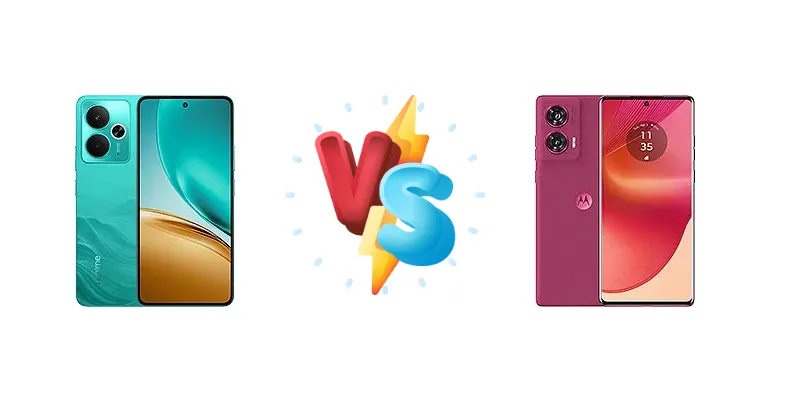
The mid-range smartphone market is fiercely competitive, and the Realme 14T and Motorola Edge 50 Fusion represent compelling options for budget-conscious buyers. The Realme 14T prioritizes exceptional battery life, while the Motorola Edge 50 Fusion aims for a balance of performance and display quality. This comparison dissects their key specifications to determine which device delivers the best overall experience.
🏆 Quick Verdict
For users prioritizing all-day battery life and longevity, the Realme 14T is the clear winner, boasting a remarkable 72:49h endurance. However, the Motorola Edge 50 Fusion, particularly the international version with the Snapdragon 7s Gen 2, offers a more powerful processor and a significantly brighter display, making it ideal for media consumption and gaming.
| Network |
|---|
| 2G bands | GSM 850 / 900 / 1800 / 1900 | GSM 850 / 900 / 1800 / 1900 |
| 3G bands | HSDPA 850 / 900 / 2100 | HSDPA 850 / 900 / 1900 / 2100 |
| 4G bands | 1, 3, 5, 8, 28, 40, 41 | 1, 2, 3, 5, 7, 8, 18, 19, 20, 26, 28, 32, 38, 40, 41, 42, 71 - International |
| 5G bands | 1, 3, 5, 8, 28, 40, 41, 77, 78 SA/NSA | 1, 3, 5, 7, 8, 20, 26, 28, 38, 40, 41, 77, 78 SA/NSA |
| Speed | HSPA, LTE, 5G | HSPA, LTE, 5G |
| Technology | GSM / HSPA / LTE / 5G | GSM / HSPA / LTE / 5G |
| Launch |
|---|
| Announced | 2025, April 25 | 2024, April 16 |
| Status | Available. Released 2025, April 25 | Available. Released 2024, May 15 |
| Body |
|---|
| Build | Glass front, plastic back | Glass front, silicone polymer back (eco leather), plastic frame |
| Dimensions | 163.2 x 75.7 x 8 mm (6.43 x 2.98 x 0.31 in) | 161.9 x 73.1 x 7.9 mm (6.37 x 2.88 x 0.31 in) |
| SIM | Nano-SIM + Nano-SIM | · Nano-SIM + eSIM· Nano-SIM + Nano-SIM |
| Weight | 196 g (6.91 oz) | 174.9 g (6.17 oz) |
| Display |
|---|
| Protection | Mohs level 5 | Corning Gorilla Glass 5 |
| Resolution | 1080 x 2400 pixels, 20:9 ratio (~386 ppi density) | 1080 x 2400 pixels, 20:9 ratio (~393 ppi density) |
| Size | 6.67 inches, 112.5 cm2 (~91.0% screen-to-body ratio) | 6.7 inches, 108.4 cm2 (~91.6% screen-to-body ratio) |
| Type | AMOLED, 120Hz, 2100 nits (peak) | P-OLED, 1B colors, 120Hz (LATAM), 144Hz (INT), 1600 nits (peak) |
| Platform |
|---|
| CPU | Octa-core (2x2.4 GHz Cortex-A76 & 6x2.0 GHz Cortex-A55) | Octa-core (4x2.40 GHz Cortex-A78 & 4x1.95 GHz Cortex-A55) - InternationalOcta-core (4x2.2 GHz Cortex-A78 & 4x1.8 GHz Cortex-A55) - LATAM |
| Chipset | Mediatek Dimensity 6300 (6 nm) | Qualcomm SM7435-AB Snapdragon 7s Gen 2 (4 nm) - InternationalQualcomm SM6450 Snapdragon 6 Gen 1 (4 nm) - LATAM |
| GPU | Mali-G57 MC2 | Adreno 710 |
| OS | Android 15, up to 3 major Android upgrades, Realme UI 6.0 | Android 14, upgradable to Android 15, up to 3 major Android upgrades |
| Memory |
|---|
| Card slot | No | No |
| Internal | 128GB 8GB RAM, 256GB 8GB RAM, 256GB 12GB RAM | 128GB 8GB RAM, 256GB 8GB RAM, 256GB 12GB RAM, 512GB 8GB RAM, 512GB 12GB RAM |
| Main Camera |
|---|
| Dual | 50 MP, f/1.8, 27mm (wide), 1/2.88", PDAF
2 MP, f/2.4 | 50 MP, f/1.9, (wide), 1/1.56", 1.0µm, multi-directional PDAF, OIS
13 MP, f/2.2, 120˚ (ultrawide), 1/3.0", 1.12µm, AF |
| Features | LED flash, HDR, panorama | LED flash, HDR, panorama |
| Video | 1080p@30/60, gyro-EIS | 4K@30fps, 1080p@30/60/120fps, gyro-EIS |
| Selfie camera |
|---|
| Features | - | HDR |
| Single | 16 MP, f/2.4, 23mm (wide), 1/3.09" | 32 MP, f/2.5, (wide), 1/3.14", 0.7µm |
| Video | 1080p@30fps | 4K@30fps, 1080p@30fps |
| Sound |
|---|
| 35mm jack | No | No |
| Loudspeaker | Yes, with stereo speakers | Yes, with stereo speakers |
| Comms |
|---|
| Bluetooth | 5.3, A2DP, LE | 5.2, A2DP, LE |
| NFC | Yes (market/region dependent) | Yes |
| Positioning | GPS, GLONASS, GALILEO, BDS, QZSS | GPS, GLONASS, GALILEO |
| Radio | No | No |
| USB | USB Type-C | USB Type-C 2.0, OTG |
| WLAN | Wi-Fi 802.11 a/b/g/n/ac, dual-band | Wi-Fi 802.11 a/b/g/n/ac, dual-band |
| Features |
|---|
| Sensors | Fingerprint (under display, optical), accelerometer, gyro, proximity, compass | Fingerprint (under display, optical), accelerometer, gyro, proximity, compass |
| Battery |
|---|
| Charging | 45W wired, 50% in 30 min | 68W wired, 50% in 15 min |
| Type | 6000 mAh | 5000 mAh |
| Misc |
|---|
| Colors | Surf Green, Obsidian Black, Lightning Purple | Forest Blue, Marshmallow Blue, Hot Pink |
| Models | RMX5078 | XT2429-1 |
| Price | $ 219.23 / € 223.80 / ₹ 16,499 | € 208.99 / $ 245.00 / ₹ 18,667 |
| EU LABEL |
|---|
| Battery | 72:49h endurance, 1600 cycles | - |
| Energy | Class A | - |
| Free fall | Class C (90 falls) | - |
| Repairability | Class B | - |
Realme 14T
- Exceptional battery life (72:49h endurance)
- Long-term battery health (1600 charge cycles)
- Efficient Mediatek Dimensity 6300 chipset
- Display brightness likely lower than the competition
- Processor performance lags behind Snapdragon 7s Gen 2
Motorola Edge 50 Fusion
- Bright and vibrant display (1322 nits)
- Powerful Snapdragon 7s Gen 2 (International version)
- Fast 68W charging
- Significantly shorter battery life (12:40h)
- LATAM version uses a less powerful Snapdragon 6 Gen 1
Display Comparison
The Motorola Edge 50 Fusion immediately stands out with its 1322 nits peak brightness, a substantial advantage over what we'd expect from the Realme 14T (spec not provided, but likely lower). This brightness level ensures excellent visibility in direct sunlight. While the Realme 14T’s panel characteristics are unknown, the Edge 50 Fusion’s high brightness is a significant benefit for outdoor users. The Edge 50 Fusion’s display is likely to offer a more immersive viewing experience, particularly for HDR content.
Camera Comparison
Detailed camera specifications are missing for both devices. However, given the price points, we can assume both phones will feature a primary camera with a decent megapixel count. The focus should be on image processing capabilities and low-light performance. Without further data, it’s difficult to definitively state which phone has the superior camera system. We anticipate both will include standard features like portrait mode and night mode, but the quality of these modes will depend heavily on software optimization.
Performance
The chipset choice is a key differentiator. The Motorola Edge 50 Fusion, in its international configuration, utilizes the Qualcomm Snapdragon 7s Gen 2 (4nm), built on a more efficient process node than the Realme 14T’s Mediatek Dimensity 6300 (6nm). The Snapdragon 7s Gen 2 features Cortex-A78 cores (4x2.40 GHz) which are architecturally superior to the Cortex-A76 cores (2x2.4 GHz) in the Dimensity 6300, promising better single-core performance. However, the LATAM version of the Edge 50 Fusion uses the Snapdragon 6 Gen 1, which represents a performance step down. The Realme 14T’s Dimensity 6300, while less powerful, is still capable for everyday tasks and moderate gaming. The 6nm process should provide reasonable thermal management.
Battery Life
The Realme 14T dominates in battery endurance with a tested 72:49h score, significantly exceeding the Motorola Edge 50 Fusion’s 12:40h active use score. This translates to potentially two full days of use on a single charge for the Realme 14T. While the Edge 50 Fusion compensates with faster 68W charging (50% in 15 minutes), the Realme 14T’s 45W charging (50% in 30 minutes) is adequate. Furthermore, the Realme 14T boasts an impressive 1600 charge cycles, suggesting superior long-term battery health.
Buying Guide
Buy the Realme 14T if you need a phone that can reliably last through two full days of moderate use, and value long-term battery health with its 1600 charge cycles. Buy the Motorola Edge 50 Fusion if you prioritize a vibrant, high-brightness display for outdoor visibility and smoother performance for demanding applications, especially if you can secure the international version with the Snapdragon 7s Gen 2.
Frequently Asked Questions
❓ Does the Snapdragon 7s Gen 2 in the Motorola Edge 50 Fusion get hot during extended gaming sessions?
The Snapdragon 7s Gen 2 is a relatively efficient chip built on a 4nm process. While some heat generation is inevitable during prolonged gaming, it's unlikely to experience significant throttling, especially compared to older or less efficient chipsets. Motorola's thermal management implementation will also play a role, but the 7s Gen 2 is generally well-regarded for its thermal performance.
❓ Is the Realme 14T's 45W charging slow compared to the Motorola Edge 50 Fusion's 68W?
While 68W is faster on paper, 45W is still a respectable charging speed. The Realme 14T reaches 50% charge in 30 minutes, which is a reasonable timeframe. Given the Realme 14T’s larger battery endurance, the slightly slower charging speed is a worthwhile trade-off for significantly longer battery life.
❓ Which phone is better for users who frequently travel and rely on their phone for navigation and photography?
The Motorola Edge 50 Fusion is better suited for travelers due to its brighter display, which enhances visibility when using navigation apps outdoors. The Snapdragon 7s Gen 2 (International version) also provides smoother performance for photo editing and processing on the go.
❓ What is the impact of the different Snapdragon chipsets (7s Gen 2 vs 6 Gen 1) on the Motorola Edge 50 Fusion's performance?
The Snapdragon 7s Gen 2 offers a noticeable performance uplift over the Snapdragon 6 Gen 1. The 7s Gen 2 features more powerful CPU cores and a faster GPU, resulting in smoother multitasking, faster app loading times, and improved gaming performance. If performance is a priority, it's crucial to confirm which chipset version you are purchasing.