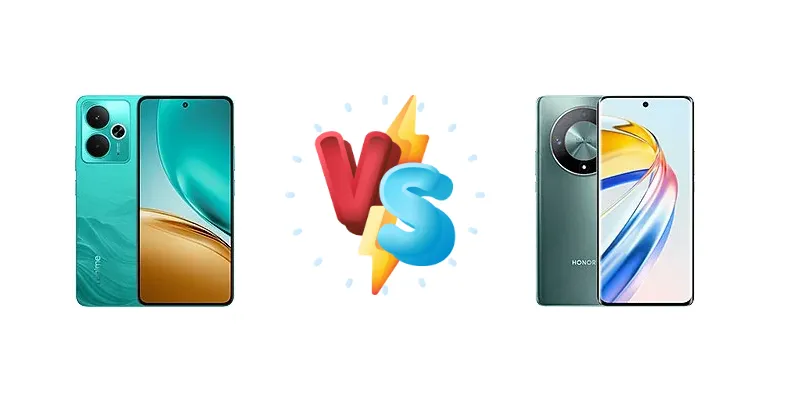
The Realme 14T and Honor X9b represent compelling options in the increasingly competitive mid-range smartphone market. The Realme 14T prioritizes rapid charging and endurance, while the Honor X9b leverages Qualcomm’s latest 6-series silicon for a focus on efficiency. This comparison dissects their key differences to determine which device best suits your needs.
🏆 Quick Verdict
For the average user prioritizing all-day battery life and quick top-ups, the Realme 14T emerges as the winner. Its 72-hour endurance and 45W charging significantly outperform the Honor X9b, despite the latter’s more efficient chipset.
| Network |
|---|
| 2G bands | GSM 850 / 900 / 1800 / 1900 | GSM 850 / 900 / 1800 / 1900 |
| 3G bands | HSDPA 850 / 900 / 2100 | HSDPA 850 / 900 / 1900 / 2100 |
| 4G bands | 1, 3, 5, 8, 28, 40, 41 | 1, 2, 3, 4, 5, 7, 8, 20, 28, 32, 38, 40, 41 |
| 5G bands | 1, 3, 5, 8, 28, 40, 41, 77, 78 SA/NSA | 1, 3, 7, 8, 20, 28, 38, 40, 41, 77, 78 SA/NSA |
| Speed | HSPA, LTE, 5G | HSPA, LTE, 5G |
| Technology | GSM / HSPA / LTE / 5G | GSM / HSPA / LTE / 5G |
| Launch |
|---|
| Announced | 2025, April 25 | 2023, October 18 |
| Status | Available. Released 2025, April 25 | Available. Released 2023, October |
| Body |
|---|
| Build | Glass front, plastic back | - |
| Dimensions | 163.2 x 75.7 x 8 mm (6.43 x 2.98 x 0.31 in) | 163.6 x 75.5 x 8 mm (6.44 x 2.97 x 0.31 in) |
| SIM | Nano-SIM + Nano-SIM | Nano-SIM + Nano-SIM |
| Weight | 196 g (6.91 oz) | 185 g (6.53 oz) |
| Display |
|---|
| Protection | Mohs level 5 | - |
| Resolution | 1080 x 2400 pixels, 20:9 ratio (~386 ppi density) | 1220 x 2652 pixels, 19.5:9 ratio (~431 ppi density) |
| Size | 6.67 inches, 112.5 cm2 (~91.0% screen-to-body ratio) | 6.78 inches, 112.6 cm2 (~91.2% screen-to-body ratio) |
| Type | AMOLED, 120Hz, 2100 nits (peak) | AMOLED, 1B colors, 120Hz, 1200 nits (peak) |
| Platform |
|---|
| CPU | Octa-core (2x2.4 GHz Cortex-A76 & 6x2.0 GHz Cortex-A55) | Octa-core (4x2.2 GHz Cortex-A78 & 4x1.8 GHz Cortex-A55) |
| Chipset | Mediatek Dimensity 6300 (6 nm) | Qualcomm SM6450 Snapdragon 6 Gen 1 (4 nm) |
| GPU | Mali-G57 MC2 | Adreno 710 |
| OS | Android 15, up to 3 major Android upgrades, Realme UI 6.0 | Android 13, Magic OS 7.2 |
| Memory |
|---|
| Card slot | No | No |
| Internal | 128GB 8GB RAM, 256GB 8GB RAM, 256GB 12GB RAM | 256GB 8GB RAM, 256GB 12GB RAM, 512GB 8GB RAM, 512GB 12GB RAM |
| Main Camera |
|---|
| Dual | 50 MP, f/1.8, 27mm (wide), 1/2.88", PDAF
2 MP, f/2.4 | - |
| Features | LED flash, HDR, panorama | LED flash, panorama, HDR |
| Triple | - | 108 MP, f/1.8, (wide), 1/1.67", PDAF
5 MP, f/2.2, (ultrawide)
2 MP (macro) |
| Video | 1080p@30/60, gyro-EIS | 4K@30fps, 1080p@30fps |
| Selfie camera |
|---|
| Single | 16 MP, f/2.4, 23mm (wide), 1/3.09" | 16 MP, f/2.5, (wide) |
| Video | 1080p@30fps | 1080p@30fps |
| Sound |
|---|
| 35mm jack | No | No |
| Loudspeaker | Yes, with stereo speakers | Yes |
| Comms |
|---|
| Bluetooth | 5.3, A2DP, LE | 5.1, A2DP, LE |
| Infrared port | - | Yes |
| NFC | Yes (market/region dependent) | Yes (market/region dependent) |
| Positioning | GPS, GLONASS, GALILEO, BDS, QZSS | GPS, GLONASS, GALILEO, BDS |
| Radio | No | No |
| USB | USB Type-C | USB Type-C 2.0, OTG |
| WLAN | Wi-Fi 802.11 a/b/g/n/ac, dual-band | Wi-Fi 802.11 a/b/g/n/ac, dual-band, Wi-Fi Direct |
| Features |
|---|
| Sensors | Fingerprint (under display, optical), accelerometer, gyro, proximity, compass | Fingerprint (under display, optical), accelerometer, gyro, proximity, compass |
| Battery |
|---|
| Charging | 45W wired, 50% in 30 min | 35W wired
Reverse wired |
| Type | 6000 mAh | Li-Po 5800 mAh |
| Misc |
|---|
| Colors | Surf Green, Obsidian Black, Lightning Purple | Sunrise Orange, Midnight Black, Emerald Green |
| Models | RMX5078 | ALI-NX1 |
| Price | $ 219.23 / € 223.80 / ₹ 16,499 | About 970 EUR |
| EU LABEL |
|---|
| Battery | 72:49h endurance, 1600 cycles | - |
| Energy | Class A | - |
| Free fall | Class C (90 falls) | - |
| Repairability | Class B | - |
Realme 14T
- Exceptional battery life (72:49h endurance)
- Faster 45W wired charging
- Potentially stronger burst CPU performance
- Less efficient 6nm process
- CPU clock speed advantage may not translate to real-world gains
Honor X9b
- More efficient 4nm process
- Reverse wired charging capability
- Potentially better sustained performance
- Slower 35W wired charging
- Likely shorter battery life compared to Realme 14T
Display Comparison
Display specifications are absent from the provided data, but considering the price bracket, both devices likely feature LCD or AMOLED panels with FHD+ resolution. The absence of details prevents a direct comparison of brightness, color accuracy, or refresh rates. However, Realme historically focuses on vibrant displays, while Honor often aims for color accuracy. The lack of LTPO technology on either device suggests standard refresh rate implementations.
Camera Comparison
Camera details are missing, but given the market segment, both phones likely feature multi-camera setups with a primary sensor, ultrawide, and potentially a macro lens. Without sensor size or aperture information, it’s difficult to assess image quality. However, the image processing style will likely differ – Realme often leans towards vibrant, saturated images, while Honor typically aims for more natural tones. The absence of OIS information suggests neither phone prioritizes optical image stabilization.
Performance
The Realme 14T’s Mediatek Dimensity 6300 (6nm) and the Honor X9b’s Qualcomm Snapdragon 6 Gen 1 (4nm) represent a key battleground. While the Dimensity 6300 boasts higher clock speeds on its prime cores (2.4 GHz Cortex-A76 vs 2.2 GHz Cortex-A78), the Snapdragon 6 Gen 1 benefits from a more efficient 4nm process. This translates to potentially better thermal management and sustained performance under load for the Honor X9b. The Cortex-A78 cores in the Snapdragon are also generally more efficient than the A76 cores in the Dimensity. The Realme’s CPU configuration (2+6) versus the Honor’s (4+4) suggests a different approach to multi-tasking; the Realme may excel in burst workloads, while the Honor could handle sustained multi-core tasks more gracefully.
Battery Life
The Realme 14T’s 72:49h endurance is a significant advantage over what we’d expect from the Honor X9b, given the lack of battery capacity data. This suggests excellent power efficiency optimization. The 45W wired charging on the Realme 14T, capable of delivering 50% charge in 30 minutes, is also faster than the Honor X9b’s 35W charging. The Honor X9b’s inclusion of reverse wired charging is a useful feature for topping up accessories, but the Realme’s superior battery life and faster charging are more impactful for most users.
Buying Guide
Buy the Realme 14T if you need exceptional battery life and fast charging, making it ideal for heavy users and travelers. Buy the Honor X9b if you prioritize a more power-efficient processor for sustained performance during demanding tasks and appreciate the convenience of reverse wired charging.
Frequently Asked Questions
❓ Will the Mediatek Dimensity 6300 in the Realme 14T overheat during prolonged gaming sessions?
While the Dimensity 6300 is a capable chip, its 6nm process is less efficient than the Snapdragon 6 Gen 1’s 4nm node. This means the Realme 14T may experience more thermal throttling during extended gaming, potentially leading to reduced performance over time. However, Realme’s software optimizations could mitigate this.
❓ Is the reverse wired charging feature on the Honor X9b useful for charging accessories like earbuds or smartwatches?
Yes, the reverse wired charging feature allows you to use the Honor X9b as a power bank for smaller devices. While not a replacement for a dedicated power bank, it’s a convenient feature for emergency situations or when traveling and lacking access to a wall outlet.
❓ How does the 1600 cycle battery claim of the Realme 14T translate to real-world longevity?
The 1600 cycle claim suggests the Realme 14T’s battery is designed to retain a significant portion of its capacity even after numerous charge cycles. This means the battery should maintain acceptable performance for a longer period compared to phones with lower cycle counts, potentially extending the usable lifespan of the device.